


Collecting and processing information with Chandler

Note to self

We'll help you organize your data with Chandler, an application that lets you gather information and then decide how to use it.
As far as conventional wisdom goes, it makes perfect sense to use dedicated applications for different types of data: a task manager to manage your to-dos, a calendaring application to track your appointments, and an email client to take care of your messaging needs. But as the volume of information grows, you might find yourself constantly switching back and forth between different applications and spending an increasing amount of time on organizing and structuring incoming information. Enter Chandler [1], an application that attempts to change the way we manage and process information (you can read more about the project's vision on the Chandler website [2]).
Chandler's developers called it "the Note-to-Self Organizer," but you can also think of it as an information aggregator and processor. Unlike traditional applications, Chandler allows you to collect information first and then decide how to process and manage it. Chandler doesn't distinguish between different types of data: Everything you feed into it is treated as generic notes. All notes collected in Chandler can be transformed into more conventional tasks and events, which you can then manage with the use of some rather nifty tools.
Installing and Configuring Chandler
Installing Chandler is not particularly difficult. First, grab the latest .tar.gz archive from the project's website, then unpack it in the desired location. To launch Chandler, use the terminal to switch to the resulting directory and run the ./chandler command. Before you start using Chandler, you should do some preparatory work.
Although you can use Chandler as a standalone application, you should consider connecting it to the Chandler Hub service [3]. This allows you to sync Chandler's data between several machines, access your information through a web browser, and share data with other users. To enable this feature, you have to create a Chandler Hub account first. Once you've done that, switch to Chandler, choose File | Accounts, select the Chandler Hub Sharing account, and enter your Chandler Hub username and password in the appropriate fields (Figure 1). While you're at it, you can also configure the Incoming Mail and Outgoing Mail accounts, which allow you to send, receive, and process messages directly in Chandler.
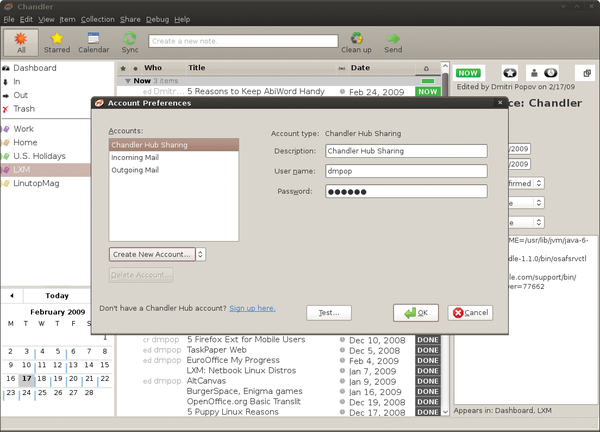 Figure 1: Configuring mail and Chandler Hub accounts.
All notes in Chandler can be organized into collections. Although the application comes with a few default collections, such as Work, Home, and Fun, you will most likely need to add your own. To do this, choose Collection | New, give the collection a name, and press Enter. Right-click on the created collection and pick a color from the Collection Color menu.
TIP: Chandler and Gmail
Although the current release of Chandler does work with the popular Gmail email service, the application doesn't fetch messages in Gmail's Inbox folder. The problem is easy to fix, though. When specifying the Incoming Mail account, press the Configure Chandler folders button. This creates three additional folders in your Gmail account: Chandler Mail, Chandler Starred, and Chandler Events. If you then create filters in Gmail that redirect incoming email to the appropriate folders, you are good to go.
Chandler Basics
Chandler sports a conventional three-pane interface that is packed with tiny nifty creature comforts (Figure 2). Starting with the left pane, which is divided into three sections, the top section contains four built-in collections: Dashboard, which provides a global view of all your notes; In and Out for incoming and outgoing email messages, respectively; and Trash, which holds deleted notes. The next section contains user-defined collections; here, you create and manage all your collections. The last section holds mini-calendars for the current and next month (you can hide the next month's mini-calendar by dragging the section divider down). Each date with events has a so-called busybar next to it, and the size of the busybar depends on how many events are scheduled for the particular date. If you click on any date, you'll see a list of events attached to it right above the mini-calendar.
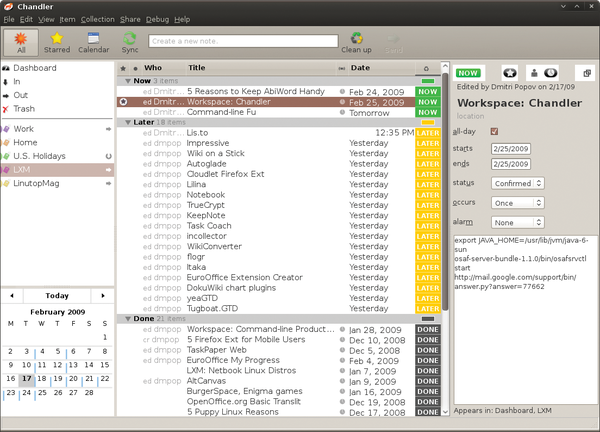 Figure 2: Chandler in all its beauty.
The middle pane displays a list of notes in the currently selected collection. To switch from list view to calendar mode, press the Calendar button in the main toolbar (Figure 3). This essentially turns Chandler into a calendaring application, wherein all events (i.e., notes with dates and times assigned to them) are displayed in the weekly calendar view. With ease, you can move events around and adjust their start and end times with the mouse. When in the Calendar view, you can quickly navigate to the desired month and week via the mini-calendars in the right pane. Clicking on the tiny tag icon next to each collection lets you combine several collections into a single calendar view. The middle pane is also where you process your notes. For example, you can easily star any note in the list by clicking in the Star column next to it. Then you can view all starred notes by clicking on the Starred button in the main toolbar. Also, you can sort notes by their titles or dates as well as mark them as unread or as needing a reply. The latter can be particularly useful if you use Chandler to process email messages. Besides that, Chandler allows you to process notes quickly according to the Now-Later-Done triage.
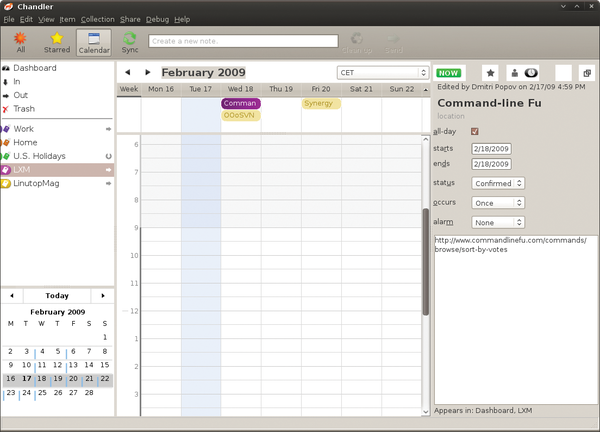 Figure 3: Viewing collections as a calendar.
Finally, the right pane acts as a property inspector, which allows you to change the settings of the currently selected note. The button at the top of the pane allows you to change triage status, star the note, convert it into an email message, add the note to the calendar (thus turning it into an event), specify the event's settings, configure the alarm, and add comments.
Using Chandler
Now it's time to put Chandler to some practical use. The first step is to create a new note and add it to Chandler. The easiest way to do this is to use the Quick Entry bar in the main toolbar. Simply type the text you want and hit Enter to add the note to Chandler. The Quick Entry bar sports a smart data parsing feature that automatically analyzes and processes notes. For example, if you enter a note like "Dinner with friends 05/09/2009 6pm--9pm," it will automatically be turned into an event scheduled for May 9, 2009, from 6 to 9pm. Once the note is in Chandler, you can add it to a specific collection. Notes in Chandler can belong to several collections at the same time, so you can use collections as tags. For example, you can add a business trip-related note to both the Work and Travel collections.
The Triage feature lets you track the status of added and processed notes. To switch to the triage view, click on the Triage column in the middle pane. In this view, all notes in the currently selected collection are grouped by their triage status. Clicking on its triage label changes the triage status of a particular note. To refresh the view, press the Clean up button in the toolbar.
Chandler allows you not only to collect and process information but also share it with other users, which makes it a perfect collaboration tool for workgroups. If you have configured mail accounts, you can use Chandler's email capabilities to share information. To turn any note or event into an email message, select the item you want in the middle pane, then choose Item | Address Item from the main menu. Specify the recipient and add an optional message in the comments field. Choose Item | Send to send the message. When the message arrives in the recipient's In collection, it can be processed as any other note in Chandler (Figure 4).
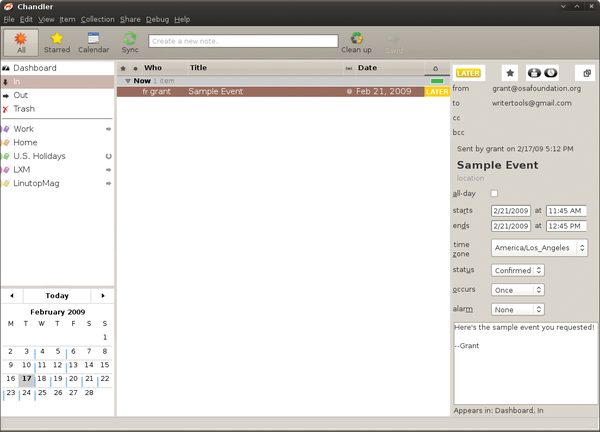 Figure 4: Chandler allows you to receive notes and events via email.
Another, and more efficient, approach is to use the Chandler Hub service, which lets you publish your collections and share them with other users. To publish a specific collection, select it and choose Share | Publish from the main menu. Once the collection is published, you can invite other users to subscribe to it by pressing the Invite button (or you can do it later by choosing Share | Invite). This generates two links: one for the view-and-edit subscription and another for the view-only subscription. Copy the links and send them to other users. Chandler Hub also lets you access and manage your information with a web browser, which can come in handy when you don't have access to the Chandler desktop application (Figure 5). Chandler Hub does a good job of mimicking the desktop client, and thanks to the clever use of AJAX technology, the web-based interface behaves pretty much like the desktop application.
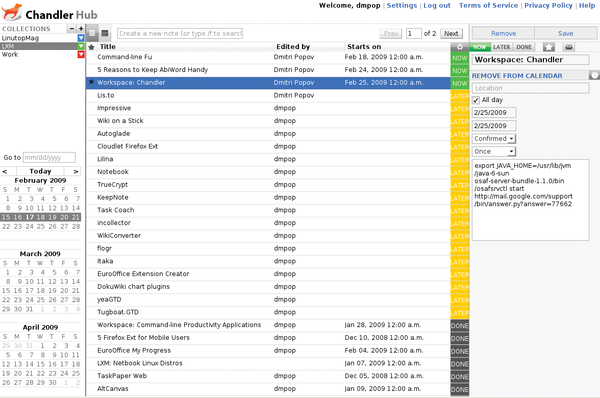 Figure 5: Chandler Hub lets you share collections and manage them via a browser.
The Cosmo server, which powers the Chandler Hub service, is also released under an open source license, and a ready-to-use version of it is available at the project's website. This means that you can easily roll out your own Chandler Hub service. To do this, download the latest release of the Cosmo server and unpack the downloaded archive. Before you start the server, make sure that the Java Runtime Environment is installed on your machine. Next, define the JAVA_HOME environment variable by running the following command in the terminal (the exact path depends on your Linux distribution and Java Runtime Environment version):
export JAVA_HOME=/usr/lib/jvm/ java-6-sun
To start the server, run the command below, replacing OSAFSRV_HOME with the actual server directory (e.g., osaf-server-bundle-1.1.0):
$OSAFSRV_HOME/bin/osafsrvctl start
Now point your browser to http://localhost:8080/ and you should see the welcome page.
Buy this article as PDF
(incl. VAT)
Buy Linux Magazine


US / Canada
UK / Australia
Subscribe to our Linux Newsletters
Find Linux and Open Source Jobs
Subscribe to our ADMIN Newsletters
Support Our Work
Linux Magazine content is made possible with support from readers like you. Please consider contributing when you’ve found an article to be beneficial.

News
-
XZ Gets the All-Clear
The back door xz vulnerability has been officially reverted for Fedora 40 and versions 38 and 39 were never affected.
-
Canonical Collaborates with Qualcomm on New Venture
This new joint effort is geared toward bringing Ubuntu and Ubuntu Core to Qualcomm-powered devices.
-
Kodi 21.0 Open-Source Entertainment Hub Released
After a year of development, the award-winning Kodi cross-platform, media center software is now available with many new additions and improvements.
-
Linux Usage Increases in Two Key Areas
If market share is your thing, you'll be happy to know that Linux is on the rise in two areas that, if they keep climbing, could have serious meaning for Linux's future.
-
Vulnerability Discovered in xz Libraries
An urgent alert for Fedora 40 has been posted and users should pay attention.
-
Canonical Bumps LTS Support to 12 years
If you're worried that your Ubuntu LTS release won't be supported long enough to last, Canonical has a surprise for you in the form of 12 years of security coverage.
-
Fedora 40 Beta Released Soon
With the official release of Fedora 40 coming in April, it's almost time to download the beta and see what's new.
-
New Pentesting Distribution to Compete with Kali Linux
SnoopGod is now available for your testing needs
-
Juno Computers Launches Another Linux Laptop
If you're looking for a powerhouse laptop that runs Ubuntu, the Juno Computers Neptune 17 v6 should be on your radar.
-
ZorinOS 17.1 Released, Includes Improved Windows App Support
If you need or desire to run Windows applications on Linux, there's one distribution intent on making that easier for you and its new release further improves that feature.