


Web service and reverse proxy with the speedy nginx

Small but Powerful

© Juan Jones, 123Rf
The fast and practical Nginx web server is easy to configure and extend.
Nginx (pronounced Engine-ex) is an Open Source HTTP server and reverse proxy. The Nginx web server is known for its high performance, stability, rich feature set, simple configuration, and low resource consumption. Nginx, which was written by Igor Sysoev, is used with many high-profile sites, including WordPress.com, Hulu, and LinuxQuestions.org. In addition to its HTTP-related functionality, nginx can also serve as an IMAP/POP3 proxy.
Nginx's basic HTTP support includes the ability to serve static files, accelerated reverse proxying with optional caching, simple load balancing and fault tolerance, remote FastCGI with caching/acceleration, and SSL/TLS server name indication (SNI). Like Apache's httpd, nginx has many features that are implemented in a modular fashion and only need to be enabled if you plan to use them. Unlike the process-based httpd, though, nginx is asynchronous. The main advantage of the asynchronous approach is scalability. In a process-based server, each simultaneous connection requires a thread, which can lead to significant overhead, especially when under high load. An asynchronous server, on the other hand, is event-driven and handles requests in a single (or at least very few) threads.
Installation
If you have a simple site or are starting from scratch, it's very possible you can completely forgo Apache and just use nginx for all your HTTP needs. If you choose to go this route, I recommend you visit the nginx Modules page [2] and verify that all the functionality you require is available with an nginx module. This article describes the common case of nginx acting as a load balancing reverse proxy to multiple existing Apache httpd back-ends. Nginx will serve some static content and then automatically gzip the dynamic content it is proxying from httpd.
Most Linux distributions have nginx in their package repositories, so you can easily install it using the standard package manager. If the packaged version for your distro is outdated or not available, visit http://nginx.net/ and download the latest stable version (0.7.61 at the time this article was written). The installation involves the standard ./configure && make && make install process. Although the defaults should work in most cases, I recommend you check out the available configuration options and tailor them to suit your environment. By default, you should see something similar to the following after you run ./configure:
Configuration summary
  + using system PCRE library
  + using system OpenSSL library
  + md5: using OpenSSL library
  + using sha1 library: /usr/include
  + using system zlib library
It's important to verify that the preceding libraries are found if you plan on using any of the functionality associated with them. For instance, the Rewrite module requires the PCRE library, and SSL support requires OpenSSL. With nginx installed, it's time set up a basic configuration.
Basic Configuration
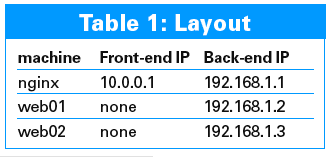
This article assumes a three-server infrastructure. The machine with nginx should ideally be on both a front-end public facing network and a back-end private network. The machines running httpd do not need any front-end network access. The layout for this article is shown in Table 1. With Table 1 in mind, edit the nginx.conf file with the information shown in Listing 1.
Listing 1
Basic nginx.conf
This configuration will result in both back-end machines getting the same number of requests. By default, nginx performs simple per-request, round-robin load balancing. If you'd like requests to be distributed between upstreams based on the IP address of the client, you can use the ip_hash directive. Additional, more advanced load balancing algorithm support is planned for a future nginx release. Note that, by default, all requests passed to the back-end httpd processes will appear to originate from the IP address of the nginx machine. I suggest you pass the IP address from the original request to httpd via the X-Forwarded-For HTTP header and then intercept that information with the httpd mod_rpaf module, which will change the remote IP address visible to other httpd modules. The mod_rpaf module is open source and available for download [3].
SSL Support
If you're using nginx as a load balancing reverse proxy, configuring it to handle SSL requests has multiple benefits. This approach simplifies your httpd configuration, offloads the CPU-load associated with SSL processing, and allows for easier load balancing, since it resolves the need to have "sticky" SSL sessions. Configuring SSL support is simple and requires the same CRT and KEY files as an httpd SSL configuration. Using the proxy configuration in Listing 1 as a template, add the settings in Listing 2.
Listing 2
SSL in nginx.conf
Note that there are two caveats in the current nginx SSL implementation. The stable branch does not have certificate revocation list support. This issue has been addressed in unstable versions ≥0.8.7. Next, if you have a chain certificate file (sometimes called an intermediate certificate), you don't specify it separately as you do in httpd. Instead you need to add the information from the chain certificate to the end of your main certificate file. Do this by typing cat chain.crt >> server.crt on the command line. Once that is done, you won't use the chain certificate file for anything else; you simply point ssl_certificate to the main certificate file.
Buy this article as PDF
(incl. VAT)
Buy Linux Magazine


US / Canada
UK / Australia
Subscribe to our Linux Newsletters
Find Linux and Open Source Jobs
Subscribe to our ADMIN Newsletters
Support Our Work
Linux Magazine content is made possible with support from readers like you. Please consider contributing when you’ve found an article to be beneficial.

News
-
Linux Servers Targeted by Akira Ransomware
A group of bad actors who have already extorted $42 million have their sights set on the Linux platform.
-
TUXEDO Computers Unveils Linux Laptop Featuring AMD Ryzen CPU
This latest release is the first laptop to include the new CPU from Ryzen and Linux preinstalled.
-
XZ Gets the All-Clear
The back door xz vulnerability has been officially reverted for Fedora 40 and versions 38 and 39 were never affected.
-
Canonical Collaborates with Qualcomm on New Venture
This new joint effort is geared toward bringing Ubuntu and Ubuntu Core to Qualcomm-powered devices.
-
Kodi 21.0 Open-Source Entertainment Hub Released
After a year of development, the award-winning Kodi cross-platform, media center software is now available with many new additions and improvements.
-
Linux Usage Increases in Two Key Areas
If market share is your thing, you'll be happy to know that Linux is on the rise in two areas that, if they keep climbing, could have serious meaning for Linux's future.
-
Vulnerability Discovered in xz Libraries
An urgent alert for Fedora 40 has been posted and users should pay attention.
-
Canonical Bumps LTS Support to 12 years
If you're worried that your Ubuntu LTS release won't be supported long enough to last, Canonical has a surprise for you in the form of 12 years of security coverage.
-
Fedora 40 Beta Released Soon
With the official release of Fedora 40 coming in April, it's almost time to download the beta and see what's new.
-
New Pentesting Distribution to Compete with Kali Linux
SnoopGod is now available for your testing needs