


Application development for the Cell processor
Simulated Entity
Before you can launch the Cell Full System Simulator, you must store the path to the simulator in the SYSTEMSIM_TOP environmental variable, which is /opt/ibm/systemsim-cell by default.
The following command wakes up the simulator:
/opt/ibm/systemsim-cell/bin/systemsim -g
The -g option launches a Tcl/Tk-based graphical interface (Figure 6). To see the various modes the simulator offers, press the Mode button. For a simple function test, Fast Mode is probably your best choice. Clicking Go launches the simulator. Now the console window will show you the operating system booting on the simulated Cell machine.
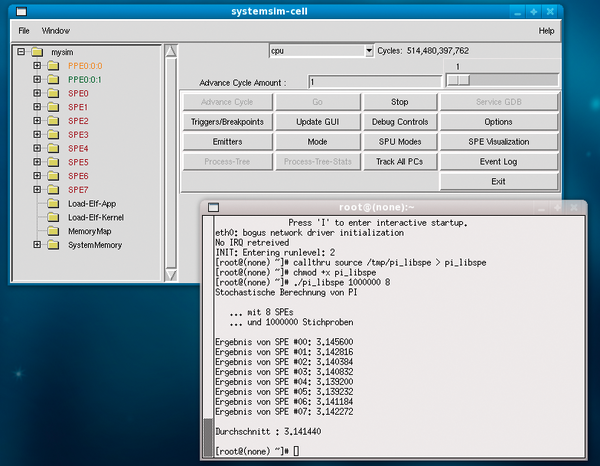 Figure 6: The Cell Full System Simulator by IBM makes physical Cell hardware unnecessary.
To load the program you want to run on the simulator, use the callthru command. If you run the command without any parameters, it will just show a help text. To import an executable file stored in the path /tmp/pi_libspe on the physical machine, use the command:
callthru source /tmp/pi_libspe > pi_libspe
After modifying the permissions, as in chmod u+x pi_libspe, you can then finally launch the program:
./pi_libspe 1000000 8
Running the program tells the simulation machine to create a million pairs of random numbers using eight SPEs. The precision with which the result matches the accepted value of PI depends on the quality of the pseudo-random numbers, but also on the number of attempts. The statistical error is approximately identical to the reciprocal value of the square root of the number of attempts. Given one-million attempts, the deviation between the approximated value and the actual value of PI is about one thousandth, that is, about 0.003.
Another programming tool is the Data Communication and Synchronization (DaCS) library. Dacs abstracts a number of the Cell processor's special features, which means that it potentially could be ported to other accelerator architectures. In contrast to this, the Accelerator Library Framework (ALF) implements a programming model that swaps out individual functions to the SPEs. DaCS and ALF are included in the IBM developer environment.
The Multicore Application Runtime System (Mars) is an open source project spearheaded by Sony [7]. Mars installs miniature kernels on the SPEs, and the kernels autonomously manage the execution of programs on "their" SPEs. Released in November 2008, version 1.0.1 is available as either an RPM package or Tar archive.
Infos
- Top 500: http://www.top500.org
- Green 500: http://www.green500.org
- Cell SDK: http://www.ibm.com/developerworks/power/cell
- Cell system simulator: http://www.alphaworks.ibm.com/tech/cellsystemsim
- Barcelona Supercomputer Center: http://www.bsc.es
- Linux on the PS 3: http://en.wikipedia.org/wiki/Linux_for_PlayStation_3
- Mars software and documentation: ftp://ftp.infradead.org/pub/Sony-PS3/mars
« Previous 1 2 3
Buy this article as PDF
(incl. VAT)
Buy Linux Magazine


US / Canada
UK / Australia
Subscribe to our Linux Newsletters
Find Linux and Open Source Jobs
Subscribe to our ADMIN Newsletters
Support Our Work
Linux Magazine content is made possible with support from readers like you. Please consider contributing when you’ve found an article to be beneficial.

News
-
Canonical Releases Ubuntu 24.04
After a brief pause because of the XZ vulnerability, Ubuntu 24.04 is now available for install.
-
Linux Servers Targeted by Akira Ransomware
A group of bad actors who have already extorted $42 million have their sights set on the Linux platform.
-
TUXEDO Computers Unveils Linux Laptop Featuring AMD Ryzen CPU
This latest release is the first laptop to include the new CPU from Ryzen and Linux preinstalled.
-
XZ Gets the All-Clear
The back door xz vulnerability has been officially reverted for Fedora 40 and versions 38 and 39 were never affected.
-
Canonical Collaborates with Qualcomm on New Venture
This new joint effort is geared toward bringing Ubuntu and Ubuntu Core to Qualcomm-powered devices.
-
Kodi 21.0 Open-Source Entertainment Hub Released
After a year of development, the award-winning Kodi cross-platform, media center software is now available with many new additions and improvements.
-
Linux Usage Increases in Two Key Areas
If market share is your thing, you'll be happy to know that Linux is on the rise in two areas that, if they keep climbing, could have serious meaning for Linux's future.
-
Vulnerability Discovered in xz Libraries
An urgent alert for Fedora 40 has been posted and users should pay attention.
-
Canonical Bumps LTS Support to 12 years
If you're worried that your Ubuntu LTS release won't be supported long enough to last, Canonical has a surprise for you in the form of 12 years of security coverage.
-
Fedora 40 Beta Released Soon
With the official release of Fedora 40 coming in April, it's almost time to download the beta and see what's new.