


Monitor Bandwidth Usage with vnStat

Productivity Sauce
In these days of bandwidth caps and pay-per-kilobyte rates, keeping an eye on your bandwidth usage makes a lot of sense. While there is no lack of bandwidth monitoring utilities, vnStat stands out from the crowd thanks to its ability to store monitoring data in a database and resume monitoring automatically on reboot. This means that once installed and configured, vnStat quietly monitors a specified network interface and saves the collected data. You can then use vnStat's command parameters to view detailed reports of your bandwidth usage.
vnStat is available in the software repositories of many mainstream Linux distributions, so you can easily install it using your distro's package manager. On an Ubuntu-based system, vnStat can be installed using the sudo apt-get install vnstat command. Before you can start using the utility, you must specify the network interface you want vnStat to monitor. First, run the ifconfig command to view a list of all available network interfaces. You can then use the -u and -i parameters to create a database for the specified network interface, for example:
sudo vnstat -u -i wlan0
Once vnstat is configured, it needs some time to collect data. After that you can view the bandwidth usage statistics using the vnstat command. The utility sports a few rather useful parameters, too. The -d ( or --days) parameter displays the daily bandwidth usage, while the -w ( --weeks) and -m ( --months) parameters break down the statistics by week and month. You can view a full list of available parameters using either the vnstat --help or vnstat --longhelp command.
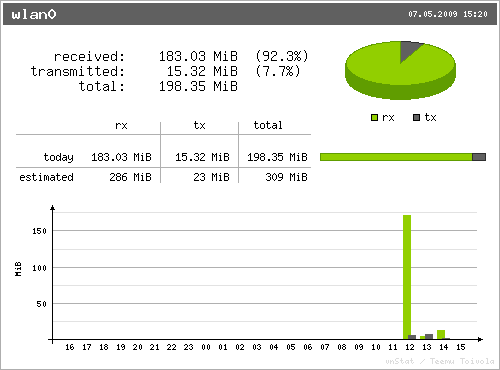
The packaged version of vnStat that is available in your distro's software repositories may not include vnStati -- a nifty utility which can turn dry text-only statistics into nice-looking graphs. In this case, if you want to analyze monitoring data visually, you have to compile vnStat from source. Fortunately, this is a rather straightforward procedure. First of all, make sure that you have all the tools necessary for building software from source. On Ubuntu, you can install them using the sudo apt-get install build-essential command. Next, install the libgd2-noxpm and libgd2-noxpm-dev libraries, using the sudo apt-get install libgd2-noxpm libgd2-noxpm-dev command. Download the latest .tar.gz version of vnStat from the project's Web site and unpack it. Switch to the resulting directory in the terminal and execute the make all command. Finally, run the sudo make install command to install the software. To generate a graph in the PNG format using VnStati, you have to specify at least three parameters: a graph type, a network interface, and the output file. For example, the command below produces a vnstat.png graphics file containing a traffic summary including hourly data using a horizontal layout:
vnstati -vs -i wlan0 -o ~/vnstat.png
Of course, you can use the vstati --help command to view a list of the available parameters.
Comments
comments powered by DisqusSubscribe to our Linux Newsletters
Find Linux and Open Source Jobs
Subscribe to our ADMIN Newsletters
Support Our Work
Linux Magazine content is made possible with support from readers like you. Please consider contributing when you’ve found an article to be beneficial.

News
-
United Nations Open Source Portal Goes Live
A new open source portal seeks to coordinate and scale open source efforts across the United Nations system.
-
KDE Linux Drops AUR
KDE Linux developers have dropped the Arch User Repository from the build pipeline due to security concerns; other distributions should consider doing the same.
-
California May Exempt Linux from Its Age-Verification Law
After backlash from the Linux community, California may be backing off on its promise to force all operating systems to verify age, but one platform may still have to comply.
-
Another Logic Bug Found in Linux Kernel
Qualys has discovered a vulnerability in the Linux kernel that can be used to elevate standard user privileges.
-
Ubuntu Core 26 Offers Game-Changing Enterprise Features
Ubuntu Core 26 could be a game-changer for organizations looking for increased security and reliability.
-
AI Flooding the Linux Kernel Security Mailing List
AI is giving Linus Torvalds a headache, but not in the way you might think.
-
Top Priorities for Open Source Pros Seeking a New Job
Professional fulfillment tops the list, according to LPI report.
-
Container-Based Fedora Hummingbird Designed for Agent-First Builders
Fedora Hummingbird brings the same approach to the host OS as it does to containers to level up security.
-
Linux kernel Developers Considering a Kill Switch
With the rise of Linux vulnerabilities, the kernel developers are now considering adding a component that could help temporarily mitigate against them… in the form of a kill switch.
-
Fedora 44 Now Gaming Ready
The latest version of Fedora has been released with gaming support.
Additional Tools
If anyone has additional network monitoring needs, let me suggest this website: http://www.activitymonitori...network_server_monitoring1.php
great tip
was easy to install through ubuntu's apt
I am trying to configure vnstat php fontend (http://www.sqweek.com/sqweek/index.php?p=1) must have for a server