


Coming to life

Beagleblog
There are several options for running a Linux system on the BeagleBoard. The most common is the Angstrom distribution, alternatives include an Android port by the Embinux company, a custom Ubuntu, and maybe more I don't even know of. I'll go with Angstrom for now, others distributions will have to wait.
The BeagleBoard has a card reader slot that can read SD and SDHC cards, so I am getting an 8GB SDHC card to store the Linux system. Conveniently, you can just prepare the flash card with your Linux PC – provided you have a working card reader.
Installing Angstrom is not a big deal; the only challenge is to partition the SD card appropriately. I just followed the tutorial on http://code.google.com/p/beagleboard/wiki/LinuxBootDiskFormat and everything worked out. According to the tutorial, you need to set some low-level parameters you might know from BIOS settings for your hard drive, such as cylinders and read/write heads (which don't really exist with a flash card). One FAT partition is for booting the system, another Ext3 partition will contain the Linux system.
When you are done partitioning, you need to copy the boot files into the FAT partition and un-tar Angstrom to the Linux filesystem. The web page http://code.google.com/p/beagleboard/wiki/HowToGetAngstromRunning lists the actual commands. I did not need to update the BeagleBoard firmware as the page proposes because it was already up to date on my hardware. So after unpacking the files, you just need to configure the boot loader.
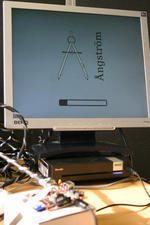
Putting the SD card into the slot on the BeagleBoard and plugging the (USB) power in will immediately show the bootloader screen, followed by the well-known Linux boot messages. If you have a monitor attached to the board via an HDMI/DVI cable, you will see a graphical boot screen, too. Connecting mouse and keyboard via a USB hub will make the BeagleBoard an almost fully functional graphical terminal – you just don't have a network connection.
Subscribe to our Linux Newsletters
Find Linux and Open Source Jobs
Subscribe to our ADMIN Newsletters
Support Our Work
Linux Magazine content is made possible with support from readers like you. Please consider contributing when you’ve found an article to be beneficial.

News
-
United Nations Open Source Portal Goes Live
A new open source portal seeks to coordinate and scale open source efforts across the United Nations system.
-
KDE Linux Drops AUR
KDE Linux developers have dropped the Arch User Repository from the build pipeline due to security concerns; other distributions should consider doing the same.
-
California May Exempt Linux from Its Age-Verification Law
After backlash from the Linux community, California may be backing off on its promise to force all operating systems to verify age, but one platform may still have to comply.
-
Another Logic Bug Found in Linux Kernel
Qualys has discovered a vulnerability in the Linux kernel that can be used to elevate standard user privileges.
-
Ubuntu Core 26 Offers Game-Changing Enterprise Features
Ubuntu Core 26 could be a game-changer for organizations looking for increased security and reliability.
-
AI Flooding the Linux Kernel Security Mailing List
AI is giving Linus Torvalds a headache, but not in the way you might think.
-
Top Priorities for Open Source Pros Seeking a New Job
Professional fulfillment tops the list, according to LPI report.
-
Container-Based Fedora Hummingbird Designed for Agent-First Builders
Fedora Hummingbird brings the same approach to the host OS as it does to containers to level up security.
-
Linux kernel Developers Considering a Kill Switch
With the rise of Linux vulnerabilities, the kernel developers are now considering adding a component that could help temporarily mitigate against them… in the form of a kill switch.
-
Fedora 44 Now Gaming Ready
The latest version of Fedora has been released with gaming support.