


Serving false signatures to attack scanners with Portspoof

Flytrap

The Internet is a tough place to live – especially for publicly accessible computers. A small tool called Portspoof makes port scanning a real challenge for attackers.
Seasoned attackers, and even some amateur cyber-vandals, find sport in trying to scan servers and hijack them at the same time (Figure 1). Firewalls and Intrusion Detection/Prevention systems can help, but if a single tool could truly stop all potential attacks, the Internet intrusion industry wouldn't even exist.
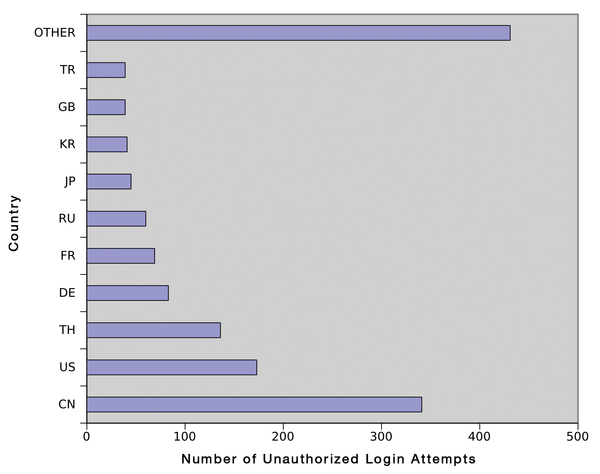 Figure 1: Number of unuathorized login attempts on the author's network in a two-month period (by country or origin).
A professional intrusion attempt is typically preceded by reconnaissance and scanning. Many attackers simply perform a scan, which is easily automated with tools like Nmap. An attacker who discovers a firewall and similar defensive system can often guess which ports and services are worth attacking. However, a tool called Portspoof [1] intervenes to cause complications and confusion for the attacker. Portspoof answers port requests with a wild mix of signatures and payloads. This confusing and unwanted information slows down any attempted port scan, forcing the attacker to manually evaluate the results in a time-consuming process.
[...]
Buy this article as PDF
(incl. VAT)
Buy Linux Magazine
Subscribe to our Linux Newsletters
Find Linux and Open Source Jobs
Subscribe to our ADMIN Newsletters
Digital Autonomy
• How the Fediverse Found Parts for Its Platforms
• The Answer Was Already on the Shelf
• Changing the Chip Industry: How Public Investment Has Grown Open Silicon
• United Nations Open Source Portal Goes Live
• EU Open Source Strategy Plays Key Role in Tech Sovereignty Package
• France Says “Au Revoir” to Microsoft
Support Our Work
Linux Magazine content is made possible with support from readers like you. Please consider contributing when you’ve found an article to be beneficial.

News
-
openKylin 3.0 Released with Expanded AI Integration
The latest release features a pre-installed AI agent to help perform tasks.
-
DigitalOcean Ends Open Source Credits Program
In a change that has surprised many open source developers, DigitalOcean has decided to sunset its Open Source Credits Program.
-
Office 365 Available for Testing on Linux via Bottles
Linux users can now test the official Office 365, thanks to Mirko Brombin's work on Bottles.
-
Dutch Government Turns to Open Source for Digital Sovereignty
Following in the footsteps of other European countries, the Netherlands is looking to increase its sovereign digital infrastructure with open source software.
-
Linux May Soon Work on Snapdragon X2-Based PCs
If you're thinking about buying a Snapdragon X2-based desktop or laptop, Linux may soon be an option.
-
KDE for People Initiative Calls for AI Ban in Plasma
A new community of KDE wants the project to adopt a strict no-AI policy for KDE Plasma.
-
KDE Sets Ambitious Goals for 2026 and Beyond
KDE Connect reveals the goals for the Linux desktop darling, with one of those goals long overdue.
-
It’s Time to Test Fedora 45 Beta
Fedora 45 beta has been released with updated Gnome, KDE Plasma, and kernel.
-
Ubuntu Stonking Stingray Gets Even Rustier
Ubuntu 26.10 has completed its migration to the Rust-based coreutils.
-
AI Fixes Linux Bottlenecks Using “Hideous” Code
A Linux developer used AI to fix bottlenecks that caused problems when building the kernel. The resulting AI-generated code needed a lot of work.