


WikiCrowd: Lightweight Wiki for Collaborative Editing

Productivity Sauce
There are a few things that set WikiCrowd apart from other wiki engines. Take, for example, its installation procedure. WikiCrowd doesn't require any database back-end, so you only need a machine with an Apache server and PHP 5.2 for it. WikiCrowd comes as a single install.php file which does the donkey job of installing the wiki on your server. Drop the file into the document root of your server and point your browser to http://yourserver/install.php. Fill out the required fields and specify the access rights for your wiki. You can either choose one of the available access profiles or specify your own by choosing the Your choice option and ticking the appropriate check boxes. Hit then the Install button, and your wiki is ready to go.
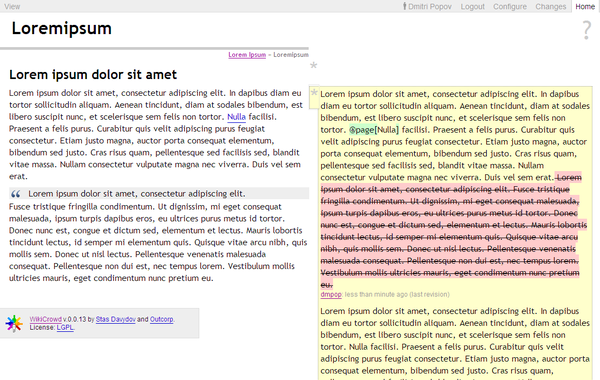
WikiCrowd is geared towards collaborative writing, and its formatting syntax reflects that. In addition to the usual text formatting options like bold, italics, superscript, and subscript, WikiCrowd features few tags for defining document structure such as @title and @subtitle for page titles and subtitles, @par for paragraphs, and @footnote for footnotes. Other tags include @listitem for formatting lists, @quote for quotations, @img for linking to graphics files, and @html for inserting HTML code snippets. Like any other wiki, you can add a new page by simply linking to it. For example, the @page[LoremIpsum] link creates the LoremIpsum page. Naturally, you can insert external links, too, by specifying the target URL: @page[http://linux-magazine.com]
WikiCrowd wouldn't be a wiki without the ability to track changes, and the Changes link in the upper-right corner provides an overview of all changes made to WikiCrowd pages. The wiki engine supports color coding, which makes it easier to keep tabs on changes. WikiCrowd also sports a nifty feature that lets you view changes made to a specific segment of the page. Click on the star icon next to the page segment, and a list of changes made to the segment appears in a sidebox. WikiCrowd can handle multiple users, and you can either let WikiCrowd handle user registration or you can create and configure user accounts manually.
While WikiCrowd won't replace a full-featured wiki system like DokuWiki or MediaWiki, it can come in handy when you need to quickly set up a collaborative environment that is easy to manage, doesn't have a learning curve, can handle multiple users, and provides an easy way to track changes.
Comments
comments powered by DisqusSubscribe to our Linux Newsletters
Find Linux and Open Source Jobs
Subscribe to our ADMIN Newsletters
Digital Autonomy
• The Answer Was Already on the Shelf
• Changing the Chip Industry: How Public Investment Has Grown Open Silicon
• United Nations Open Source Portal Goes Live
• EU Open Source Strategy Plays Key Role in Tech Sovereignty Package
• France Says “Au Revoir” to Microsoft
Support Our Work
Linux Magazine content is made possible with support from readers like you. Please consider contributing when you’ve found an article to be beneficial.

News
-
Office 365 Available for Testing on Linux via Bottles
Linux users can now test the official Office 365, thanks to Mirko Brombin's work on Bottles.
-
Dutch Government Turns to Open Source for Digital Sovereignty
Following in the footsteps of European countries, the Netherlands is looking to increase its sovereign digital infrastructure with open source software.
-
Linux May Soon Work on Snapdragon X2-Based PCs
If you're thinking about buying a Snapdragon X2-based desktop or laptop, Linux may soon be an option.
-
KDE for People Initiative Calls for AI Ban in Plasma
A new community of KDE wants the project to adopt a strict no-AI policy for KDE Plasma.
-
KDE Sets Ambitious Goals for 2026 and Beyond
KDE Connect reveals the goals for the Linux desktop darling, with one of those goals long overdue.
-
It’s Time to Test Fedora 45 Beta
Fedora 45 beta has been released with updated Gnome, KDE Plasma, and kernel.
-
Ubuntu Stonking Stingray Gets Even Rustier
Ubuntu 26.10 has completed its migration to the Rust-based coreutils.
-
AI Fixes Linux Bottlenecks Using “Hideous” Code
A Linux developer used AI to fix bottlenecks that caused problems when building the kernel. The resulting AI-generated code needed a lot of work.
-
Advanced Video Coding Still Under Patent
Brazilian patent BRPI0109962B1 has expired, which means that DivX and Xvid are no longer problematic for Linux, but it doesn’t mean that video is all of a sudden fully unleashed.
-
2,000 Vulnerabilities per Linux Release
Thanks to AI bug hunters, the Linux kernel is seeing record numbers of vulnerabilities, and it's overwhelming developers.
LionWiki URL
http://lionwiki.0o.cz
LionWiki