


WordGrinder: Word Processing Terminal Style

Productivity Sauce
You may think that word processing is all about WYSIWYG and GUI, but WordGrinder is living proof that a word processor that runs in a terminal does make sense. Thanks to its small and efficient code base containing only 6300 lines of code, WordGrinder will happily run on older machines, and you can even use it on GUI-less setups.
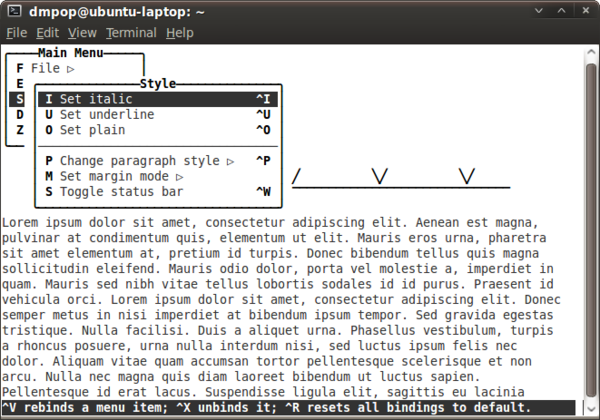
Despite being a terminal-based application, WordGrinder provides a menu system activated with the Esc key. Users who prefer to control applications via the keyboard will be pleased to learn that WordGrinder provides keyboard shortcuts for virtually every command and action. Better yet, you can reconfigure the default keyboard shortcuts to suit your needs. When it comes to word processing features, WordGrinder doesn't disappoint. It supports basic text and paragraph styles, it offers a search and replace feature, and it can handle multiple documents in a single file. There is also the mandatory word count feature and the handy Scrapbook that you can use to store text snippets. WordGrinder also lets you import and export documents in the HTML format as well as save them in the LaTex and Troff formats.
Obviously, WordGrinder won't replace OpenOffice Writer or even AbiWord, but if you are looking for a simple and efficient word processor for drafting articles and jotting down ideas, WordGrinder fits the bill quite nicely.
Comments
comments powered by DisqusSubscribe to our Linux Newsletters
Find Linux and Open Source Jobs
Subscribe to our ADMIN Newsletters
Digital Autonomy
• The Answer Was Already on the Shelf
• Changing the Chip Industry: How Public Investment Has Grown Open Silicon
• United Nations Open Source Portal Goes Live
• EU Open Source Strategy Plays Key Role in Tech Sovereignty Package
• France Says “Au Revoir” to Microsoft
Support Our Work
Linux Magazine content is made possible with support from readers like you. Please consider contributing when you’ve found an article to be beneficial.

News
-
Dutch Government Turns to Open Source for Digital Sovereignty
Following in the footsteps of European countries, the Netherlands is looking to increase its sovereign digital infrastructure with open source software.
-
Linux May Soon Work on Snapdragon X2-Based PCs
If you're thinking about buying a Snapdragon X2-based desktop or laptop, Linux may soon be an option.
-
KDE for People Initiative Calls for AI Ban in Plasma
A new community of KDE wants the project to adopt a strict no-AI policy for KDE Plasma.
-
KDE Sets Ambitious Goals for 2026 and Beyond
KDE Connect reveals the goals for the Linux desktop darling, with one of those goals long overdue.
-
It’s Time to Test Fedora 45 Beta
Fedora 45 beta has been released with updated Gnome, KDE Plasma, and kernel.
-
Ubuntu Stonking Stingray Gets Even Rustier
Ubuntu 26.10 has completed its migration to the Rust-based coreutils.
-
AI Fixes Linux Bottlenecks Using “Hideous” Code
A Linux developer used AI to fix bottlenecks that caused problems when building the kernel. The resulting AI-generated code needed a lot of work.
-
Advanced Video Coding Still Under Patent
Brazilian patent BRPI0109962B1 has expired, which means that DivX and Xvid are no longer problematic for Linux, but it doesn’t mean that video is all of a sudden fully unleashed.
-
2,000 Vulnerabilities per Linux Release
Thanks to AI bug hunters, the Linux kernel is seeing record numbers of vulnerabilities, and it's overwhelming developers.
-
Linux Exempt from California’s Age Verification Law
So long as Linux is distributed under the GPL, MIT, BSD, and Apache licenses, the OS is exempt from being required to verify the age of its users in California.
The Missing Link
Even under lynx, the "link" is still visible as a link.
Getting the internet.
Who doesn't get the Internet :^)
that their firewall or something else is refusing to open
the link. It works fine for me on Fedora 10/Firefox.
Regards
cwww
Cool!
re: Evidence of failure to "get" the internet
Re: Evidence of failure to "get" the internet
Kind regards,
Dmitri
Evidence of failure to "get" the internet
Evidence that the author must work for a dead tree newspaper, because they clearly do not "get" the internet.