


Aard Dictionary: Reference Tool for Linux Desktop and Android

Productivity Sauce
Need a dictionary tool that works equally well on a Linux desktop and Android devices? Consider Aard dictionary. This is a rather competent dictionary tool that can handle humongous references like an offline version of Wikipedia with aplomb. Aadict can also manage multiple references and dictionaries, so you can look up a word in multiple sources at once. The application uses its own aar format, and the project's website offers tools for compiling dictionaries. But before you get your hands dirty building your own .aar files, you might want to check the selection of ready-made dictionaries, which include the ever-popular WordNet dictionary, an assortment of Wikipedia files, Wiktionary dictionaries, and much more.
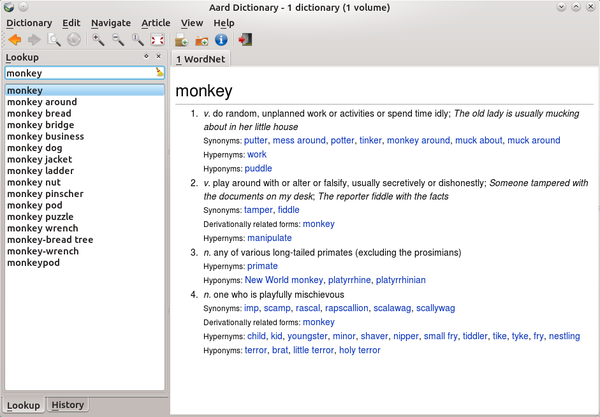
Aard Dictionary binaries are available for Ubuntu and other platforms. Alternatively, you can install Aard Dictionary from source. To do this on Ubuntu, install the python-pyicu package, grab the latest source code release from the project's website, and unpack the downloaded archive. Switch to the resulting directory in the terminal and execute the sudo python setup.py install command. You can also launch Aard Dictionary without installing it using the run.py script. Once the application is up and running, press the Add dictionaries button to add individual dictionary files, or use the Add dictionary directory button to point Aard Dictionary to a directory containing dictionary files. Type then the desired word in the Lookup field to view the results from the added dictionary files.
The Android version of Aard Dictionary is available on Google Play. During the first run, the app automatically scans the default locations and adds the found dictionary files. The app's interface is bare-bones, but it gets the job done.
comments powered by DisqusSubscribe to our Linux Newsletters
Find Linux and Open Source Jobs
Subscribe to our ADMIN Newsletters
Digital Autonomy
• How the Fediverse Found Parts for Its Platforms
• The Answer Was Already on the Shelf
• Changing the Chip Industry: How Public Investment Has Grown Open Silicon
• United Nations Open Source Portal Goes Live
• EU Open Source Strategy Plays Key Role in Tech Sovereignty Package
• France Says “Au Revoir” to Microsoft
Support Our Work
Linux Magazine content is made possible with support from readers like you. Please consider contributing when you’ve found an article to be beneficial.

News
-
Linux Mint 27 Set for a Christmas Release
The developers behind Linux Mint have announced a Christmas release, and it looks like Santa's sack will be brimming with features.
-
Is Linus Torvalds Vibe Coding?
The creator of Linux has added AI into his process for Linux kernel development, and it's more than just for debugging.
-
openKylin 3.0 Released with Expanded AI Integration
The latest release features a pre-installed AI agent to help perform tasks.
-
DigitalOcean Ends Open Source Credits Program
In a change that has surprised many open source developers, DigitalOcean has decided to sunset its Open Source Credits Program.
-
Office 365 Available for Testing on Linux via Bottles
Linux users can now test the official Office 365, thanks to Mirko Brombin's work on Bottles.
-
Dutch Government Turns to Open Source for Digital Sovereignty
Following in the footsteps of other European countries, the Netherlands is looking to increase its sovereign digital infrastructure with open source software.
-
Linux May Soon Work on Snapdragon X2-Based PCs
If you're thinking about buying a Snapdragon X2-based desktop or laptop, Linux may soon be an option.
-
KDE for People Initiative Calls for AI Ban in Plasma
A new community of KDE wants the project to adopt a strict no-AI policy for KDE Plasma.
-
KDE Sets Ambitious Goals for 2026 and Beyond
KDE Connect reveals the goals for the Linux desktop darling, with one of those goals long overdue.
-
It’s Time to Test Fedora 45 Beta
Fedora 45 beta has been released with updated Gnome, KDE Plasma, and kernel.