


ReText: A Text Editor with Support for reStructuredText and Markdown

Productivity Sauce
ReText is a nifty text editor for those who appreciate markup systems like reStructuredText and Markdown. The application allows you to easily create formatted texts using either reStructuredText or Markdown markups, and then output the result in several formats including ODF, PDF, and HTML. In addition to that, you can upload formatted documents to Google Docs directly from within the editor. ReText boasts other handy features, including HTML syntax highlighting, auto save option, and support for CSS styles. The editor sports a tabbed interface, so you can manage multiple text files, while the Preview pane lets you view the formatted output of the currently edited file. The Tags and Symbols drop-down lists allow you to quickly insert often-used HTML tags and symbols like em dash, right and left arrows, dot, etc. Like any text editor worth its salt, ReText supports a simple find feature as well as undo and redo operations. The only missing piece here is the lack of word count and line numbering features.
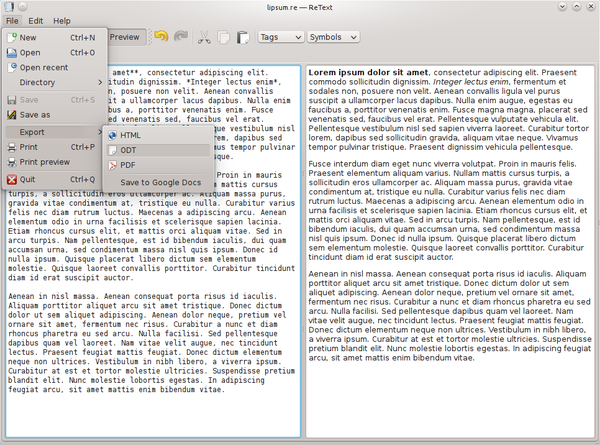
ReText is written in Python, and the text editor requires no installation. However, it depends on a handful of packages, including python-qt4, python-markdown, python-docutils, and python-gdata. These packages are available in the software repositories of most mainstream Linux distributions, so you can easily install them using your distro's package manager. Grab then the latest release of ReText and unpack the downloaded archive. Make the retext.py file in the resulting directory executable using the chmod +x retext.py command, and launch the editor by running the ./retext.py command (or double-click on the retext.py file in the file manager).
Users of Ubuntu-based distributions can install ReText via a dedicated PPA:
sudo add-apt-repository ppa:mitya57/ppa
sudo apt-get update
sudo apt-get install retext
Comments
comments powered by DisqusSubscribe to our Linux Newsletters
Find Linux and Open Source Jobs
Subscribe to our ADMIN Newsletters
Digital Autonomy
• The Answer Was Already on the Shelf
• Changing the Chip Industry: How Public Investment Has Grown Open Silicon
• United Nations Open Source Portal Goes Live
• EU Open Source Strategy Plays Key Role in Tech Sovereignty Package
• France Says “Au Revoir” to Microsoft
Support Our Work
Linux Magazine content is made possible with support from readers like you. Please consider contributing when you’ve found an article to be beneficial.

News
-
KDE for People Initiative Calls for AI Ban in Plasma
A new community of KDE wants the project to adopt a strict no-AI policy for KDE Plasma.
-
KDE Sets Ambitious Goals for 2026 and Beyond
KDE Connect reveals the goals for the Linux desktop darling, with one of those goals long overdue.
-
It’s Time to Test Fedora 45 Beta
Fedora 45 beta has been released with updated Gnome, KDE Plasma, and kernel.
-
Ubuntu Stonking Stingray Gets Even Rustier
Ubuntu 26.10 has completed its migration to the Rust-based coreutils.
-
AI Fixes Linux Bottlenecks Using “Hideous” Code
A Linux developer used AI to fix bottlenecks that caused problems when building the kernel. The resulting AI-generated code needed a lot of work.
-
Advanced Video Coding Still Under Patent
Brazilian patent BRPI0109962B1 has expired, which means that DivX and Xvid are no longer problematic for Linux, but it doesn’t mean that video is all of a sudden fully unleashed.
-
2,000 Vulnerabilities per Linux Release
Thanks to AI bug hunters, the Linux kernel is seeing record numbers of vulnerabilities, and it's overwhelming developers.
-
Linux Exempt from California’s Age Verification Law
So long as Linux is distributed under the GPL, MIT, BSD, and Apache licenses, the OS is exempt from being required to verify the age of its users in California.
-
Roll Out the Cake: Linux Turns 35
35 years ago, a Finnish student began a humble project that would forever change the course of technology.
-
China Switching from Windows to Linux
China has ordered several government agencies to drop a Chinese-developed version of Windows 10 in favor of either KylinOS or UOS.
Using Markdown as an input for Slideshow - s6 and s9