


26C3: Milkymist Visual Synthesizer Soon with Ethernet and USB

Initiator and main developer of the Milkymist project, Sébastien Bourdeauducq, showed a prototype of his visual synthesizer at the latest Chaos Congress and builds his own board for it.
Bourdeauducq describes his one-and-a-half-year-old system on a programmable chip (SoPC) as "eye candy on a chip." The board shown in a schematic diagram, with a soc-lm32 CPU, FPGA and floating-point coprocessor, visualizes audio input and renders its moving images over VGA. The name Milkymist comes from Bourdeauducq's association with MilkDrop, a visualization plugin for the Winamp audio player.
In his talk at the Berlin conference he covered how he solved the speed and RAM capacity problem with a minimum of expense. For a rate of 30 pictures per second at 1024 x 768 pixels, the texture mapping unit (TMU) needed to process 24 million pixels. Because memory, according the SoaC designer recently graduated in Sweden, depends on intelligent controller programming, he lets it gather into four memory chunks (a "burst") before releasing it, instead of one chunk at a time. His studies revealed that field-programmable gate arrays (FPGAs) are hugely underrated -- they're easy to obtain and dependable, but underused.
 With his Milkymist platform Bourdeauducq wants to provide visual jockeys (VJs) with "MilkDrop-esque" effects as a compact SoC.
The first prototype of his SoC was based on the $500 Xilinx ML401 board, which ran Linux kernel 2.6.23 and simulators such as Verilog with GPL Cver. Mid-2009 he presented his visualizer at the Hackerspace Festival in Paris. Since two months it now he is building his own board, which Bourdeauducq gave Linux Magazine Online a glimpse of.
The new board, which has a smaller footprint, processes audio and video input and have an Ethernet and USB interface. The Frenchman wants to swap the previous CF memory card with an SD card. According to his November writeup, it should eventually run on µClinux. The previous software is available in source and binary versions as well as a Debian package.
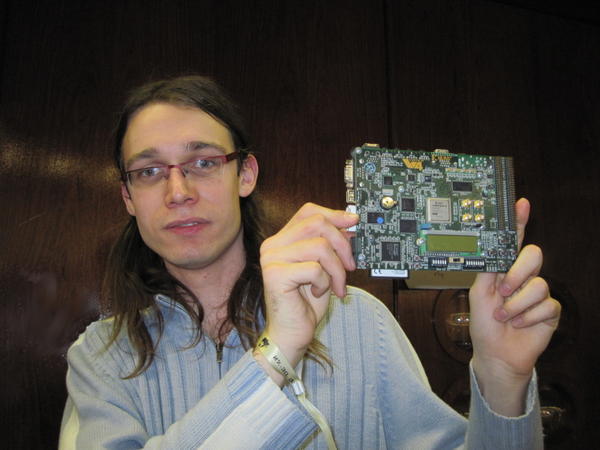 Bourdeauducq with his prototype of the visual synthesizer. Instead of the Xilinx ML401 board that normally runs soc-lm32, he designed his own, which also has USB and Ethernet ports.
Motivation for the project was to produce a completely open system on the hardware side. The BeagleBoard was too closed for Bourdeauducq: it's based on the proprietary OMAP chip and some of the drivers are also proprietary. "Texas Instruments," he complains, "does its own boards and otherwise marketing, for inexpensively produced software."
Subscribe to our Linux Newsletters
Find Linux and Open Source Jobs
Subscribe to our ADMIN Newsletters
Support Our Work
Linux Magazine content is made possible with support from readers like you. Please consider contributing when you’ve found an article to be beneficial.

News
-
Canonical Releases Ubuntu 24.04
After a brief pause because of the XZ vulnerability, Ubuntu 24.04 is now available for install.
-
Linux Servers Targeted by Akira Ransomware
A group of bad actors who have already extorted $42 million have their sights set on the Linux platform.
-
TUXEDO Computers Unveils Linux Laptop Featuring AMD Ryzen CPU
This latest release is the first laptop to include the new CPU from Ryzen and Linux preinstalled.
-
XZ Gets the All-Clear
The back door xz vulnerability has been officially reverted for Fedora 40 and versions 38 and 39 were never affected.
-
Canonical Collaborates with Qualcomm on New Venture
This new joint effort is geared toward bringing Ubuntu and Ubuntu Core to Qualcomm-powered devices.
-
Kodi 21.0 Open-Source Entertainment Hub Released
After a year of development, the award-winning Kodi cross-platform, media center software is now available with many new additions and improvements.
-
Linux Usage Increases in Two Key Areas
If market share is your thing, you'll be happy to know that Linux is on the rise in two areas that, if they keep climbing, could have serious meaning for Linux's future.
-
Vulnerability Discovered in xz Libraries
An urgent alert for Fedora 40 has been posted and users should pay attention.
-
Canonical Bumps LTS Support to 12 years
If you're worried that your Ubuntu LTS release won't be supported long enough to last, Canonical has a surprise for you in the form of 12 years of security coverage.
-
Fedora 40 Beta Released Soon
With the official release of Fedora 40 coming in April, it's almost time to download the beta and see what's new.