


Creating Ebooks with Sigil

Productivity Sauce
There are plenty of places on the Web where you can find ebooks in the EPUB format, but what if you need to create an ebook yourself? Sigil can help you with that. This nifty application allows you to create ebooks using the graphical interface without getting your hands dirty with coding. Despite being a relatively new application, Sigil already sports all the essential features that simplify the process of formatting ebooks and generating ready-to-use EPUB files.
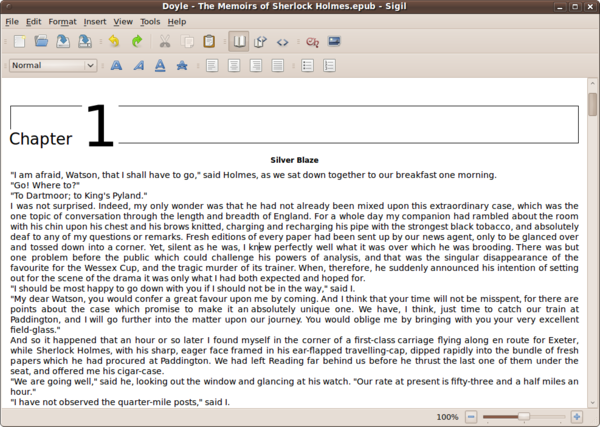
Installing Sigil is as easy as it gets. Download the installer .bin file. and run it in the terminal as root:
./Sigil-x.x.x-Linux-x86-Install.bin
Sigil supports most common formatting options such as bold, italics, and underlined as well as different text aligning options. All these features can be accessed via the buttons on the main toolbar. With Sigil, you don't have to start from scratch: the application can import files in the TXT, HTML and EPUB formats. Using the built-in HTML Tidy module, Sigil cleans the imported documents, removing all the cruft and fixing broken code. Sigil's interface sports three views. The Book View lets you edit the book graphically, hiding the underlying code behind the WYSIWYG interface. If you want to keep an eye on the code, you can switch to Split View, and in case you prefer to code your book by hand, there is the Code View that allows you to do just that. Sigil also comes with a metada editor which supports more than 200 entries and lets you provide a comprehensive description of your book. And you can use the Table of Contents editor to easily generate a multi-level Table of Contents for your book. Once your book is ready, you can save it as an EPUB file that can be viewed in any ebook reader application that supports the popular format.
comments powered by DisqusSubscribe to our Linux Newsletters
Find Linux and Open Source Jobs
Subscribe to our ADMIN Newsletters
Digital Autonomy
• The Answer Was Already on the Shelf
• Changing the Chip Industry: How Public Investment Has Grown Open Silicon
• United Nations Open Source Portal Goes Live
• EU Open Source Strategy Plays Key Role in Tech Sovereignty Package
• France Says “Au Revoir” to Microsoft
Support Our Work
Linux Magazine content is made possible with support from readers like you. Please consider contributing when you’ve found an article to be beneficial.

News
-
KDE for People Initiative Calls for AI Ban in Plasma
A new community of KDE wants the project to adopt a strict no-AI policy for KDE Plasma.
-
KDE Sets Ambitious Goals for 2026 and Beyond
KDE Connect reveals the goals for the Linux desktop darling, with one of those goals long overdue.
-
It’s Time to Test Fedora 45 Beta
Fedora 45 beta has been released with updated Gnome, KDE Plasma, and kernel.
-
Ubuntu Stonking Stingray Gets Even Rustier
Ubuntu 26.10 has completed its migration to the Rust-based coreutils.
-
AI Fixes Linux Bottlenecks Using “Hideous” Code
A Linux developer used AI to fix bottlenecks that caused problems when building the kernel. The resulting AI-generated code needed a lot of work.
-
Advanced Video Coding Still Under Patent
Brazilian patent BRPI0109962B1 has expired, which means that DivX and Xvid are no longer problematic for Linux, but it doesn’t mean that video is all of a sudden fully unleashed.
-
2,000 Vulnerabilities per Linux Release
Thanks to AI bug hunters, the Linux kernel is seeing record numbers of vulnerabilities, and it's overwhelming developers.
-
Linux Exempt from California’s Age Verification Law
So long as Linux is distributed under the GPL, MIT, BSD, and Apache licenses, the OS is exempt from being required to verify the age of its users in California.
-
Roll Out the Cake: Linux Turns 35
35 years ago, a Finnish student began a humble project that would forever change the course of technology.
-
China Switching from Windows to Linux
China has ordered several government agencies to drop a Chinese-developed version of Windows 10 in favor of either KylinOS or UOS.