


Kick-start Your Brain with Scribble

Productivity Sauce
Sometimes your brain needs a gentle push to get into gear. For some a good cup of coffee does the trick, while others prefer to use a good word game to kick-start their gray cells. If you belong to the latter category, you might appreciate Scribble, a command line-based version of the popular Scrabble game. Scribble is available in the software repositories of many mainstream Linux distributions, including Debian and Ubuntu. To install Scribble on the latter, run the sudo apt-get install scribble command and you are good to go. Run the scribble command to start a new game. You can also specify a difficulty level from 1 (easiest) to 9 (most difficult), for example: scribble 5 or scribble 7.
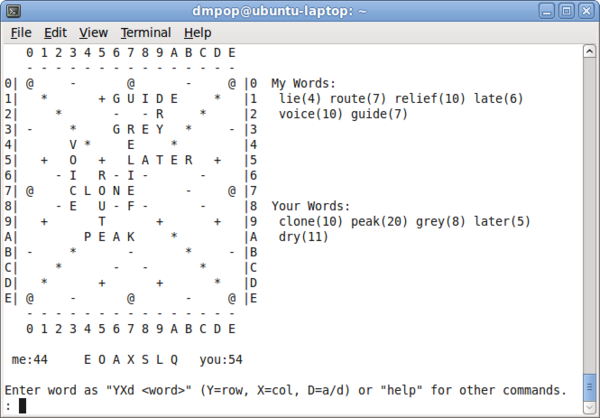
If you are familiar with Scrabble, you won't have problems figuring out how to play Scribble. Your task is to use the letters at your disposal to construct a word and place it on the board. To do the latter, you have to specify coordinates and direction first, for example 57a (a stands for "across") or 9Bd (d stands for "down"). Similar to the original game, Scribble's board sports bonus squares that double and triple letter and word scores. You can view a full list of letter values and bonus scores at any time using the info command. The pass command allows you to skip your turn, while the quit command quits Scribble. To view a list of all available commands, type help and press Enter.
Although Scribble doesn't sport advanced features like multi-player or network games, and it lacks a graphical interface, it's still a fun game to play. So if you need a quick brain exercise, give Scribble a try.
Comments
comments powered by DisqusSubscribe to our Linux Newsletters
Find Linux and Open Source Jobs
Subscribe to our ADMIN Newsletters
Support Our Work
Linux Magazine content is made possible with support from readers like you. Please consider contributing when you’ve found an article to be beneficial.

News
-
EU Open Source Strategy Plays Key Role in Tech Sovereignty Package
Comprehensive measures adopted by the European Commission aim to reduce dependency on non-EU countries.
-
Linux Foundation Report Indicates AI Driving Tech Hiring
Within growing security and skills gaps, AI has been found to be a positive driving force behind tech hiring trends in Europe.
-
United Nations Open Source Portal Goes Live
A new open source portal seeks to coordinate and scale open source efforts across the United Nations system.
-
KDE Linux Drops AUR
KDE Linux developers have dropped the Arch User Repository from the build pipeline due to security concerns; other distributions should consider doing the same.
-
California May Exempt Linux from Its Age-Verification Law
After backlash from the Linux community, California may be backing off on its promise to force all operating systems to verify age, but one platform may still have to comply.
-
Another Logic Bug Found in Linux Kernel
Qualys has discovered a vulnerability in the Linux kernel that can be used to elevate standard user privileges.
-
Ubuntu Core 26 Offers Game-Changing Enterprise Features
Ubuntu Core 26 could be a game-changer for organizations looking for increased security and reliability.
-
AI Flooding the Linux Kernel Security Mailing List
AI is giving Linus Torvalds a headache, but not in the way you might think.
-
Top Priorities for Open Source Pros Seeking a New Job
Professional fulfillment tops the list, according to LPI report.
-
Container-Based Fedora Hummingbird Designed for Agent-First Builders
Fedora Hummingbird brings the same approach to the host OS as it does to containers to level up security.
Scribble on Fedora?