


CeBIT 2009: Mozilla Shows Off Next Generation Web

The Mozilla Foundation features a booth in the Open Source Project lounge in Hall 6 at this year's CeBIT.
"Just about everyone visiting our booth uses Firefox," said Tim Riley of Mozilla. The Firefox pins and other goodies that the conference team distributed were hotly sought after.
Riley and his colleagues presented at their booth the features of the upcoming Firefox version 3.1 that should be on the market in a couple of months. Notable among them are the enhancements in HTML 5 such as video tags that allow embedded Ogg and Theora videos to be played without a plug-in. As Riley says, "This way you get everything with the Open Source browser and don't need to rely on Adobe or others." Other enhancements involve Scalable Vector Graphics (SVG) providing object drag-and-drops, as well as canvas libraries for scriptable bitmap image rendering.
Both canvas bitmaps and SVG are part of the HTML 5 specification. Chris Hofmann, one of the first Mozilla Foundation employees, added, "SVG meanwhile is available in all distributed browsers, something Web developers can depend upon." He reported that new Web technologies will take some time to be adopted: "XMLHttpRequest, for example, has been around since 2001, but only in the last few years has it gained acceptance." One reason, he explained, was Microsoft's Internet Explorer whose version 6 remained stagnant between 2001 and 2004. The release of Mozilla 1.0, on the other hand, brought in a breath of fresh air: "Life came back into the Web," according to Hoffmann, who is currently responsible for special projects at Mozilla, a multifunctional role from testing to representing the project at conferences. He is convinced that many of the "features of the next generation" of Firefox 3.1 will start to infuse the Web.
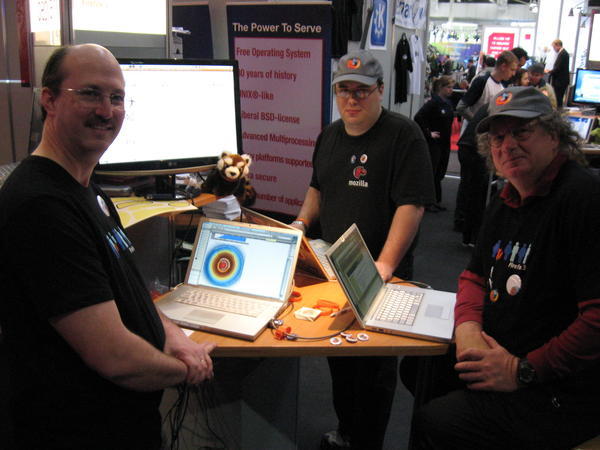 Tim Riley, Carsten Book and Chris Hofmann of Mozilla.
According to Riley, Mozilla's director of quality assurance, the browser project puts a great value on testing: "Everyone checking code into Firefox's version control has to deliver the matching tests." In the spirit of continuous integration, an automatic build system constantly pumps out current versions of the code, resulting in around 100,000 test cases. The full-time 17-member QA team is supplemented with about 10,000 community testers that install nightly builds every morning. Not to speak of millions of beta testers.
Next to HTML and JavaScript, the tests also involve C++, says Riley, and his team uses a whole arsenal of Open Source tools such as Mochikit, Buildbot, Mozmill and Selenium.
The two Americans manning the Mozilla booth along with their German colleague Carsten Book are excited about the active interest among visitors and the exchange with other projects. "Also, there are many more inquiries about Thunderbird here than in the U.S.," remarked Hofmann, "Apparently e-mail isn't so much dominated here by Microsoft." The Mozilla team is located in the Open Source Lounge in Hall 6 of CeBIT.
Subscribe to our Linux Newsletters
Find Linux and Open Source Jobs
Subscribe to our ADMIN Newsletters
Digital Autonomy
• How the Fediverse Found Parts for Its Platforms
• The Answer Was Already on the Shelf
• Changing the Chip Industry: How Public Investment Has Grown Open Silicon
• United Nations Open Source Portal Goes Live
• EU Open Source Strategy Plays Key Role in Tech Sovereignty Package
• France Says “Au Revoir” to Microsoft
Support Our Work
Linux Magazine content is made possible with support from readers like you. Please consider contributing when you’ve found an article to be beneficial.

News
-
Is Linus Torvalds Vibe Coding?
The creator of Linux has added AI into his process for Linux kernel development, and it's more than just for debugging.
-
openKylin 3.0 Released with Expanded AI Integration
The latest release features a pre-installed AI agent to help perform tasks.
-
DigitalOcean Ends Open Source Credits Program
In a change that has surprised many open source developers, DigitalOcean has decided to sunset its Open Source Credits Program.
-
Office 365 Available for Testing on Linux via Bottles
Linux users can now test the official Office 365, thanks to Mirko Brombin's work on Bottles.
-
Dutch Government Turns to Open Source for Digital Sovereignty
Following in the footsteps of other European countries, the Netherlands is looking to increase its sovereign digital infrastructure with open source software.
-
Linux May Soon Work on Snapdragon X2-Based PCs
If you're thinking about buying a Snapdragon X2-based desktop or laptop, Linux may soon be an option.
-
KDE for People Initiative Calls for AI Ban in Plasma
A new community of KDE wants the project to adopt a strict no-AI policy for KDE Plasma.
-
KDE Sets Ambitious Goals for 2026 and Beyond
KDE Connect reveals the goals for the Linux desktop darling, with one of those goals long overdue.
-
It’s Time to Test Fedora 45 Beta
Fedora 45 beta has been released with updated Gnome, KDE Plasma, and kernel.
-
Ubuntu Stonking Stingray Gets Even Rustier
Ubuntu 26.10 has completed its migration to the Rust-based coreutils.