


Gartner Measures EU Web Platform Activities

The EU distinguishes itself by stressing cooperation and technical interoperability in the digital age through various online platforms. To measure its success, it contracted the Gartner market research firm to do a survey. The results are now available.
Gartner conducted the "Exchange Platforms Survey: User Experience and Expectations" at the end of February and has published the results. The market research firm, under contract from the European Commission, measured the success of three European webportals, Semic, OSOR and ePractice, as to the requirements and participation of users.
The researchers based their results on a questionnaire sent to 800 individuals in 65 countries. More than half (close to 500) were users of ePractice.eu, a community platform with the most users (3,000, compared to 600 for Semantic.eu and about 500 for OSOR). Practically the remaining responses were divided between Semantic and OSOR. Italy was the top respondent (about 100), followed by Spain, Germany and Belgium (at 60 respondents). Gartner concludes that these countries have the largest activity among the three platforms.
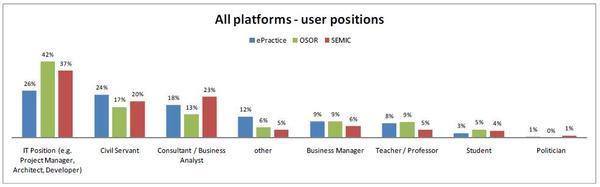 IT positions were at the top of the active users list for the ePractice, OSOR and Semic platforms. (Courtesy, Gartner)
The largest percentage of users come from IT. The EU can be happy that about half of the users are "ambassadors," that is, they often and gladly recommend the platforms. A slightly lesser percentage recommend their favorite platform only if there is real interest shown. Ease-of-use and mission criticality are therefore quite high among user perceptions. Some lack of agreement, however, surrounds whether the platforms could be merged. Some fear information overkill and confusion while others claim time-saving and scope expansion possibilities. Because the user population is high or at least increasing for all platforms, the EU consultants give them a green light for promotion and expanding content, usability, and Web 2.0 functionality.
The detailed Gartner survey results (at 75 pages) are available as a PDF from the OSOR.eu news website.
The Interoperability Solutions for European Public Administrations (ISA) program from the EU runs from 2010 through 2015 and focuses on back-office solutions for interaction between European public administrations or those that implement community policies and activities. ISA is the successor program to the IDABC that expired in 2009 and which brought the OSOR.eu information service to life. OSOR (Open Source Observatory and Repository) meanwhile has instituted an open source code-sharing platform, OSOR.eu Forge. Semic.eu (Semantic Interoperability Centre Europe) is an exchange platform for interoperable file formats, such as XML schemas that European agencies can use in common. The ePractice.eu platform, a professional community site for European web activists in the eGovernment, eInclusion and eHealth domains, has also helped the EU enter
Subscribe to our Linux Newsletters
Find Linux and Open Source Jobs
Subscribe to our ADMIN Newsletters
Digital Autonomy
• How the Fediverse Found Parts for Its Platforms
• The Answer Was Already on the Shelf
• Changing the Chip Industry: How Public Investment Has Grown Open Silicon
• United Nations Open Source Portal Goes Live
• EU Open Source Strategy Plays Key Role in Tech Sovereignty Package
• France Says “Au Revoir” to Microsoft
Support Our Work
Linux Magazine content is made possible with support from readers like you. Please consider contributing when you’ve found an article to be beneficial.

News
-
Linux Mint 27 Set for a Christmas Release
The developers behind Linux Mint have announced a Christmas release, and it looks like Santa's sack will be brimming with features.
-
Is Linus Torvalds Vibe Coding?
The creator of Linux has added AI into his process for Linux kernel development, and it's more than just for debugging.
-
openKylin 3.0 Released with Expanded AI Integration
The latest release features a pre-installed AI agent to help perform tasks.
-
DigitalOcean Ends Open Source Credits Program
In a change that has surprised many open source developers, DigitalOcean has decided to sunset its Open Source Credits Program.
-
Office 365 Available for Testing on Linux via Bottles
Linux users can now test the official Office 365, thanks to Mirko Brombin's work on Bottles.
-
Dutch Government Turns to Open Source for Digital Sovereignty
Following in the footsteps of other European countries, the Netherlands is looking to increase its sovereign digital infrastructure with open source software.
-
Linux May Soon Work on Snapdragon X2-Based PCs
If you're thinking about buying a Snapdragon X2-based desktop or laptop, Linux may soon be an option.
-
KDE for People Initiative Calls for AI Ban in Plasma
A new community of KDE wants the project to adopt a strict no-AI policy for KDE Plasma.
-
KDE Sets Ambitious Goals for 2026 and Beyond
KDE Connect reveals the goals for the Linux desktop darling, with one of those goals long overdue.
-
It’s Time to Test Fedora 45 Beta
Fedora 45 beta has been released with updated Gnome, KDE Plasma, and kernel.