


Gran Canaria: GNOME Zeitgeist Tracks What You've Done

"Where are the notes I took online while at the library Tuesday night?" A question such as this might be best answered by the likes of GNOME Zeitgeist.
At the GNOME Users' And Developers' European Conference (GUADEC) track at the Gran Canaria Desktop Summit on July 5, Federico Mena-Quintero, Seif Lotfy and Thorsten Prante presented their Zeitgeist project. The team was working on a new way to make users' files searchable based on their daily usage events and patterns.
Zeitgeist consists of an engine that logs events and an activity journal that presents the logged events as a GUI. While the Zeitgeist engine is logging (per systrace) which applications are running and which files or URLs they're opening, the journal viewer can show a user which document he was viewing while email from his mother came in Monday of last week.
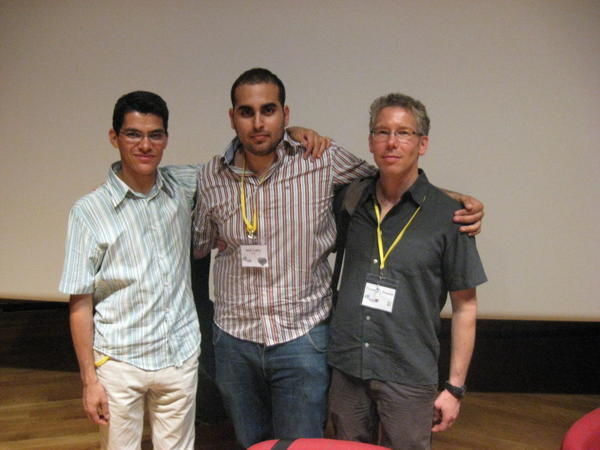 The Zeitgeist team l-t-r: Federico Mena-Quintero, Seif Lotfy and Thorsten Prante.
In this way the application can nudge your episodic memory to make event connections and organize your life. Zeitgeist's activity journal is the work of Seif Lotfy, currently a student at Darmstadt University. It shows user events based on date and time, and keeps track of the most commonly opened and collaborated upon files -- resulting in a semantic connection between the two.
Commonly occurring patterns can point to particular work activities. For example, opened source code together with an opened PDF and a bugtracker URL running in the browser can mean software development activity was going on. Thorsten Prante also indicated that Zeitgeist can pull external conditions into the equation. Next to time, GPS location can also be a consideration, so that a question such as "What file was I working on during the train ride from..." can be answered.
The Zeitgeist team clarified that their work isn't an index or desktop search such as Tracker or Beagle. Instead it simply tracks events and evaluates them. However, this doesn't mean that Zeitgeist events can't be combined with Tracker tags.
At the end of their presentation, the Zeitgeist team showed a particular application for their software: parental tracking. The software can close a child's browser or send a warning email to its parents based on detected usage events. While the use case provoked a mixed and even negative response from some, Seif Lotfy emphasized that it was only one of many possible Zeitgeist applications.
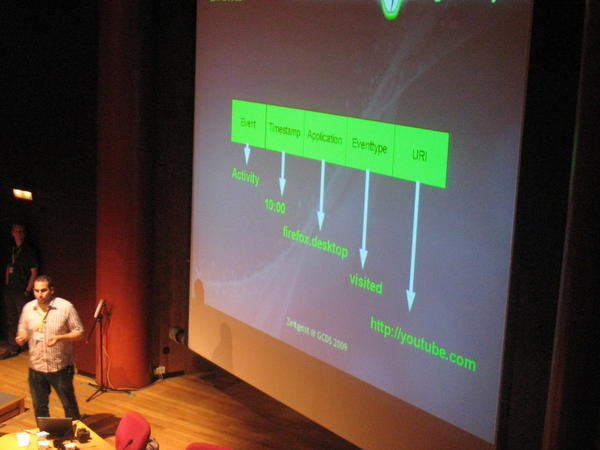 Zeitgeist at the conference: it tracks events such as programs started, files read and websites visited.
Subscribe to our Linux Newsletters
Find Linux and Open Source Jobs
Subscribe to our ADMIN Newsletters
Digital Autonomy
• How the Fediverse Found Parts for Its Platforms
• The Answer Was Already on the Shelf
• Changing the Chip Industry: How Public Investment Has Grown Open Silicon
• United Nations Open Source Portal Goes Live
• EU Open Source Strategy Plays Key Role in Tech Sovereignty Package
• France Says “Au Revoir” to Microsoft
Support Our Work
Linux Magazine content is made possible with support from readers like you. Please consider contributing when you’ve found an article to be beneficial.

News
-
PwnEscape Poses VM Vulnerability
A guest-to-host escape flaw in Linux KVM, named PwnEscape, might be yet another means of attacking Linux.
-
Linux Mint 27 Set for a Christmas Release
The developers behind Linux Mint have announced a Christmas release, and it looks like Santa's sack will be brimming with features.
-
Is Linus Torvalds Vibe Coding?
The creator of Linux has added AI into his process for Linux kernel development, and it's more than just for debugging.
-
openKylin 3.0 Released with Expanded AI Integration
The latest release features a pre-installed AI agent to help perform tasks.
-
DigitalOcean Ends Open Source Credits Program
In a change that has surprised many open source developers, DigitalOcean has decided to sunset its Open Source Credits Program.
-
Office 365 Available for Testing on Linux via Bottles
Linux users can now test the official Office 365, thanks to Mirko Brombin's work on Bottles.
-
Dutch Government Turns to Open Source for Digital Sovereignty
Following in the footsteps of other European countries, the Netherlands is looking to increase its sovereign digital infrastructure with open source software.
-
Linux May Soon Work on Snapdragon X2-Based PCs
If you're thinking about buying a Snapdragon X2-based desktop or laptop, Linux may soon be an option.
-
KDE for People Initiative Calls for AI Ban in Plasma
A new community of KDE wants the project to adopt a strict no-AI policy for KDE Plasma.
-
KDE Sets Ambitious Goals for 2026 and Beyond
KDE Connect reveals the goals for the Linux desktop darling, with one of those goals long overdue.