


Phenomenon Redux: AMD Phenom II in Linux Test

A recent Linux Community test compared the AMD Phenom X4 with a Turion X2 and Intel P9400. Meanwhile AMD has sent us its new Phenom II processor, prompting a new test. These are the latest benchmark results.
The Phenom II Z940 processor is officially clocked at 3 GHz, which the Linux Kernel 2.6.27 recognized, although /proc/cpuinfo reported the model itself as still unknown. The new Phenom can be lowered to as much as 800 MHz via speed-stepping. When idle, the CPU in our test system used up 65 watts of power, while its 2.2-GHz Phenom X4 9550 predecessor required about 75 watts.
The Phenom II footprint is indistinguishable from that of the Phenom I, so that it can also fit into the mainboard's AM2+ socket. The Phenom 9550's internal cache is 2 MBytes, while the Z940's is three times that at 6 MBytes. The Linux tests involved an Asus M3A78-EM mainboard with a 1-GByte main memory.
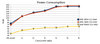
Our test used the same ffmpeg benchmark as before, whereby a script had to convert one, two, three, four, six and eight AVI files into H.264 format. Apart from speed, we also measured power consumption. The following graphs show the results.
The new quadcore CPU proved to be around 30% faster than its predecessor, but also clocked much higher. It went nose-to-nose with the Intel P9400 in processing speed until about two concurrent tasks, then sprinted ahead. Power usage, on the other hand, was somewhat less impressive.
The Phenom II might use somewhat less idling power than the 9550, but still considerably more than the Intel Core2. At full load the Z940 test system required almost 160 watts.
Conclusion
The new Phenom is clearly better than its predecessor. It uses less power when idling and still provides better performance. However, its higher purchase price brings it closer in line with the Intel CPU. Another advantage is its backward compatibility so that the CPU can fit on any current AM2+ boards. Even a couple of older AM2 boards can accommodate it after a BIOS update. As far as the competition, Intel is promising its own i7 test system in early February.
| Gallery (4 images) |
|---|

|
Comments
comments powered by DisqusSubscribe to our Linux Newsletters
Find Linux and Open Source Jobs
Subscribe to our ADMIN Newsletters
Digital Autonomy
• How the Fediverse Found Parts for Its Platforms
• The Answer Was Already on the Shelf
• Changing the Chip Industry: How Public Investment Has Grown Open Silicon
• United Nations Open Source Portal Goes Live
• EU Open Source Strategy Plays Key Role in Tech Sovereignty Package
• France Says “Au Revoir” to Microsoft
Support Our Work
Linux Magazine content is made possible with support from readers like you. Please consider contributing when you’ve found an article to be beneficial.

News
-
Office 365 Available for Testing on Linux via Bottles
Linux users can now test the official Office 365, thanks to Mirko Brombin's work on Bottles.
-
Dutch Government Turns to Open Source for Digital Sovereignty
Following in the footsteps of other European countries, the Netherlands is looking to increase its sovereign digital infrastructure with open source software.
-
Linux May Soon Work on Snapdragon X2-Based PCs
If you're thinking about buying a Snapdragon X2-based desktop or laptop, Linux may soon be an option.
-
KDE for People Initiative Calls for AI Ban in Plasma
A new community of KDE wants the project to adopt a strict no-AI policy for KDE Plasma.
-
KDE Sets Ambitious Goals for 2026 and Beyond
KDE Connect reveals the goals for the Linux desktop darling, with one of those goals long overdue.
-
It’s Time to Test Fedora 45 Beta
Fedora 45 beta has been released with updated Gnome, KDE Plasma, and kernel.
-
Ubuntu Stonking Stingray Gets Even Rustier
Ubuntu 26.10 has completed its migration to the Rust-based coreutils.
-
AI Fixes Linux Bottlenecks Using “Hideous” Code
A Linux developer used AI to fix bottlenecks that caused problems when building the kernel. The resulting AI-generated code needed a lot of work.
-
Advanced Video Coding Still Under Patent
Brazilian patent BRPI0109962B1 has expired, which means that DivX and Xvid are no longer problematic for Linux, but it doesn’t mean that video is all of a sudden fully unleashed.
-
2,000 Vulnerabilities per Linux Release
Thanks to AI bug hunters, the Linux kernel is seeing record numbers of vulnerabilities, and it's overwhelming developers.
Details
Question
Thanks for this article!
Could you please post details of your test system?
Was the power usage at idle (65W) meansured at AC outlet? Was the processor downclocked by cpufreq or it operated at full speed?
Thanks in advance!