


USENIX LISA: Security Theater Plays a Role - Bruce Schneier's Keynote

The opening keynote Thursday of the USENIX LISA conference in San Diego was by author and security expert Bruce Schneier. In his opinion "perceived security" should be an aspect of all security implementation.
The large conference room was packed at Schneier's presentation, "Reconceptualizing Security." In one of his first slides, he pointed out that security has always been one of the basic human instincts by showing the part of the brain known as the amygdala where the emotion of fear (and its opposite, security) is seated. Schneier joked that "the newer part of the human brain responsible for heuristics is still in beta." He undermined the discrepancy between subjective feelings and provable facts with a few examples. Deviating from his slides and presentation material, he relied mainly on his words and gestures. "Security is at one time feeling and reality," according to his thesis, "You can feel safe without actually being safe, and you can feel unsafe for no apparent reason."
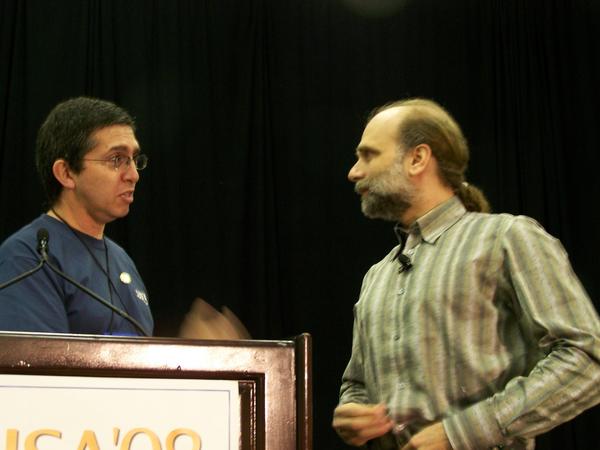 Mario Obejas congratulates Bruce Schneier on his keynote.
Schneier applied his thesis to a phenomenon he called "security theater." As an example he used the safety screw cap, designed to quell any fear that the content of the bottle might have been tampered with. He could think of at least ten ways that the content could be compromised, mentioning a syringe for one. Nevertheless, tamper-proof bottles provide an objective sense of security, which proved a saving grace for the medication industry after some well known poisoning incidents. Schneier felt that "as technicians, we kid ourselves that the security for which we're responsible is reliabable. That isn't true. We forget that humans play a major role."
Ignoring the emotional part of security is wrong in Schneier's judgment, and he advises technicians to incorporate the "security theater" concept in their work. Responding to a question about statistics, he suggested that they have little effect: "People who know statistics think they work better, but they don't." According to him, security models should adhere closely to reality, while recognizing that reality is mutable. His conclusion: "It's only when the feeling and the reality of security converge that we have real security."
Subscribe to our Linux Newsletters
Find Linux and Open Source Jobs
Subscribe to our ADMIN Newsletters
Digital Autonomy
• How the Fediverse Found Parts for Its Platforms
• The Answer Was Already on the Shelf
• Changing the Chip Industry: How Public Investment Has Grown Open Silicon
• United Nations Open Source Portal Goes Live
• EU Open Source Strategy Plays Key Role in Tech Sovereignty Package
• France Says “Au Revoir” to Microsoft
Support Our Work
Linux Magazine content is made possible with support from readers like you. Please consider contributing when you’ve found an article to be beneficial.

News
-
Bottlenecks Discovered by Meta Engineers Lead to Scalability Improvements
Thanks to a small group of engineers at Meta, the Linux kernel module kernfs has been improved, which has led to some serious gains.
-
PwnEscape Poses VM Vulnerability
A guest-to-host escape flaw in Linux KVM, named PwnEscape, might be yet another means of attacking Linux.
-
Linux Mint 27 Set for a Christmas Release
The developers behind Linux Mint have announced a Christmas release, and it looks like Santa's sack will be brimming with features.
-
Is Linus Torvalds Vibe Coding?
The creator of Linux has added AI into his process for Linux kernel development, and it's more than just for debugging.
-
openKylin 3.0 Released with Expanded AI Integration
The latest release features a pre-installed AI agent to help perform tasks.
-
DigitalOcean Ends Open Source Credits Program
In a change that has surprised many open source developers, DigitalOcean has decided to sunset its Open Source Credits Program.
-
Office 365 Available for Testing on Linux via Bottles
Linux users can now test the official Office 365, thanks to Mirko Brombin's work on Bottles.
-
Dutch Government Turns to Open Source for Digital Sovereignty
Following in the footsteps of other European countries, the Netherlands is looking to increase its sovereign digital infrastructure with open source software.
-
Linux May Soon Work on Snapdragon X2-Based PCs
If you're thinking about buying a Snapdragon X2-based desktop or laptop, Linux may soon be an option.
-
KDE for People Initiative Calls for AI Ban in Plasma
A new community of KDE wants the project to adopt a strict no-AI policy for KDE Plasma.