


Coming to life

Beagleblog
There are several options for running a Linux system on the BeagleBoard. The most common is the Angstrom distribution, alternatives include an Android port by the Embinux company, a custom Ubuntu, and maybe more I don't even know of. I'll go with Angstrom for now, others distributions will have to wait.
The BeagleBoard has a card reader slot that can read SD and SDHC cards, so I am getting an 8GB SDHC card to store the Linux system. Conveniently, you can just prepare the flash card with your Linux PC – provided you have a working card reader.
Installing Angstrom is not a big deal; the only challenge is to partition the SD card appropriately. I just followed the tutorial on http://code.google.com/p/beagleboard/wiki/LinuxBootDiskFormat and everything worked out. According to the tutorial, you need to set some low-level parameters you might know from BIOS settings for your hard drive, such as cylinders and read/write heads (which don't really exist with a flash card). One FAT partition is for booting the system, another Ext3 partition will contain the Linux system.
When you are done partitioning, you need to copy the boot files into the FAT partition and un-tar Angstrom to the Linux filesystem. The web page http://code.google.com/p/beagleboard/wiki/HowToGetAngstromRunning lists the actual commands. I did not need to update the BeagleBoard firmware as the page proposes because it was already up to date on my hardware. So after unpacking the files, you just need to configure the boot loader.
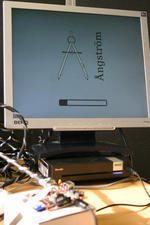
Putting the SD card into the slot on the BeagleBoard and plugging the (USB) power in will immediately show the bootloader screen, followed by the well-known Linux boot messages. If you have a monitor attached to the board via an HDMI/DVI cable, you will see a graphical boot screen, too. Connecting mouse and keyboard via a USB hub will make the BeagleBoard an almost fully functional graphical terminal – you just don't have a network connection.
Subscribe to our Linux Newsletters
Find Linux and Open Source Jobs
Subscribe to our ADMIN Newsletters
Support Our Work
Linux Magazine content is made possible with support from readers like you. Please consider contributing when you’ve found an article to be beneficial.

News
-
New Linux Flaw Lets Attackers Escape VMs
A 16-year-old vulnerability allows an attacker to escape a virtual machine, gain access to the host, and execute malicious code.
-
Hannah Montana Linux Is Back!
Developer Noah Cagle decided the world needed the once obscure but beloved Linux distribution and gave it a decidedly pink refresh.
-
System76 Refreshes the Lemur Laptop
If you're looking for a laptop with tons of power and battery, look no further than the latest iteration of the System76 Lemur Pro.
-
More than 43 Million Lines of Code in Linux Kernel 7.2
Using the cloc utility, Michael Larabel of Phoronix discovered that Linux kernel 7.2 has over 43 million lines of code.
-
Kubuntu Focus Goes Ultra
The Kubuntu Focus team has upped the performance ante of its M2 and Zr laptops with the latest, greatest CPUs from Intel.
-
Linux Gamers May Soon See Less Mouse Lag in KDE Plasma
Gamers using KDE’s Plasma desktop have been suffering from a slight input delay in mouse movement that could lead to getting fragged.
-
Three Lines of Code Improve Linux Storage Performance
A developer changed three lines of code, giving Linux storage performance a 5% bump.
-
AUR Hit Again with Malicious Packages
Once again the Arch User Repository is plagued by a high volume of malicious packages.
-
Alpine Linux 3.24 Features Fresh Desktops and a Newer Kernel
If you're a fan of Alpine Linux, it's time to upgrade because the latest version has been released with KDE Plasma 6.6, Gnome 50, and Linux kernel 6.18 LTS.
-
EU Open Source Strategy Plays Key Role in Tech Sovereignty Package
Comprehensive measures adopted by the European Commission aim to reduce dependency on non-EU countries.