


LinuxTag 2009: Resource Management with OpenVZ

OpenVZ project leader Kir Kolyshkin clarified at LinuxTag 2009 that the software also lends itself to Linux resource management.
The facts are clear, Koyshkin said at the outset: every computer has but finite resources such as CPU time, memory, hard disk size and I/O, and network I/O. Administrators are interested in protecting these resources from DoS attacks so that they can continue providing QoS or simple processing.
The Linux kernel already provides resource management tools, said Kolyshkin: disk quotas, nice and renice, the real-time priority queue and limits on CPU time with ulimit -c. Ulimit alone controls 16 different parameters. However, Kolyshkin doesn't find this pallet to be enough. Some limits can't be set and the others are done so at login and can't subsequently be regulated. This is where Kolyshkin brought OpenVZ into the picture. The software allows creating multiple isolated userspace instances, called containers, on a single kernel. Webhosters, for example, could use these containers for their services. From a resource management viewpoint, containers are simply groups of processes.
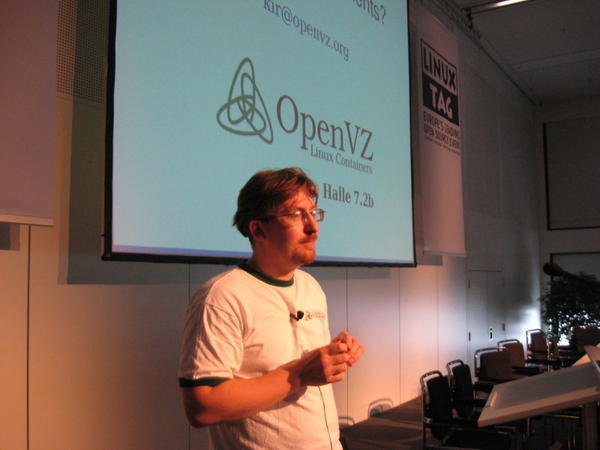 OpenVZ chief Kir Kolyshkin points out at LinuxTag 2009 how his container software can provide resource management.
OpenVZ brings its own resource control mechanisms, called beancounters, that have access to 20 parameters modifiable for process groups at runtime. These groups can be containers, users or applications. For example, the Apache 2 webserver has many processes that could more sensibly combined into application groups. OpenVZ categorizes these user beancounters (UBCs) on its wiki page.
Kolyshkin revealed that further mainline kernel control mechanisms are available through control groups (cgroups) developed over the years by the big iron folks at Bull and SGI. Paul Menage was responsible for bringing cgroups into the Linux kernel for grouping processes for binding memory controllers. Cgroups, however, don't offer as many features as OpenVZ's beancounters, although Kolyshkin wishes for future OpenVZ features such as shared pages accounting, I/O priorities per cgroup and checkpoint/recreate. The latter freezes the state of a group and is used by container or virtualization software such as OpenVZ and Xen for live migration. Further details are in the /usr/src/linux/Documentation/cgroups/* and /controllers/* directories of the kernel source code.
Kolyshkin would love to see the OpenVZ container features integrated into the mainline kernel, but that will "take years." But he's thinking of the future: integration of checkpoint/recreate in the official Linux kernel.
Subscribe to our Linux Newsletters
Find Linux and Open Source Jobs
Subscribe to our ADMIN Newsletters
Support Our Work
Linux Magazine content is made possible with support from readers like you. Please consider contributing when you’ve found an article to be beneficial.

News
-
Canonical Releases Ubuntu 24.04
After a brief pause because of the XZ vulnerability, Ubuntu 24.04 is now available for install.
-
Linux Servers Targeted by Akira Ransomware
A group of bad actors who have already extorted $42 million have their sights set on the Linux platform.
-
TUXEDO Computers Unveils Linux Laptop Featuring AMD Ryzen CPU
This latest release is the first laptop to include the new CPU from Ryzen and Linux preinstalled.
-
XZ Gets the All-Clear
The back door xz vulnerability has been officially reverted for Fedora 40 and versions 38 and 39 were never affected.
-
Canonical Collaborates with Qualcomm on New Venture
This new joint effort is geared toward bringing Ubuntu and Ubuntu Core to Qualcomm-powered devices.
-
Kodi 21.0 Open-Source Entertainment Hub Released
After a year of development, the award-winning Kodi cross-platform, media center software is now available with many new additions and improvements.
-
Linux Usage Increases in Two Key Areas
If market share is your thing, you'll be happy to know that Linux is on the rise in two areas that, if they keep climbing, could have serious meaning for Linux's future.
-
Vulnerability Discovered in xz Libraries
An urgent alert for Fedora 40 has been posted and users should pay attention.
-
Canonical Bumps LTS Support to 12 years
If you're worried that your Ubuntu LTS release won't be supported long enough to last, Canonical has a surprise for you in the form of 12 years of security coverage.
-
Fedora 40 Beta Released Soon
With the official release of Fedora 40 coming in April, it's almost time to download the beta and see what's new.