


OLAT

CeBIT Open Source 2011 - Project Presentation OLAT
ByDuring CeBIT 2011 open source projects such as OLAT, online learning and training management system, will have the opportunity to showcase what is currently in active development.
Short and sweet: How would you describe your project in one or two sentences?

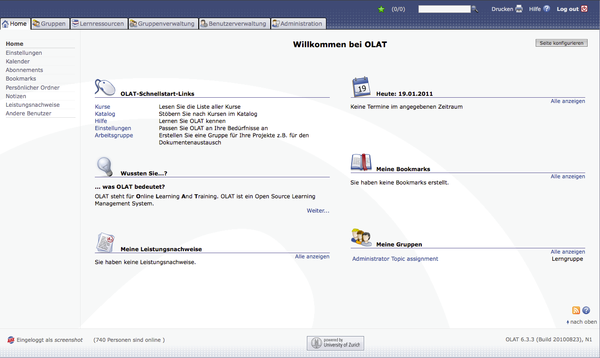
OLAT is an open source Learning Management System offering a flexible online course system along with extensive features to guarantee learning and teaching independent of time and place. It has been created especially for public institutions such as universities, academies or colleges, however, it is also suitable for other businesses since OLAT can easily represent any didactic concept or be used in any kind of learning environment.
When did the project begin?
In 1999, the Learning Management System (LMS) OLAT – an acronym for 'Online Learning And Training' – was originated at the University of Zurich. Since 2004 OLAT is the strategic LMS at the University of Zurich and Open Source.Q. How many active members does the project have?
80 active members, of which about 30 do contribute substantially code.
Why was the project created?
Three tutors at the Institute of computer science at the University of Zurich wanted to support their courses electronically and decided to develop their own solution due to a lack of suitable offers. What began as a student project, became a success story. Over the years, thus a powerful tool was created, not only at its place of origin, but also worldwide.
Why should a CeBIT visitor come to your booth?
Thanks to its course-based architecture OLAT offers a learning environment in accordance with established teaching methods. Piling up files or transparencies can be confusing–OLAT on the contrary provides you with plenty of possibilities to prepare and structure your learning content, to test your students’ knowledge, and to support them during their training. Even social skills can be exercised by using various group tools to enable synchronous as well as asynchronous cooperation. Its Java-based software architecture offers the highest level of security as regards operations and the system’s access. At the same time this technology with its well-structured, coherent source code allows for much flexibility as to its further development. Since version 6.x OLAT relies on scalability and can afford a large amount of users by employing a cluster containing multiple servers.
Who do you make your software for?
It has been created especially for public institutions such as universities, academies or colleges, but it is also suitable for other businesses.
Where do you see your biggest current challenges?
Missing plugin structure for the modular development. Appropriate redevelopment is already underway.
Under which license is the software currently offered?
Apache 2.0 Open Source License
Internet address: http://www.olat.org
Subscribe to our Linux Newsletters
Find Linux and Open Source Jobs
Subscribe to our ADMIN Newsletters
Digital Autonomy
• The Answer Was Already on the Shelf
• Changing the Chip Industry: How Public Investment Has Grown Open Silicon
• United Nations Open Source Portal Goes Live
• EU Open Source Strategy Plays Key Role in Tech Sovereignty Package
• France Says “Au Revoir” to Microsoft
Support Our Work
Linux Magazine content is made possible with support from readers like you. Please consider contributing when you’ve found an article to be beneficial.

News
-
Roll Out the Cake: Linux Turns 35
35 years ago, a Finnish student began a humble project that would forever change the course of technology.
-
China Switching from Windows to Linux
China has ordered several government agencies to drop a Chinese-developed version of Windows 10 in favor of either KylinOS or UOS.
-
Pine64 Halts Production of Linux Devices
With continued DRAM and eMMC shortages, Pine64 has decided to discontinue production of Linux devices.
-
The Bullet-Proof KDE Software Initiative Is Coming
KDE, Techpaladin, and Kubuntu Focus have announced a new initiative that will provide at least three years of support for KDE Plasma 6.6 LTS and related software.
-
Linux Mint Shares a Possible Kernel Cleanup Solution
For those on Linux Mint who like to keep multiple kernels around but don't want them to take up too much space, you might be getting a new automated tool.
-
CachyOS Gets an Update
CachyOS August 2026 release is now available with the latest version of KDE, some new features, and plenty of improvements.
-
The Linux Kernel Dev Staging Area Now Rejects AI-Generated Patches
Unless a kernel patch is a valid security fix, it will be rejected if it was created using AI.
-
Linux Surpasses Double-Digit Market Share
According to two sources, the Linux operating system has hit a major milestone in market share that naysayers thought would never happen.
-
AI Helped Develop a Linux Exploit
A use-after-free race exploit was discovered and exploited on CentOS Stream 9.
-
Yet Another Linux Kernel Vulnerability Discovered
Affecting millions of systems, a kernel flaw discovered by Qualys could allow users to gain root privileges.