


Issue 99 Feb 2009
Buy this issue as a PDF
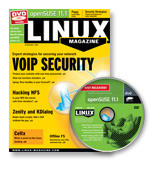
Cover Theme: VoIP Security
DVD Theme: openSUSE 11.1
Article Code
This month we investigate expert techniques for securing your VoIP and wireless networks. We describe how to use one-time passwords to add two-factor authentication to a website, and we look at security testing with hping. Other articles dig into Puppy Linux, Minux 3, Zenity and KDialog, Offline FS, spam blacklists, NFS 3, the Cell architecture, Celtx authoring software, and Firefox extensions.
Issue 98 Jan 2009
Buy this issue as a PDF
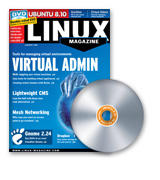
Cover Theme: Virtual Admin
DVD Theme: Ubuntu 8.10
Article Code
So you already know about Xen – what now? Do you have the tools you need to stay ahead of your virtual environment? This month we explore some expert apps for deploying and managing virtual networks. We'll explain how MLN lets you set up virtual machines with a few easy commands, you'll learn how to create your own virtual appliances with VMware Studio and SUSE Studio, and we'll tell you how to build high-performance virtual clusters with Rocks.
Other articles in this issue examine lightweight CMS tools, Gnome 2.24, X2Go, Avant Window Navigator, Gwibber, GIMP 2.6, Dropbox, and more.
Issue 109 Dec 2009

Buy this issue as a PDF
Cover Theme: ACCESS LINUX FROM A SMARTPHONE
DVD Theme: Ultimate Distro Sampler
Article Code
Portable and Mobile: Whether you tote a camera, a GPS device, a smartphone, or a netbook, you want to be functional outside the home and office. This month we study some Linux tools for portable and mobile environments:
- Smartphone VNC: Keep in touch with your laptop from your iPhone, iPod Touch, or other mobile device.
- Open Atrium: Marcel Gagné looks at this “intranet in a box,” which facilitates group communication and collaboration and makes the server your newest mobile app.
- Maemo: The Qt toolkit for Maemo lets you build apps with GUIs, I/O, and networking for smartphones and Internet tablets.
Additional articles in the December issue include:
- acpid: Hal Pomeranz explains how you can customize your laptop by programming your own hot key hacks with the ACPI daemon.
- Jolicloud: Your netbook needs a different desktop metaphor; check out Jolicloud.
- Moblin: This alternative desktop is customized for the Intel Atom processor.
- ExtSQL: Get detailed usage statistics for MySQL and PostgreSQL databases.
- Miredo: Move from IPv4 to IPv6 through a Miredo tunnel.
- Security Lessons: Sniff your network with Wireshark.
- OpenVAS: An open source network vulnerability scanner.
- Perl – Log Chat Sessions: Let this tricky bot keep an eye on your IRC.
- gPhoto: Remotely control digital cameras.
- Prune: The data in your GPS device is just begging you to Prune it.
- OpenOffice Macros: Compose and publish your blog from OpenOffice.org.
- Yum: Master this RPM package manager.
- Moodle CMS: The Moodle course management system is every teacher's friend.
- Event Reports: Reports from Ohio Linux Fest, LinuxCon 2009, and the Grace Hopper conference.
Issue 108 Nov 2009
Buy this issue as a PDF
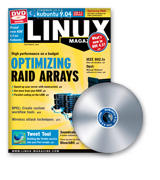
Cover Theme: OPTIMIZING RAID ARRAYS
DVD Theme: KDE 4.3 & Kubuntu 9.04
Article Code
Sheer power alone doesn't guarantee better performance. The more you ask of your systems, the more you'll need these strategies to optimize and improve performance:
- RAID Optimization: Find out how to improve performance up to 20% by using the right parameters when you configure the filesystems on your RAID devices.
- memcached: Reduce the load on web database servers by as much as 90% with the use of memcached.
- LAM/MPI: If you're looking for a stable and practical platform for building high-performance apps, take a look at the open source implementation of the Message-Passing Interface (MPI) standard.
Other articles in the November issue include:
- KDE 4.3: We make the new KDE 4.3 update jump through a few hoops to show you how well this third major update of KDE 4 performs.
- IEEE 802.1X: This standard isn't just for wireless. We show you how to set up a network access control system on a wired network with the help of a FreeRADIUS server.
- Ask Klaus! Knoppix creator Klaus Knopper answers your Linux questions.
- RoundCube: Our sys admin expert, Charly, looks at this Web 2.0 web mailer.
- Security Lessons: Kurt shows sys admins how to keep on top of their wireless security by knowing how the bad guys operate.
- Opsi: Take care of the Windows machines on your network with the use of Linux software distribution methods.
- BleachBit: Clean up your overflowing logfiles so you can find the information you really want to see.
- BPEL: Don't continually rewrite your custom scripts as your business processes evolve. Use open source tools to implement the BPEL standard and create a manageable workflow management system.
- Perl – Twitter: The Perlmeister uses Twitter in an unorthodox way to keep tabs on his automated irrigation system.
- Pauker Flash Card System: Rote memorization is never fun, but this tool can take away some of the pain.
- PivotX: This user-friendly and extendable blogging engine can store data in either a plain text file or a MySQL database and offers a nifty administration GUI.
- ResourceSpace: Organize all your digital collections from a single user interface with this digital asset manager.
- apt-get: Watch dependency tangles fall away with the Debian package management system.
- Projects: A look at the free Gluon library and a proposed new sound recording app for Gnome.
- Doghouse: Jon 'maddog' Hall explains the difference between "free" and "gratis."
- Community: The annual Linux Beer Hike strikes again, and Jono Bacon reports on OpenSource World.
Issue 107 Oct 2009

Buy this issue as a PDF
Cover Theme: SPEED UP YOUR WEB SERVER
DVD Theme: SLAMPP 2.0 LIVE
Article Code
Are your customers tapping their pencils? In today's competitive web environment, milliseconds make a difference. This month we explore some options for leaner and faster websites – with or without Apache:
- Fast Web Servers: We look at some lean and fast web server alternatives. And if you really want to stick with Apache, we have some tips for tuning up and getting organized.
- Hiawatha: This lean web server alternative delivers good performance and comes with some helpful security features.
- Nginx: This little workhorse serves up some high-profile websites – we get you starting with Nginx on your own network.
- Apache Tuning Tips: We show you some simple strategies for dialing up the performance on your Apache web server.
- Server Side Includes: We help you get organized with Server Side Includes.
Other articles in the October issue include:
- Python 3: Find out what's new in the latest Python release.
- rTorrent Download Box: Put your old PC to work as a dedicated download system.
- Clonezilla: Clone partitions and hard disks with this useful backup tool.
- OpenKubus: This innovative project helps you build your own authentication token.
- Resettable Lab Accounts: Let your lab users play, then reset the account with a simple reboot.
- Ask Klaus! Knoppix creator Klaus Knopper answers your Linux questions.
- Httptunnel: Work around firewalls.
- Security Lessons: The future of security updates.
- Webmin: A handy GUI for managing servers.
- Perl – Sharpen Images: The Perlmeister looks at a Perl plugin for GIMP.
- Picard: Manage your music collection with this handy tag editor.
- Zotero: Turn Firefox into a research tool with this sensible extension.
- Adobe AIR for Linux: Run Flash apps on the desktop.
- Command Line – Bash Bootcamp: Get back to the fundamentals with a look at some Bash basics.
- OSCON: Mike Schilli reports from O'Reilly's Open Source Conference 2009.
- Projects: A look at Open PC and Robocode.
- Doghouse: Jon 'maddog' Hall looks at future-proofing your business.
Issue 106 Sep 2009
Buy this issue as a PDF
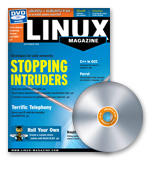
Cover Theme: STOPPING INTRUDERS
DVD Theme: UBUNTU AND KUBUNTU 9.04
Article Code
Understanding intrusion techniques is half the battle. The other half is having the right tools. This month we study some popular attack methods and show you some tools for spotting and stopping break ins:
- Intrusion 101: Security columnist Kurt Seifried offers an inside look at the art of intrusion.
- Security Visualization Tools: Handy tools help you find signs of suspicious activity.
- LIDS: The Linux Intrusion Detection System keeps intruders from escalating privileges.
Other articles in the September 2009 issue include:
- MacPorts and Fink: Learn about the effort to bring free software to Mac OS.
- Ask Klaus! Knoppix creator Klaus Knopper answers your Linux questions.
- eBox: The eBox tool provides DNS, DHCP, and web services in one convenient package
- XRandR: This X extension helps you set up a projector or dual-monitor system.
- Slowloris: Slowing down a web server with Slowloris.
- FreeSWITCH: Build your own home PBX.
- Perl – GitHub: The Perlmeister spins a tool for managing source code.
- C++: New features of the C++ standard and what they mean for GCC.
- Parrot: Use this cool tool to compile Perl, Ruby, and other dynamic languages.
- JavE: A new-age approach to old-fashioned ASCII art.
- Slax: Build your own distro with Slax.
- OpenGoo: Get productive with this smart collaboration suite.
- Command Line: View files with cat, more, less, head, and tail.
- KnjOn: Learn about an innovative effort to shut down spam sites.
- Doghouse: Columnist and blogger Jon 'maddog' Hall looks at how to go from hacker to programmer.
Issue 105 Aug 2009
Buy this issue as a PDF
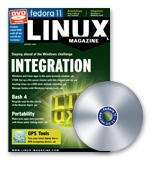
Cover Theme: Integration
DVD Theme: Fedora 11
Article Code
Windows Integration: Heterogeneous environments pose special problems. This month we present some tools to help you navigate the troubled waters of interoperability, including Ulteo OVD, a QEMU virtualization tool, and Samba.
- Ulteo OVD: Your Linux and Windows apps can meet in a single browser window.
- QEMU and Qemu Manager: We'll show you a trick for starting up Linux on a Windows PC without rebooting.
- Samba for Clusters: You'll learn how Samba's new CTDB add-on brings clustering and high availability to your file server configuration.
- Samba's Registry: Find out how a new back end stores Samba configuration data in an internal registry database.
Other articles in this issue include:
- UNetbootin: This handy tool lets you create your own bootable USB stick.
- GpsDrive and tangoGPS: Turn your Linux system into a GPS navigation tool.
- Ermine vs. Statifier: Static linking lets you move your apps to any distro, without worrying about dependencies.
- SpiderOak: Back up your data and keep it in sync across multiple machines.
- TTYtter: Charly tweets with a command-line Twitter client.
- Security Lessons - Backups: Save your data with smart backups.
- Bash 4: The latest Bash release offers some powerful new scripting features.
- Practical strace: Part two in this series explores debugging in the real world.
- Perl - Google Chart: Charting netbook battery performance.
- ActivityDiary: Create a digital workout diary.
- Tonido: Collaborate in a local cloud.
- Kexi: Manage data the easy way with KDE's Kexi database tool.
- Command Line - System Info: System information utilities.
Issue 104 Jul 2009

Buy this issue as a PDF
Cover Theme: Device Tricks
DVD Theme: Debian 5.0.1 "Lenny" & Mandriva Linux 2009.1
Article Code
Linux is getting much better at handling devices. This month we examine some recent developments in driver management and explore a few interesting innovations from the mysterious region where the system meets the hardware:
- State of Linux Drivers: Jon Masters describes some recent initiatives within the Linux community to address the problem of driver updates.
- MTP on Linux: The open source libmtp library provides support for MTP multimedia devices.
-
Aufs2: Klaus Knopper explains how to add temporary write capability to a read-
only device with the aufs stacked filesystem. - Encrypting USB Sticks: What would happen if your USB stick fell into unfriendly hands? We show you how to encrypt your data.
Plus you'll find articles on:
- Ebook Readers: Free ebooks are popping up all over the web. Why not turn your netbook into an ebook reader? We help you get started with the free ebook reader applications FBReader, GutenPy, and Calibre.
- Mozilla Weave: Synchronize bookmarks and other critical browsing settings among multiple machines with Mozilla Weave for Firefox.
- Bootchart: Help your system boot faster with this powerful analysis tool.
- PDF Import with OOo: Import and edit PDFs in OpenOffice.
- Charly’s Column – HAProxy: Charly spotlights the “Unknown Stuntman” of load balancers.
- Security Lessons – Tunneling: Move data under the radar.
- Building a Munin Plugin: If you want the perfect plugin to capture and graph network data, you might need to roll your own.
- Microblogs in OpenOffice: Manage deadlines and microblogs.
- Command Line: Customizing Bash
- XMind Mind Mapper: Structure your ideas with XMind.
- Makagiga: Desktop for the desktop.
- and much more!
Issue 103 Jun 2009

Buy this issue as a PDF
Cover Theme: Tuning Virtual Machines
DVD Theme: SUSE Linux Enterprise Desktop 11
Article Code
The server space is changing, and if you plan on taking up residence in the new data center, you better have your toolkit ready. This month we explore some techniques for fitting in with data center environments.
We take a closer look at the fundamental challenge of improving performance in a virtual environment, and we examine some programming techniques that take advantage of cloud computing’s scalability and flexibility. Learn about the PelicanHPC Live CD, which helps you transform your mild-mannered desktop network into a number-crunching super computer, and find out about NagVis, the Nagios add-on that lets you create custom maps to visualize your network.
In the June 2009 issue, you'll learn about:
- GLPI: This web-based app provides inventory management, job tracking, and basic network information.
- Xoops: Learn why this lean and lively content management system might be all you need.
- Strace: Is your homegrown app a little buggy? Debug faster with strace.
- Ask Klaus! Knoppix creator Klaus Knopper answers your Linux questions.
- Serendipity: The Serendipity blog engine is an effective tool for quick web design.
- Security Lessons: OSSEC – Monitor and block attacks.
- Portsmith: Authenticate at the firewall and let users enable ports in their browsers.
- Boo: Mono’s Boo brings Python-like syntax to .NET.
- Perl: USB Subsystem Perl power a toy USB canon.
- Yum Package Manager Get started with yum.
- Workspace: Openoffice.org Base – Creating a custom database.
- Command line: Terminal Magic – Bruce Byfield on the command line.
- and much more!
Issue 102 May 2009
Buy this issue as a PDF
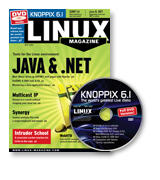
Cover Theme: JAVA & .NET
DVD Theme: Knoppix 6.1
Article Code
This month we look at the Java and .NET frameworks in Linux. We start with DotGNU and Mod_Mono, then we round up some Java Virtual Machine tools to show you how to monitor a Java application server with Hyperic HQ.
Other articles in this issue examine GIMP 2.6, FreeIPA, Multicast IP, Fsniper, Zim, Chandler, Agedu, WebHTB, NicTool, Samba4Wins, and more.
Issue 101 Apr 2009

Buy this issue as a PDF
Cover Theme: Network Management
DVD Theme: Linux Mint 6 "Felicia" Universal Version
Article Code
This month we examine some popular open source tools for deploying, configuring, updating, and monitoring software and systems on the network. The tools in this issue are great for enterprise and small-scale networks. We examine Cfengine 3, Bcfg2, and Zenoss. Other articles in this issue look at netbook-friendly Linux distros, Honeynet, Jokosher, JClic, Osmo PIM, Ratproxy, Dnsmasq, Chaos Communication Congress, command-line tools, reviews, news, and more.
Issue 100 Mar 2009
Buy this issue as a PDF
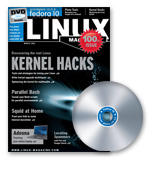
Cover Theme: Kernel Hacks
DVD Theme: Fedora 10/Slackware 12.2
Article Code
In honor of our 100th issue, we focus on tools for tuning and tailoring the Linux kernel. We'll show you some useful performance tuning tricks, tips for building and upgrading the Linux kernel, and how to improve audio and video performance by compiling your own media-optimized kernel with the help of free source code. Other articles look at media centers, filtering content with Squid, deploying Debian with Fully Automatic Installation, and much more. Also, we present the 2009 Open Source horoscope!
Subscribe to our Linux Newsletters
Find Linux and Open Source Jobs
Subscribe to our ADMIN Newsletters
Support Our Work
Linux Magazine content is made possible with support from readers like you. Please consider contributing when you’ve found an article to be beneficial.

News
-
Linux kernel Developers Considering a Kill Switch
With the rise of Linux vulnerabilities, the kernel developers are now considering adding a component that could help temporarily mitigate against them… in the form of a kill switch.
-
Fedora 44 Now Gaming Ready
The latest version of Fedora has been released with gaming support.
-
Manjaro 26.1 Preview Unveils New Features
The latest Manjaro 26.1 preview has been released with new desktop versions, a new kernel, and more.
-
Microsoft Issues Warning About Linux Vulnerability
The company behind Windows has released information about a flaw that affects millions of Linux systems.
-
Is AI Coming to Your Ubuntu Desktop?
According to the VP of Engineering at Canonical, AI could soon be added to the Ubuntu desktop distribution.
-
Framework Laptop 13 Pro Competes with the Best
Framework has released what might be considered the MacBook of Linux devices.
-
The Latest CachyOS Features Supercharged Kernel
The latest release of CachyOS brings with it an enhanced version of the latest Linux kernel.
-
Kernel 7.0 Is a Bit More Rusty
Linux kernel 7.0 has been released for general availability, with Rust finally getting its due.
-
France Says "Au Revoir" to Microsoft
In a move that should surprise no one, France announced plans to reduce its reliance on US technology, and Microsoft Windows is the first to get the boot.
-
CIQ Releases Compatibility Catalog for Rocky Linux
The company behind Rocky Linux is making an open catalog available to developers, hobbyists, and other contributors, so they can verify and publish compatibility with the CIQ lineup.