


Build a coin counter from particleboard and a Pi Pico

Feed the Meter

© Lead Image © Andrey Burmakin, 123RF.com
Parking meters and vending machines detect and count the coins you insert, but how do they work? We'll show you how to mimic the functionality with some particleboard, a Raspberry Pi Pico, a few extra chips, and some Python code.
Counting coins is a problem that was solved decades ago, but I was wondering whether I could come up with a solution of my own. While I may not have the same set of sophisticated tools that a parking meter manufacturer has, it should certainly be possible to create an electronic coin counter using just a Raspberry Pi Pico and some common components. Writing software that can count is trivial, but how do you detect what type of coin was inserted? If you assume that only legal US coins will be used, the easiest way to recognize them is by measuring their diameter. Table 1 lists the diameters of US coins, both in millimeters and in inches [1].
I decided to sort the coins using different sized slots. The coins roll down a small ramp and pass several cut-out slots. If the coin is the correct size, it falls through the slot. The required width of the slot depends on how fast the coin is rolling past whereas the height of the slot needs to be slightly larger than the actual coin while still being smaller than the next largest coin. In my case, the slots were approximately twice the width of the coin (see Figure 1).
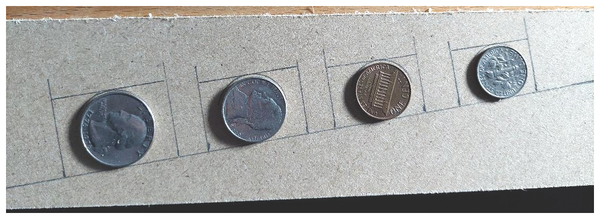 Figure 1: Each coin slot needs the right height and width so that coins will fall through the correct slots.
[...]
Buy this article as PDF
(incl. VAT)
Buy Linux Magazine
Subscribe to our Linux Newsletters
Find Linux and Open Source Jobs
Subscribe to our ADMIN Newsletters
Support Our Work
Linux Magazine content is made possible with support from readers like you. Please consider contributing when you’ve found an article to be beneficial.

News
-
Substantial Update to IPFire Now Available
The lastest version of IPFire features a fundamental change to how the system handles DNS.
-
Gnome Working on Test Center App to Make Testing Easier
It's now possible to test experimental features on the Gnome desktop without worrying that you'll break things.
-
New Vulnerability Discovered in Linux Kernel
Hiding out for nearly 15 years, the Ghostlock vulnerability allows a standard logged-in user to gain root privileges.
-
New Linux Flaw Lets Attackers Escape VMs
A 16-year-old vulnerability allows an attacker to escape a virtual machine, gain access to the host, and execute malicious code.
-
Hannah Montana Linux Is Back!
Developer Noah Cagle decided the world needed the once obscure but beloved Linux distribution and gave it a decidedly pink refresh.
-
System76 Refreshes the Lemur Laptop
If you're looking for a laptop with tons of power and battery, look no further than the latest iteration of the System76 Lemur Pro.
-
More than 43 Million Lines of Code in Linux Kernel 7.2
Using the cloc utility, Michael Larabel of Phoronix discovered that Linux kernel 7.2 has over 43 million lines of code.
-
Kubuntu Focus Goes Ultra
The Kubuntu Focus team has upped the performance ante of its M2 and Zr laptops with the latest, greatest CPUs from Intel.
-
Linux Gamers May Soon See Less Mouse Lag in KDE Plasma
Gamers using KDE’s Plasma desktop have been suffering from a slight input delay in mouse movement that could lead to getting fragged.
-
Three Lines of Code Improve Linux Storage Performance
A developer changed three lines of code, giving Linux storage performance a 5% bump.