


Command Line Little Helper: CLI Companion

Productivity Sauce
Whether you are a command line newbie or a proficient terminal user, you'll probably appreciate CLI Companion. This nifty little tool couples the terminal with a database of frequently-used commands. So if you need to execute a specific command, you don't have to type it manually and remember all its parameters. Instead, select the command from the list and hit the Apply button.
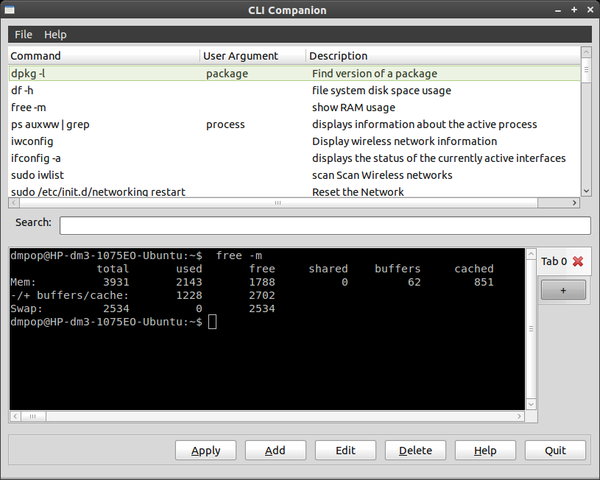
CLI Companion comes with a comprehensive list of commands, and you can easily add your own commands to the database. To do this, press the Add button, enter the command in the Command field, and provide an optional description in the Description field. If the command requires user input, specify it in the User Input field. Press OK to save the new entry in the database. By default, custom commands are added at the end of the list, but what if you want to move them at the top? CLI Companion doesn't offer any tools for rearranging entries in the database, there is a simple workaround for this. CLI Companion stores all commands in the ~/.clicompanion text file. Open it in your favorite text editor, and rearrange the commands in the list to your liking.
CLI Companion also provides a handy search feature which can help you to quickly find the command you need. Simply enter the command you want to find in the Search field, and the utility automatically narrows the result as you type.
The CLI Companion project page at Launchpad provides a .deb binary package for Ubuntu and its derivatives. Alternatively, you can add the CLI Companion's PPA and install the utility from it using the following commands:
sudo add-apt-repository ppa:clicompanion-devs/clicompanion-nightlies
sudo apt-get update
sudo apt-get install clicompanion
Comments
comments powered by DisqusSubscribe to our Linux Newsletters
Find Linux and Open Source Jobs
Subscribe to our ADMIN Newsletters
Digital Autonomy
• How the Fediverse Found Parts for Its Platforms
• The Answer Was Already on the Shelf
• Changing the Chip Industry: How Public Investment Has Grown Open Silicon
• United Nations Open Source Portal Goes Live
• EU Open Source Strategy Plays Key Role in Tech Sovereignty Package
• France Says “Au Revoir” to Microsoft
Support Our Work
Linux Magazine content is made possible with support from readers like you. Please consider contributing when you’ve found an article to be beneficial.

News
-
Office 365 Available for Testing on Linux via Bottles
Linux users can now test the official Office 365, thanks to Mirko Brombin's work on Bottles.
-
Dutch Government Turns to Open Source for Digital Sovereignty
Following in the footsteps of European countries, the Netherlands is looking to increase its sovereign digital infrastructure with open source software.
-
Linux May Soon Work on Snapdragon X2-Based PCs
If you're thinking about buying a Snapdragon X2-based desktop or laptop, Linux may soon be an option.
-
KDE for People Initiative Calls for AI Ban in Plasma
A new community of KDE wants the project to adopt a strict no-AI policy for KDE Plasma.
-
KDE Sets Ambitious Goals for 2026 and Beyond
KDE Connect reveals the goals for the Linux desktop darling, with one of those goals long overdue.
-
It’s Time to Test Fedora 45 Beta
Fedora 45 beta has been released with updated Gnome, KDE Plasma, and kernel.
-
Ubuntu Stonking Stingray Gets Even Rustier
Ubuntu 26.10 has completed its migration to the Rust-based coreutils.
-
AI Fixes Linux Bottlenecks Using “Hideous” Code
A Linux developer used AI to fix bottlenecks that caused problems when building the kernel. The resulting AI-generated code needed a lot of work.
-
Advanced Video Coding Still Under Patent
Brazilian patent BRPI0109962B1 has expired, which means that DivX and Xvid are no longer problematic for Linux, but it doesn’t mean that video is all of a sudden fully unleashed.
-
2,000 Vulnerabilities per Linux Release
Thanks to AI bug hunters, the Linux kernel is seeing record numbers of vulnerabilities, and it's overwhelming developers.
Other Solution
export PROMPT_COMMAND='history -a;echo -ne "\033]0;${USER}@${HOSTNAME%%.*}:${PWD/$HOME/~}\007"'
export HISTSIZE=500000
CLIcompanion -- more explanation might be helpful
"tasks" that you routinely accomplish with those commands. Often, these tasks are performed at a low frequency and so that associated command often requires re-invention. Features that enable one to store those commands once configured and recall them when needed at a future time, make one's like easier in many ways. I encourage the authors of CLI-Companion to add features to augment shell history features with "helpers". When when tries a new command, CLI-Companion might remember what was tried before and guide the end-user with prompts or questions accompanied with suggestions for suitable command verbs and associated options.
While this article is an informative piece about the existence of CLI-Companion, it might be more valuable if it contained at least one good example of effective use of this interesting tool.
~~~8d;-Dan