


Five Useful Extensions for OpenOffice.org

Productivity Sauce
Want to expand OpenOffice.org's default functionality? The official extension repository has quite a few extensions you can use to add some nifty features to the productivity suite. Precisely which extensions you might find useful depends, of course, on your particular needs, but there are at least five extensions that deserve a closer look no matter how you use OpenOffice.org.
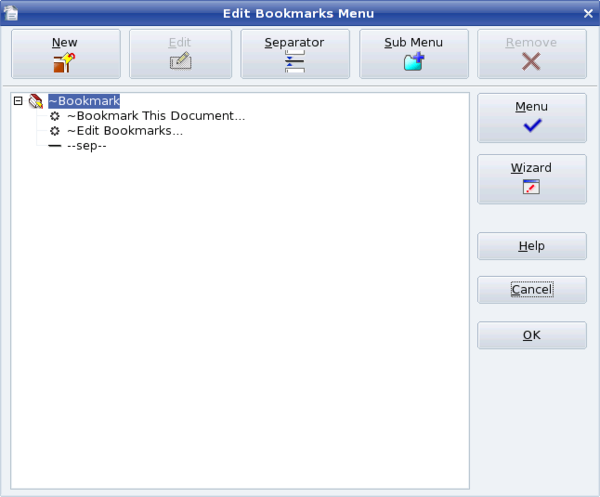
The Bookmarks Menu extension adds the ability to bookmark frequently used documents, so you can open them in a few clicks instead of wading through directories. Better yet, the extension allows you to bookmark directories, macros, and even external applications. Using the latter, you can, for example, create a bookmark to the Firefox browser and specify an URL to open. This way you can open the Web page you want directly from within OpenOffice.org using just a single mouse click. The Bookmarks Menu extension has been covered in greater detail in issue 94 of Linux Magazine.
Maybe one day you'll all be doing our daily computing in the cloud but until that day comes, the OpenOffice.org2GoogleDocs extension provides a bridge between OpenOffice.org and Web-based productivity suites like Google Docs and Zoho. As a bonus, the extension also works with WebDAV servers. With OpenOffice.org2GoogleDocs, you can get the best of both worlds. You can use Google Docs or Zoho to quickly create documents and easily share them with other users. And for more advanced word processing you can import and edit documents in OpenOffice.org. Even if you don't fancy using the Web-based applications, you can still use the extension to quickly create off-site backup of your OpenOffice.org documents.
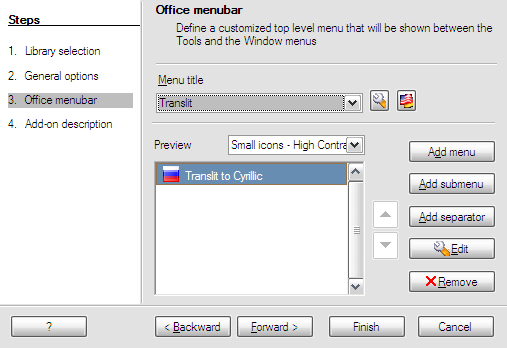
So you've created a nifty OpenOffice.org Basic macro and want to share it with the world? The best way to do this is to turn it into an extension, and the BasicAddOnBuilder tool allows you to create ready-to-use .oxt packages with consummate ease. The extension adds a separate toolbar containing a single button; press it, and a wizard guides you through the entire process of creating an extension. Most of the wizard's options are self-explanatory, so you can turn a macro into a full-blown extension in no time.
While applying syntax highlighting to programming code fragments in a document can make them look better and easier to read, coloring code blocks manually is a rather daunting proposition. Fortunately, the COOoder extension can take this burden off your shoulders and apply syntax highlighting automatically. All you have to do is to select the code block in the document, run COOoder, and choose the appropriate programming language. COOoder can handle all programming languages supported by the GeSHi syntax highlighter.
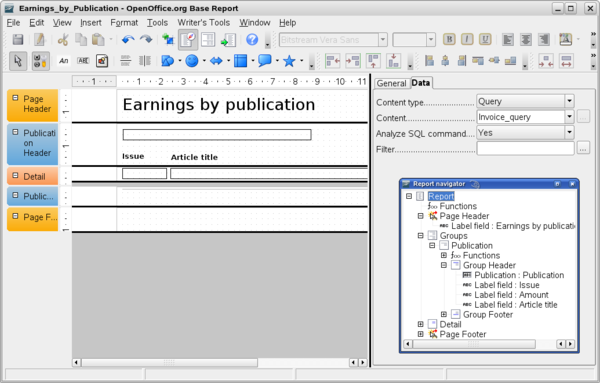
OpenOffice.org Base is a rather competent database application, but when it comes to generating reports, the built-in reporting capabilities don't really cut it. The Sun Report Builder extension adds a powerful engine which allows you to create rather advanced reports. Report Builder's graphical tools allow you to create complex report layouts using drag-and-drop. You can also specify functions to manipulate data as well as create calculated fields, and conditional printing expressions. The latest release of Sun Report Builder also comes with charting capabilities.
comments powered by DisqusSubscribe to our Linux Newsletters
Find Linux and Open Source Jobs
Subscribe to our ADMIN Newsletters
Digital Autonomy
• How the Fediverse Found Parts for Its Platforms
• The Answer Was Already on the Shelf
• Changing the Chip Industry: How Public Investment Has Grown Open Silicon
• United Nations Open Source Portal Goes Live
• EU Open Source Strategy Plays Key Role in Tech Sovereignty Package
• France Says “Au Revoir” to Microsoft
Support Our Work
Linux Magazine content is made possible with support from readers like you. Please consider contributing when you’ve found an article to be beneficial.

News
-
Office 365 Available for Testing on Linux via Bottles
Linux users can now test the official Office 365, thanks to Mirko Brombin's work on Bottles.
-
Dutch Government Turns to Open Source for Digital Sovereignty
Following in the footsteps of other European countries, the Netherlands is looking to increase its sovereign digital infrastructure with open source software.
-
Linux May Soon Work on Snapdragon X2-Based PCs
If you're thinking about buying a Snapdragon X2-based desktop or laptop, Linux may soon be an option.
-
KDE for People Initiative Calls for AI Ban in Plasma
A new community of KDE wants the project to adopt a strict no-AI policy for KDE Plasma.
-
KDE Sets Ambitious Goals for 2026 and Beyond
KDE Connect reveals the goals for the Linux desktop darling, with one of those goals long overdue.
-
It’s Time to Test Fedora 45 Beta
Fedora 45 beta has been released with updated Gnome, KDE Plasma, and kernel.
-
Ubuntu Stonking Stingray Gets Even Rustier
Ubuntu 26.10 has completed its migration to the Rust-based coreutils.
-
AI Fixes Linux Bottlenecks Using “Hideous” Code
A Linux developer used AI to fix bottlenecks that caused problems when building the kernel. The resulting AI-generated code needed a lot of work.
-
Advanced Video Coding Still Under Patent
Brazilian patent BRPI0109962B1 has expired, which means that DivX and Xvid are no longer problematic for Linux, but it doesn’t mean that video is all of a sudden fully unleashed.
-
2,000 Vulnerabilities per Linux Release
Thanks to AI bug hunters, the Linux kernel is seeing record numbers of vulnerabilities, and it's overwhelming developers.