


Intel Atom Platform: Smaller, More Energy-Efficient

Intel's reworked Atom platform enhances netbooks and Internet devices with integrated graphics and memory controller.
With its usual focus on optimization, the chip vendor now provides the Atom 45-nanometer processor, with minimal energy consumption and better performance. Intel claims a 20% reduction in power consumption over Atom's predecessor. Integrated graphics and memory management for the first time in a CPU do the rest and allow for a smaller form factor. Said differently, the memory controller eliminates one of three chips, with only the CPU and chipset remaining. Intel claims this translates to a 60% smaller footprint for netbooks and mobile Internet devices.
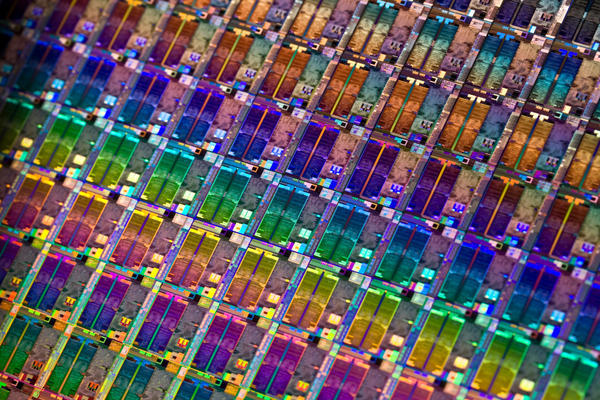 The smaller the die, the more fits on the wafer, as in the N450 chip, code-named Pine Trail.
The new platform for netbooks consists of the N450 processor and the low-power NM10 Express chipset. Vendors building entry-level desktops have recourse to the Atom D410 or dual-core D510 processor using the same chipset.
The most energy-efficient of the three, the N450, provides a core with 512 KBytes L2 cache. Intel gives a benchmark for power consumption of a thermal design power (TDP) of 7 watts for the total package including chipset. The single-core D410 also provides the 512-KByte L2 cache, with a 12-watt TDP. The dual-processor D510 has 1 MByte L2 cache with a 15-watt TDP. All chips have the 1.66-GHz processor frequency in common. Prices should be available in January. Further details on the new chip microarchitecture are on Intel's technology webpage.
 Die for the new N450.
Subscribe to our Linux Newsletters
Find Linux and Open Source Jobs
Subscribe to our ADMIN Newsletters
Digital Autonomy
• How the Fediverse Found Parts for Its Platforms
• The Answer Was Already on the Shelf
• Changing the Chip Industry: How Public Investment Has Grown Open Silicon
• United Nations Open Source Portal Goes Live
• EU Open Source Strategy Plays Key Role in Tech Sovereignty Package
• France Says “Au Revoir” to Microsoft
Support Our Work
Linux Magazine content is made possible with support from readers like you. Please consider contributing when you’ve found an article to be beneficial.

News
-
Fedora 45 Now Available
The latest iteration of Fedora has arrived with Gnome 51 and KDE Plasma 6.8.
-
Linux 7.4 is "Much Healthier" Thanks to AI
At nearly 42 million lines, Linux 7.4 is the largest merge in the kernel’s history.
-
Working Exploit for a Linux Kernel Flaw Made Public
Even before a bug received its CVE identifier or an upstream fix, the local privilege escalation vulnerability exploit found its way into the wild.
-
r/opensource Bans AI-Assisted and AI-Related Projects
The de facto subreddit for all things open source has not only banned AI-related projects but also users who "don't speak English."
-
Bottlenecks Discovered by Meta Engineers Lead to Scalability Improvements
Thanks to a small group of engineers at Meta, the Linux kernel module kernfs has been improved, which has led to some serious gains.
-
PwnEscape Poses VM Vulnerability
A guest-to-host escape flaw in Linux KVM, named PwnEscape, might be yet another means of attacking Linux.
-
Linux Mint 27 Set for a Christmas Release
The developers behind Linux Mint have announced a Christmas release, and it looks like Santa's sack will be brimming with features.
-
Is Linus Torvalds Vibe Coding?
The creator of Linux has added AI into his process for Linux kernel development, and it's more than just for debugging.
-
openKylin 3.0 Released with Expanded AI Integration
The latest release features a pre-installed AI agent to help perform tasks.
-
DigitalOcean Ends Open Source Credits Program
In a change that has surprised many open source developers, DigitalOcean has decided to sunset its Open Source Credits Program.