


Q3 2009: Blade Servers and x86 Leading Server Market

With a 1.2% growth, blade servers are leading all others in the market segment that may have made strides in the past. But the IDC research firm sees light at the end of the tunnel: since the bleak period that ended 2008, the revenue curve for the worldwide server market is trending upwards again.
Compared with 2008, the worldwide revenue for the server market declined 17.3% in the third quarter of 2009 to $10.4 billion, which makes the fifth consecutive quarter of a downturn. Server unit shipments fell by almost 18% year over year. Volume shipments fell by almost 15%, with midrange enterprise server revenue falling by more than 23%.
IDC emphasizes, however, that the negative trend in revenue and unit shipments is only half as bad as it was in 2Q09. The second quarter showed a decline of a little over 30%. The market research firm rates the Q3 figures in comparatively positive terms: revenue grew for the first time since 4Q08 and server shipments increased by 12.4% year over year, "the largest sequential unit growth since 2005."
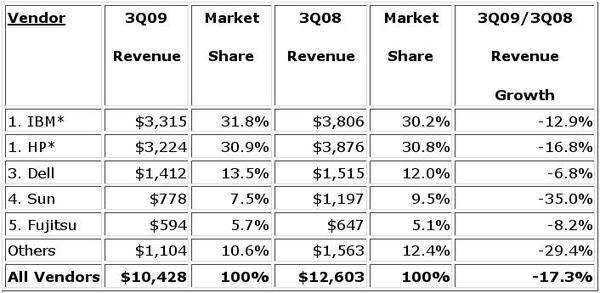 Vendor ranking in 3Q09: IBM slides a whisper ahead of HP since 2008 and Sun is hit comparatively the worst. (Source: IDC)
Linux servers grew in market share year over year by not quite one percent to 14.8%, with $1.5 billion total revenue among vendors and distributors. The increase was $200 million over the previous quarter, but still almost 13% less than 3Q08. In comparison, the UNIX server revenue came to $2.8 billion, a slight decline since Q2 and more than a 23% cut year over year, representing a market share of just under 27%. The largest revenue share came from Windows machines in 3Q09, with $4.5 billion, but with a similar year-over-year decline at just under 13% as the Linux servers.
IDC found that the x86 processor platform factory revenues grew by 18.7% from quarter to quarter, but still showed a drop of 12.3% year over year. The only growth factor seemed to be the blade server market: compared to last year, factory revenue actually grew by 1.2%, even though shipments declined by 14%. The results show a revenue growth for three quarters in a row, with blade servers the top growth market over the last six months. IDC attributes the blade server success to cost efficiencies due to next generation processors (Intel Nehalem) and increased RAM. Customers use blade servers for new, virtualized environments, considering them "closely associated technologies" and a driving force in the data center of the future.
Subscribe to our Linux Newsletters
Find Linux and Open Source Jobs
Subscribe to our ADMIN Newsletters
Digital Autonomy
• The Answer Was Already on the Shelf
• Changing the Chip Industry: How Public Investment Has Grown Open Silicon
• United Nations Open Source Portal Goes Live
• EU Open Source Strategy Plays Key Role in Tech Sovereignty Package
• France Says “Au Revoir” to Microsoft
Support Our Work
Linux Magazine content is made possible with support from readers like you. Please consider contributing when you’ve found an article to be beneficial.

News
-
KDE for People Initiative Calls for AI Ban in Plasma
A new community of KDE wants the project to adopt a strict no-AI policy for KDE Plasma.
-
KDE Sets Ambitious Goals for 2026 and Beyond
KDE Connect reveals the goals for the Linux desktop darling, with one of those goals long overdue.
-
It’s Time to Test Fedora 45 Beta
Fedora 45 beta has been released with updated Gnome, KDE Plasma, and kernel.
-
Ubuntu Stonking Stingray Gets Even Rustier
Ubuntu 26.10 has completed its migration to the Rust-based coreutils.
-
AI Fixes Linux Bottlenecks Using “Hideous” Code
A Linux developer used AI to fix bottlenecks that caused problems when building the kernel. The resulting AI-generated code needed a lot of work.
-
Advanced Video Coding Still Under Patent
Brazilian patent BRPI0109962B1 has expired, which means that DivX and Xvid are no longer problematic for Linux, but it doesn’t mean that video is all of a sudden fully unleashed.
-
2,000 Vulnerabilities per Linux Release
Thanks to AI bug hunters, the Linux kernel is seeing record numbers of vulnerabilities, and it's overwhelming developers.
-
Linux Exempt from California’s Age Verification Law
So long as Linux is distributed under the GPL, MIT, BSD, and Apache licenses, the OS is exempt from being required to verify the age of its users in California.
-
Roll Out the Cake: Linux Turns 35
35 years ago, a Finnish student began a humble project that would forever change the course of technology.
-
China Switching from Windows to Linux
China has ordered several government agencies to drop a Chinese-developed version of Windows 10 in favor of either KylinOS or UOS.