


One Storage and Two Quadcore Blades from Sun

Sun Microsystems has dropped three new Linux servers on the market: a storage module with 1.2 TBytes, a blade module with two AMD Opteron Quadcores and a blade server with two Intel Xeon Quadcores. A photo gallery shows them in detail.
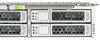
The new Disk Module is touted by Sun as the first open storage blade machine. The provider markets this series as individually configurable storage devices with open source, adaptable software. The Blade 6000 holds eight serial attached SCSI (SAS) disk drives ranging from 73 to 146 Gbytes capacity that store about 1.2 TBytes of data. The SAS controller protects RAID 0, 1 and 2 levels. The storage server runs on Solaris 10 and Windows 2003/2008, but also on 64-bit RHEL 4.6 and 5.1 and SUSE Linux Enterprise Server (SLES) 10 as well as VMware 3.0.2 and 3.5.
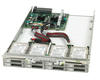
The Blade X6240 Server supports up to 16 DIMM slots at 667 MHz with two- or four-Gbyte capacity. Up to two AMD Opteron Quadcore processors provide 512 Kbytes of L2 cache per CPU and yet another 2 MBytes of shared L3 cache. CPU energy consumption is a choice of 55W, 75W or 105W apiece. Two Base-T Ethernet ports bind to the external network and a 10/100 Base-T port to the management network. This Sun server offers a 32-bit RHEL 4.6 only. Like the Disk Module it also runs on 64-bit Solaris 10, Windows 2003/2008, 64-bit RHEL 5.1 and 64-bit SLES 9 and 10, along with the VMware ESX Server 3.5 alternative.
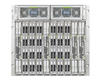
The Sun CP3250 Blade Server with Intel on board contains up to eight CPU cores with the Xeon LGA771 ATCA. A 12-Mbyte cache, an up to 24-Gbyte main memory consisting of six DIMM sockets, and a slot for type CF-2 Flash work together as memory.
The U.S. price list has the Blade 6000 module at around $1,600, the AMD Blade X6240 module at round $2,600 and the Intel CP3250 module at about $7,000. The webpages give contact information.
| Gallery (9 images) |
|---|
|
Subscribe to our Linux Newsletters
Find Linux and Open Source Jobs
Subscribe to our ADMIN Newsletters
Digital Autonomy
• How the Fediverse Found Parts for Its Platforms
• The Answer Was Already on the Shelf
• Changing the Chip Industry: How Public Investment Has Grown Open Silicon
• United Nations Open Source Portal Goes Live
• EU Open Source Strategy Plays Key Role in Tech Sovereignty Package
• France Says “Au Revoir” to Microsoft
Support Our Work
Linux Magazine content is made possible with support from readers like you. Please consider contributing when you’ve found an article to be beneficial.

News
-
openKylin 3.0 Released with Expanded AI Integration
The latest release features a pre-installed AI agent to help perform tasks.
-
DigitalOcean Ends Open Source Credits Program
In a change that has surprised many open source developers, DigitalOcean has decided to sunset its Open Source Credits Program.
-
Office 365 Available for Testing on Linux via Bottles
Linux users can now test the official Office 365, thanks to Mirko Brombin's work on Bottles.
-
Dutch Government Turns to Open Source for Digital Sovereignty
Following in the footsteps of other European countries, the Netherlands is looking to increase its sovereign digital infrastructure with open source software.
-
Linux May Soon Work on Snapdragon X2-Based PCs
If you're thinking about buying a Snapdragon X2-based desktop or laptop, Linux may soon be an option.
-
KDE for People Initiative Calls for AI Ban in Plasma
A new community of KDE wants the project to adopt a strict no-AI policy for KDE Plasma.
-
KDE Sets Ambitious Goals for 2026 and Beyond
KDE Connect reveals the goals for the Linux desktop darling, with one of those goals long overdue.
-
It’s Time to Test Fedora 45 Beta
Fedora 45 beta has been released with updated Gnome, KDE Plasma, and kernel.
-
Ubuntu Stonking Stingray Gets Even Rustier
Ubuntu 26.10 has completed its migration to the Rust-based coreutils.
-
AI Fixes Linux Bottlenecks Using “Hideous” Code
A Linux developer used AI to fix bottlenecks that caused problems when building the kernel. The resulting AI-generated code needed a lot of work.