


Reading driving data via the on-board diagnostic port

Programming Snapshot – Driving Data

© Lead Image © Rene Walter, 123rf.com
A connector plugged into the diagnostic port of Mike Schilli's cars sends current information such as speed, acceleration, and fuel economy via the mobile phone network to a cloud service. An app and a programmable API read out the data and provide stunning visualizations.
I find it absurd to invest half a year's salary on a new car. Instead of more expensive German craftsmanship, I opt for second-hand Japanese cars with screaming VTEC engines from the 1990s. Alas, this type of car won't get you the electronic bells and whistles nowadays commonly associated with the "connected car." In my adopted home of San Francisco, a startup company called Automatic has developed a connector to the car's on-board diagnostic (OBD) port [1] (Figure 1) that continually reads data from the car's on-board computer and feeds the data either to the driver's cell phone or straight to an account in the cloud via the 3G mobile network.
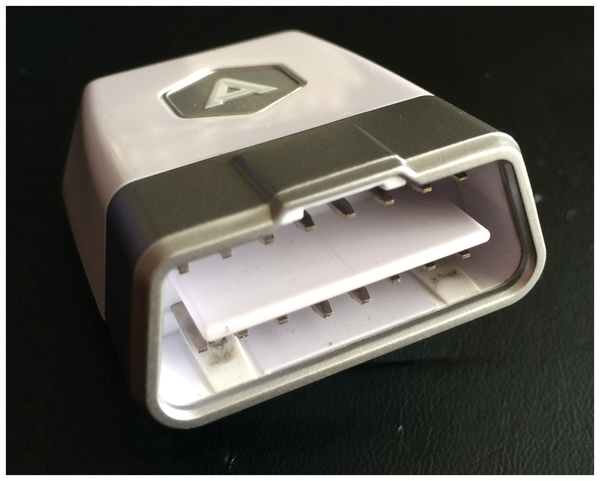 Figure 1: The Automatic adapter is plugged into the car's OBD-II port and wirelessly transmits the engine data over the 3G network.
The data is collated on Automatic's servers. From this data, the driver can then check out their driving route, how often they stepped on the gas like a madman or hit the brakes in the same way, how much gasoline the car consumed, and what the trip cost.
[...]
Buy this article as PDF
(incl. VAT)
Buy Linux Magazine
Subscribe to our Linux Newsletters
Find Linux and Open Source Jobs
Subscribe to our ADMIN Newsletters
Digital Autonomy
• How the Fediverse Found Parts for Its Platforms
• The Answer Was Already on the Shelf
• Changing the Chip Industry: How Public Investment Has Grown Open Silicon
• United Nations Open Source Portal Goes Live
• EU Open Source Strategy Plays Key Role in Tech Sovereignty Package
• France Says “Au Revoir” to Microsoft
Support Our Work
Linux Magazine content is made possible with support from readers like you. Please consider contributing when you’ve found an article to be beneficial.

News
-
Is Linus Torvalds Vibe Coding?
The creator of Linux has added AI into his process for Linux kernel development, and it's more than just for debugging.
-
openKylin 3.0 Released with Expanded AI Integration
The latest release features a pre-installed AI agent to help perform tasks.
-
DigitalOcean Ends Open Source Credits Program
In a change that has surprised many open source developers, DigitalOcean has decided to sunset its Open Source Credits Program.
-
Office 365 Available for Testing on Linux via Bottles
Linux users can now test the official Office 365, thanks to Mirko Brombin's work on Bottles.
-
Dutch Government Turns to Open Source for Digital Sovereignty
Following in the footsteps of other European countries, the Netherlands is looking to increase its sovereign digital infrastructure with open source software.
-
Linux May Soon Work on Snapdragon X2-Based PCs
If you're thinking about buying a Snapdragon X2-based desktop or laptop, Linux may soon be an option.
-
KDE for People Initiative Calls for AI Ban in Plasma
A new community of KDE wants the project to adopt a strict no-AI policy for KDE Plasma.
-
KDE Sets Ambitious Goals for 2026 and Beyond
KDE Connect reveals the goals for the Linux desktop darling, with one of those goals long overdue.
-
It’s Time to Test Fedora 45 Beta
Fedora 45 beta has been released with updated Gnome, KDE Plasma, and kernel.
-
Ubuntu Stonking Stingray Gets Even Rustier
Ubuntu 26.10 has completed its migration to the Rust-based coreutils.