


Run your Commodore emulators on a C64-lookalike PC

Keeping Up with the Commodore
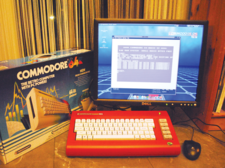
© Lead Image courtesy of Hans-Georg Eßer
The Commodore home computer is back with new hardware and software options, including a new Commodore 64 machine from the classic brand.
There have been many attempts to bring back the Commodore C64 or some machine that looks like it: You can get replacement mainboards that work in the original case, you can buy a THEC64 or its mini version from Retro Games Ltd, and there's also the MEGA65 project, which created a modern FPGA-based version of the Commodore C65 – a successor to the C64 that never reached the manufacturing stage. All those machines have one thing in common: Their main goal is to let you run original C64 programs, either with an emulator or with an FPGA-based re-implementation of the original hardware. The latest development is that Christian Simpson (known as PeriFractic on YouTube) has bought the Commodore brand and is partnering up with other groups to bring new and official Commodore products to market.
For those of you who only care about the look and the unique breadbox form factor of the C64, the Commodore 64x (with an extra "x") is a modern computer in a C64-like case with a keyboard that resembles the C64 keyboard while offering a layout that works with PC operating systems. That machine was originally available from 2011 to 2012, it came with its own Commodore-branded Linux, and it was revived in a Kickstarter campaign in 2022 [1]. My Retro Computer Ltd. is still offering a number of C64x configurations, including a bare-bones (case only, no mainboard) version. The website [2] links to mini-itx.com where prices range from £210 (~$279) for the empty case to £990 (~$1,1315) for the C64x Infinity with an AMD Ryzen 9 7940HS, 64GB RAM, and a 500GB M.2 SSD. A configurator lets you change the details.
In addition to the hardware, the 2011/2012 Linux distribution has also been updated: Commodore OS Vision 3.0 [3] is a lovingly customized version of MX Linux 23 (which itself is based on Debian GNU/Linux 12). While it is intended for use with the C64x machines, there's no stopping you from running it on any modern computer (or in a virtual machine). I'll look at the software first, because that's what everyone will have access to. Then in the second part of the article I'll talk about the C64x case and its keyboard.
[...]
Buy this article as PDF
(incl. VAT)
Buy Linux Magazine
Subscribe to our Linux Newsletters
Find Linux and Open Source Jobs
Subscribe to our ADMIN Newsletters
Digital Autonomy
• How the Fediverse Found Parts for Its Platforms
• The Answer Was Already on the Shelf
• Changing the Chip Industry: How Public Investment Has Grown Open Silicon
• United Nations Open Source Portal Goes Live
• EU Open Source Strategy Plays Key Role in Tech Sovereignty Package
• France Says “Au Revoir” to Microsoft
Support Our Work
Linux Magazine content is made possible with support from readers like you. Please consider contributing when you’ve found an article to be beneficial.

News
-
Bottlenecks Discovered by Meta Engineers Lead to Scalability Improvements
Thanks to a small group of engineers at Meta, the Linux kernel module kernfs has been improved, which has led to some serious gains.
-
PwnEscape Poses VM Vulnerability
A guest-to-host escape flaw in Linux KVM, named PwnEscape, might be yet another means of attacking Linux.
-
Linux Mint 27 Set for a Christmas Release
The developers behind Linux Mint have announced a Christmas release, and it looks like Santa's sack will be brimming with features.
-
Is Linus Torvalds Vibe Coding?
The creator of Linux has added AI into his process for Linux kernel development, and it's more than just for debugging.
-
openKylin 3.0 Released with Expanded AI Integration
The latest release features a pre-installed AI agent to help perform tasks.
-
DigitalOcean Ends Open Source Credits Program
In a change that has surprised many open source developers, DigitalOcean has decided to sunset its Open Source Credits Program.
-
Office 365 Available for Testing on Linux via Bottles
Linux users can now test the official Office 365, thanks to Mirko Brombin's work on Bottles.
-
Dutch Government Turns to Open Source for Digital Sovereignty
Following in the footsteps of other European countries, the Netherlands is looking to increase its sovereign digital infrastructure with open source software.
-
Linux May Soon Work on Snapdragon X2-Based PCs
If you're thinking about buying a Snapdragon X2-based desktop or laptop, Linux may soon be an option.
-
KDE for People Initiative Calls for AI Ban in Plasma
A new community of KDE wants the project to adopt a strict no-AI policy for KDE Plasma.