


Build a Portable Android-based Raspberry Pi Station

Productivity Sauce
Transforming a bare-bones Raspberry Pi into a fully-functional portable station is a popular pastime among enterprising users, and you can easily find instructions on how to build a Kindleberry Pi, a Kindleberry Wireless, and even a Raspberry Pi Linux laptop. But if you happen to use an Android device, you can opt for a less complicated and more modular solution devised by yours truly.
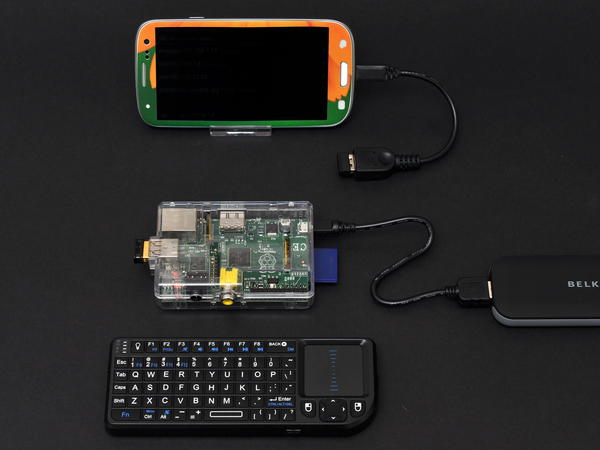
The Android device in this setup acts both as a wireless hotspot and a display for Raspberry Pi. The latter is configured to automatically connect to the Wi-Fi network created by the Android device. And an SSH client app (e.g., VX ConnectBot) running on the Android device is used to access Raspberry Pi via an SSH connection. Here is what you need for this project:
- Android device with wireless hotspot functionality
- An SSH client app like VX ConnectBox installed on the Android device
- OTG (On-The-Go) micro-USB cable (not required for use with a Bluetooth keyboard)
- Wireless mini keyboard with integrated touchpad like the one from Rii
- Wi-Fi USB dongle known to work with Raspberry Pi (e.g., Edimax EW-7811Un)
- Optional external battery pack for powering Raspbery Pi
Start with connecting the keyboard to the Android device using the OTG micro-USB cable. Alternatively, you can use a Bluetooth keyboard which eliminates the need for the cable and makes the entire setup even more elegant. Enable then the wireless hotspot feature. Configure Raspberry Pi to automatically connect to the wireless hotspot. You can do this using the graphical network configuration utility supplied with the Raspbian Linux distribution, or by editing network configuration files by hand. Once you've done that, Raspberry Pi should automatically connect to the wireless hotspot on every boot. On the Android device, find out Raspberry Pi's IP address, then use the SSH client app to establish an SSH connection to it. That's all there is to it. It's also possible to install a VNC server on Raspberry Pi and access its graphical desktop environment using a VNC client on the Android device.
comments powered by DisqusSubscribe to our Linux Newsletters
Find Linux and Open Source Jobs
Subscribe to our ADMIN Newsletters
Digital Autonomy
• The Answer Was Already on the Shelf
• Changing the Chip Industry: How Public Investment Has Grown Open Silicon
• United Nations Open Source Portal Goes Live
• EU Open Source Strategy Plays Key Role in Tech Sovereignty Package
• France Says “Au Revoir” to Microsoft
Support Our Work
Linux Magazine content is made possible with support from readers like you. Please consider contributing when you’ve found an article to be beneficial.

News
-
Dutch Government Turns to Open Source for Digital Sovereignty
Following in the footsteps of European countries, the Netherlands is looking to increase its sovereign digital infrastructure with open source software.
-
Linux May Soon Work on Snapdragon X2-Based PCs
If you're thinking about buying a Snapdragon X2-based desktop or laptop, Linux may soon be an option.
-
KDE for People Initiative Calls for AI Ban in Plasma
A new community of KDE wants the project to adopt a strict no-AI policy for KDE Plasma.
-
KDE Sets Ambitious Goals for 2026 and Beyond
KDE Connect reveals the goals for the Linux desktop darling, with one of those goals long overdue.
-
It’s Time to Test Fedora 45 Beta
Fedora 45 beta has been released with updated Gnome, KDE Plasma, and kernel.
-
Ubuntu Stonking Stingray Gets Even Rustier
Ubuntu 26.10 has completed its migration to the Rust-based coreutils.
-
AI Fixes Linux Bottlenecks Using “Hideous” Code
A Linux developer used AI to fix bottlenecks that caused problems when building the kernel. The resulting AI-generated code needed a lot of work.
-
Advanced Video Coding Still Under Patent
Brazilian patent BRPI0109962B1 has expired, which means that DivX and Xvid are no longer problematic for Linux, but it doesn’t mean that video is all of a sudden fully unleashed.
-
2,000 Vulnerabilities per Linux Release
Thanks to AI bug hunters, the Linux kernel is seeing record numbers of vulnerabilities, and it's overwhelming developers.
-
Linux Exempt from California’s Age Verification Law
So long as Linux is distributed under the GPL, MIT, BSD, and Apache licenses, the OS is exempt from being required to verify the age of its users in California.