


Instant Photo Sharing with Min.us

Productivity Sauce
Photo sharing services are a dime a dozen these days, but Min.us stands out from the crowd for two reasons. Firstly, it makes the process of sharing photos ridiculously simple. Secondly, it offers software for the Linux desktop and the Android platform, so you can share photos directly from your machine or mobile device.
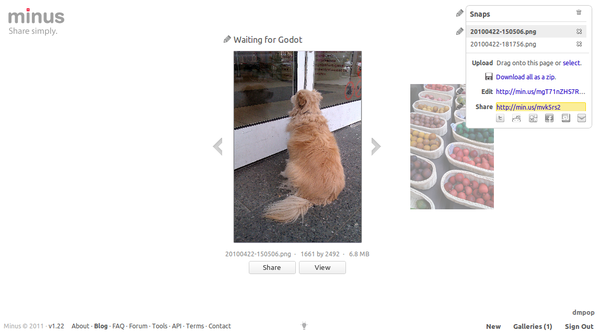
Sharing photos using Min.us is a one-step procedure. Point your browser to http://min.us and drag the photos you want to share onto the Web page. This automatically creates a new gallery and uploads the selected photos to it. That's all there is to it. Minus generates short URLs for each photo and the entire gallery which you can share via Twitter or Facebook.
If you want to upload photos to Minus without switching to the browser, you can use a simple Linux desktop applet. When you launch the applet on your desktop, it places an icon in the system tray. Drag the photos you want to upload onto the icon,and the applet takes care of the rest. Once the photos have been uploaded, you can see their short links in the applet's main window. The Min.us service also provides an Android app, so you can share mobile snaps taken with your Android device. The app lets you take a photo and share it with Min.us as well as share any existing photos stored on your device.
comments powered by DisqusSubscribe to our Linux Newsletters
Find Linux and Open Source Jobs
Subscribe to our ADMIN Newsletters
Digital Autonomy
• The Answer Was Already on the Shelf
• Changing the Chip Industry: How Public Investment Has Grown Open Silicon
• United Nations Open Source Portal Goes Live
• EU Open Source Strategy Plays Key Role in Tech Sovereignty Package
• France Says “Au Revoir” to Microsoft
Support Our Work
Linux Magazine content is made possible with support from readers like you. Please consider contributing when you’ve found an article to be beneficial.

News
-
It’s Time to Test Fedora 45 Beta
Fedora 45 beta has been released with updated Gnome, KDE Plasma, and kernel.
-
Ubuntu Stonking Stingray Gets Even Rustier
Ubuntu 26.10 has completed its migration to the Rust-based coreutils.
-
AI Fixes Linux Bottlenecks Using “Hideous” Code
A Linux developer used AI to fix bottlenecks that caused problems when building the kernel. The resulting AI-generated code needed a lot of work.
-
Advanced Video Coding Still Under Patent
Brazilian patent BRPI0109962B1 has expired, which means that DivX and Xvid are no longer problematic for Linux, but it doesn’t mean that video is all of a sudden fully unleashed.
-
2,000 Vulnerabilities per Linux Release
Thanks to AI bug hunters, the Linux kernel is seeing record numbers of vulnerabilities, and it's overwhelming developers.
-
Linux Exempt from California’s Age Verification Law
So long as Linux is distributed under the GPL, MIT, BSD, and Apache licenses, the OS is exempt from being required to verify the age of its users in California.
-
Roll Out the Cake: Linux Turns 35
35 years ago, a Finnish student began a humble project that would forever change the course of technology.
-
China Switching from Windows to Linux
China has ordered several government agencies to drop a Chinese-developed version of Windows 10 in favor of either KylinOS or UOS.
-
Pine64 Halts Production of Linux Devices
With continued DRAM and eMMC shortages, Pine64 has decided to discontinue production of Linux devices.
-
The Bullet-Proof KDE Software Initiative Is Coming
KDE, Techpaladin, and Kubuntu Focus have announced a new initiative that will provide at least three years of support for KDE Plasma 6.6 LTS and related software.