


BoZoN: Slick and Simple File Sharing Web App for Your Server

Productivity Sauce
When it comes to self-hosted file sharing web apps, you are spoiled for choice. But if you are looking for a simple and user-friendly app that is dead easy to deploy, you can do much worse than giving BoZoN a try. Written in PHP 5, BoZoN doesn't use any database back end and it has no dependencies. Deploying BoZoN on a server requires a few simple commands. Assuming that you have Git installed on the machine, switch to the document root of the web server, clone the project's GitHub repository, and make it writable by the server:
cd /var/www
git clone https://github.com/broncowdd/BoZoN.git bozon
chown www-data -R bozon/
Point then your browser to http://127.0.0.1/bozon/admin.php (replace 127.0.0.1 with the actual IP address or domain name of the server), and create a new account. Log in, and add the files you want to share by dropping them onto the upload area. To share an uploaded file, get the shared link by clicking on the appropriate icon, and send the link to the recipients. If you want to protect a file with a password, press the hamburger icon in the upper-left corner of BoZoN's main window to expand the sidebar and press the Manage Links button. Click then the Padlock icon next to the file you want to protect, and specify a password.
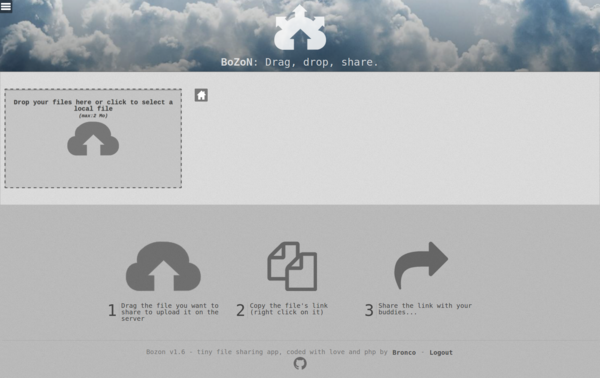
To keep tabs on the uploaded files, you can organize them into folders. To create a folder, enter the desired name into the Create a subfolder field in the sidebar and press OK. To move uploaded files into the created folder, press the Move file button in the sidebar and move the desired files. You can also upload files directly to a specific folder by first switching to it and then dragging files onto the upload area.
comments powered by DisqusSubscribe to our Linux Newsletters
Find Linux and Open Source Jobs
Subscribe to our ADMIN Newsletters
Digital Autonomy
• How the Fediverse Found Parts for Its Platforms
• The Answer Was Already on the Shelf
• Changing the Chip Industry: How Public Investment Has Grown Open Silicon
• United Nations Open Source Portal Goes Live
• EU Open Source Strategy Plays Key Role in Tech Sovereignty Package
• France Says “Au Revoir” to Microsoft
Support Our Work
Linux Magazine content is made possible with support from readers like you. Please consider contributing when you’ve found an article to be beneficial.

News
-
Office 365 Available for Testing on Linux via Bottles
Linux users can now test the official Office 365, thanks to Mirko Brombin's work on Bottles.
-
Dutch Government Turns to Open Source for Digital Sovereignty
Following in the footsteps of other European countries, the Netherlands is looking to increase its sovereign digital infrastructure with open source software.
-
Linux May Soon Work on Snapdragon X2-Based PCs
If you're thinking about buying a Snapdragon X2-based desktop or laptop, Linux may soon be an option.
-
KDE for People Initiative Calls for AI Ban in Plasma
A new community of KDE wants the project to adopt a strict no-AI policy for KDE Plasma.
-
KDE Sets Ambitious Goals for 2026 and Beyond
KDE Connect reveals the goals for the Linux desktop darling, with one of those goals long overdue.
-
It’s Time to Test Fedora 45 Beta
Fedora 45 beta has been released with updated Gnome, KDE Plasma, and kernel.
-
Ubuntu Stonking Stingray Gets Even Rustier
Ubuntu 26.10 has completed its migration to the Rust-based coreutils.
-
AI Fixes Linux Bottlenecks Using “Hideous” Code
A Linux developer used AI to fix bottlenecks that caused problems when building the kernel. The resulting AI-generated code needed a lot of work.
-
Advanced Video Coding Still Under Patent
Brazilian patent BRPI0109962B1 has expired, which means that DivX and Xvid are no longer problematic for Linux, but it doesn’t mean that video is all of a sudden fully unleashed.
-
2,000 Vulnerabilities per Linux Release
Thanks to AI bug hunters, the Linux kernel is seeing record numbers of vulnerabilities, and it's overwhelming developers.