


Language Drills with Raspberry Pi

Productivity Sauce
After a long pause, I'm back to my favorite pastime: learning foreign languages. But this time, I've enlisted Raspberry Pi as a little language learning tool. Currently, I'm using an audio language course, and Raspberry Pi helps me memorize the words and phrases I learn. The way this works is very simple. I chop each audio lesson into sentences and phrases using Audacity and save them as MP3 files in a separate directory. Raspberry Pi is hooked to a breadboard with a push button and a resistor as shown on the diagram.

When I push the button, a Python script picks a random mp3 file and plays it. The script is rather simple, and it uses the mpg321 player to play mp3 files.
#!/usr/bin/env python
 from time import sleep
import os, random
import RPi.GPIO as GPIO
 GPIO.setmode(GPIO.BCM)
GPIO.setup(17, GPIO.IN)
while True:
 if (GPIO.input(17) == False ):
  randomfile = random.choice(os.listdir("./mp3"))
  print randomfile
  os.system('mpg321 ./mp3/'+ randomfile +' &')
        sleep(0.1);
The script requires several packages which can be installed using the sudo apt-get install python-dev python-rpi.gpio mpg321 command.
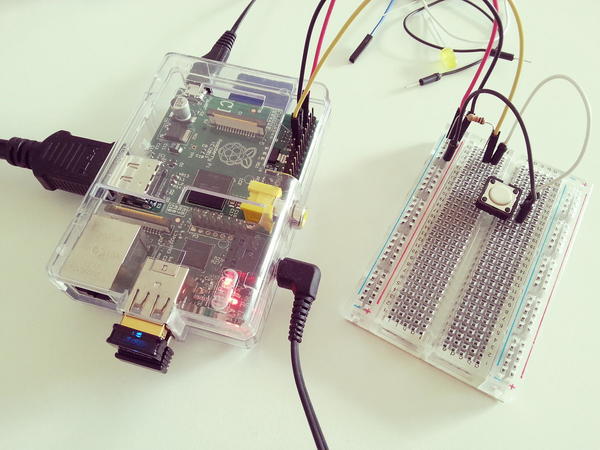
This is just a very rough prototype, and there are a lot of things that can be improved and tweaked. For example, I'm thinking about using an LDR (light-dependent resistor) to play a random file when light hits it. This way, I can place Raspberry Pi into a fridge, so it plays random files every time I open the door. Another possibility is to hook up a dot-matrix LCD screen and make Raspberry Pi display random words and phrases. Honestly, with so many ideas, I'm not sure whether I have time to learn Japanese.
comments powered by DisqusSubscribe to our Linux Newsletters
Find Linux and Open Source Jobs
Subscribe to our ADMIN Newsletters
Digital Autonomy
• How the Fediverse Found Parts for Its Platforms
• The Answer Was Already on the Shelf
• Changing the Chip Industry: How Public Investment Has Grown Open Silicon
• United Nations Open Source Portal Goes Live
• EU Open Source Strategy Plays Key Role in Tech Sovereignty Package
• France Says “Au Revoir” to Microsoft
Support Our Work
Linux Magazine content is made possible with support from readers like you. Please consider contributing when you’ve found an article to be beneficial.

News
-
PwnEscape Poses VM Vulnerability
A guest-to-host escape flaw in Linux KVM, named PwnEscape, might be yet another means of attacking Linux.
-
Linux Mint 27 Set for a Christmas Release
The developers behind Linux Mint have announced a Christmas release, and it looks like Santa's sack will be brimming with features.
-
Is Linus Torvalds Vibe Coding?
The creator of Linux has added AI into his process for Linux kernel development, and it's more than just for debugging.
-
openKylin 3.0 Released with Expanded AI Integration
The latest release features a pre-installed AI agent to help perform tasks.
-
DigitalOcean Ends Open Source Credits Program
In a change that has surprised many open source developers, DigitalOcean has decided to sunset its Open Source Credits Program.
-
Office 365 Available for Testing on Linux via Bottles
Linux users can now test the official Office 365, thanks to Mirko Brombin's work on Bottles.
-
Dutch Government Turns to Open Source for Digital Sovereignty
Following in the footsteps of other European countries, the Netherlands is looking to increase its sovereign digital infrastructure with open source software.
-
Linux May Soon Work on Snapdragon X2-Based PCs
If you're thinking about buying a Snapdragon X2-based desktop or laptop, Linux may soon be an option.
-
KDE for People Initiative Calls for AI Ban in Plasma
A new community of KDE wants the project to adopt a strict no-AI policy for KDE Plasma.
-
KDE Sets Ambitious Goals for 2026 and Beyond
KDE Connect reveals the goals for the Linux desktop darling, with one of those goals long overdue.