


An introduction to electronic weighing

Weighing In
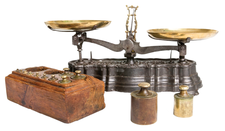
© Lead Image © Carlos Velayos, 123RF.com
Create your own weighing device with easily available components and open source software.
In this article, I discuss the design of a compact and portable workshop balance for various single-load-cell weighing applications constructed with a small load cell, an instrumentation amplifier, an excitation supply, a microcontroller, a display, and a serial port for debugging. Throughout, I used Linux and open source software, and I provide code samples, with directions for finding the complete code online.
History
Ancient civilizations used simple balances to compare weights for trading in precious metals, spices, salt, and the like. Today's civilization is no less dependent on knowing the weight of objects. It is hard to imagine a day in which the knowledge of weight does not take part: from the morning visit to the bathroom scales, a trip to the supermarket, baking a cake, to weighing baggage at the airport – the list of times weight plays a part in our lives seems endless. Today, we've moved away from mechanical balances, for the most part, obviating the need for ready reference weights.
Today's weighing equipment is usually based on electronic signals from strain gauges. These sensors are thin-film resistors whose resistance varies in response to tension or compression. When bonded to a mechanical structure subject to the force of an applied mass, the resistance of a strain gauge will change proportionally in response. Practical weighing systems use more than one strain gauge, and these are generally bonded to a metallic billet in a controlled manner to form a more complex electrical circuit designed to eliminate nonlinearities and temperature effects. These billets are known as load cells and are available commercially with working ranges from a few grams to hundreds of tonnes.
[...]
Buy this article as PDF
(incl. VAT)
Buy Linux Magazine
Subscribe to our Linux Newsletters
Find Linux and Open Source Jobs
Subscribe to our ADMIN Newsletters
Digital Autonomy
• How the Fediverse Found Parts for Its Platforms
• The Answer Was Already on the Shelf
• Changing the Chip Industry: How Public Investment Has Grown Open Silicon
• United Nations Open Source Portal Goes Live
• EU Open Source Strategy Plays Key Role in Tech Sovereignty Package
• France Says “Au Revoir” to Microsoft
Support Our Work
Linux Magazine content is made possible with support from readers like you. Please consider contributing when you’ve found an article to be beneficial.

News
-
Linux Mint 27 Set for a Christmas Release
The developers behind Linux Mint have announced a Christmas release, and it looks like Santa's sack will be brimming with features.
-
Is Linus Torvalds Vibe Coding?
The creator of Linux has added AI into his process for Linux kernel development, and it's more than just for debugging.
-
openKylin 3.0 Released with Expanded AI Integration
The latest release features a pre-installed AI agent to help perform tasks.
-
DigitalOcean Ends Open Source Credits Program
In a change that has surprised many open source developers, DigitalOcean has decided to sunset its Open Source Credits Program.
-
Office 365 Available for Testing on Linux via Bottles
Linux users can now test the official Office 365, thanks to Mirko Brombin's work on Bottles.
-
Dutch Government Turns to Open Source for Digital Sovereignty
Following in the footsteps of other European countries, the Netherlands is looking to increase its sovereign digital infrastructure with open source software.
-
Linux May Soon Work on Snapdragon X2-Based PCs
If you're thinking about buying a Snapdragon X2-based desktop or laptop, Linux may soon be an option.
-
KDE for People Initiative Calls for AI Ban in Plasma
A new community of KDE wants the project to adopt a strict no-AI policy for KDE Plasma.
-
KDE Sets Ambitious Goals for 2026 and Beyond
KDE Connect reveals the goals for the Linux desktop darling, with one of those goals long overdue.
-
It’s Time to Test Fedora 45 Beta
Fedora 45 beta has been released with updated Gnome, KDE Plasma, and kernel.