


British Local Authorities Hesitant on Open Source

A new survey by the Public Sector Forums in the U.K. on public financing of IT costs was based on a sample of 168 local authorities.
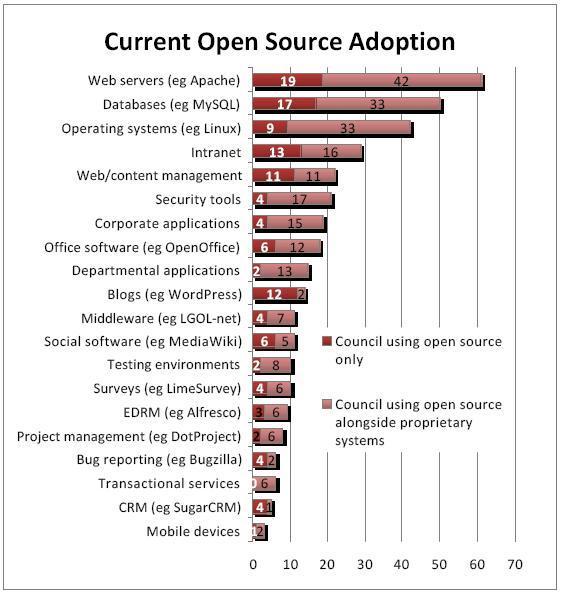 Although hesitant in using open source, there's obviously someone using it.
According to the Public Sector Forums survey report, "Open source software is already used widely by local authorities at many levels and for a very large number of different applications - primarily on open source web servers, databases and web publishing tools." The desktop sector has not been so lucky, with users not being as aware as they could about open source implementation on the backend.
Licensing costs, however, still prove to be a concern among local authorities. License savings showed to be the primary reason for applying open source software, vendor independence being in second place. 64% of the respondents felt that their organizations needed to increase their open source usage, although a scant 44% would see an actual increase over the next three years. 37% would see no change at all. The most significant growth potential for the open source alternative showed to be in the office software sector.
The survey of 168 respondents was conducted between mid-November and mid-December, culled among District Councils (31%), Unitary authorities (27%), County Councils (17%), Mets (14%) and London Boroughs (7%).
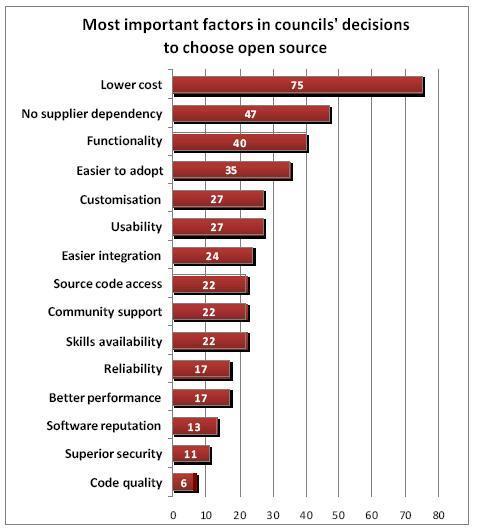 The main reason for the use of open source is still money.
The 15-page report, "Open or Closed? A Survey of Open Source Software in Local Government," is available from the UKGovOSS.org website, an online network sponsored by Bull and One Point Consulting since April 2009. The project is an initiative of the Public Sector Forums originally dedicated in the U.K. to being a public information source on digital television and its use as an e-Gov channel, but having expanding its reach to Internet and open source activist issues.
Comments
comments powered by DisqusSubscribe to our Linux Newsletters
Find Linux and Open Source Jobs
Subscribe to our ADMIN Newsletters
Digital Autonomy
• How the Fediverse Found Parts for Its Platforms
• The Answer Was Already on the Shelf
• Changing the Chip Industry: How Public Investment Has Grown Open Silicon
• United Nations Open Source Portal Goes Live
• EU Open Source Strategy Plays Key Role in Tech Sovereignty Package
• France Says “Au Revoir” to Microsoft
Support Our Work
Linux Magazine content is made possible with support from readers like you. Please consider contributing when you’ve found an article to be beneficial.

News
-
Linux Mint 27 Set for a Christmas Release
The developers behind Linux Mint have announced a Christmas release, and it looks like Santa's sack will be brimming with features.
-
Is Linus Torvalds Vibe Coding?
The creator of Linux has added AI into his process for Linux kernel development, and it's more than just for debugging.
-
openKylin 3.0 Released with Expanded AI Integration
The latest release features a pre-installed AI agent to help perform tasks.
-
DigitalOcean Ends Open Source Credits Program
In a change that has surprised many open source developers, DigitalOcean has decided to sunset its Open Source Credits Program.
-
Office 365 Available for Testing on Linux via Bottles
Linux users can now test the official Office 365, thanks to Mirko Brombin's work on Bottles.
-
Dutch Government Turns to Open Source for Digital Sovereignty
Following in the footsteps of other European countries, the Netherlands is looking to increase its sovereign digital infrastructure with open source software.
-
Linux May Soon Work on Snapdragon X2-Based PCs
If you're thinking about buying a Snapdragon X2-based desktop or laptop, Linux may soon be an option.
-
KDE for People Initiative Calls for AI Ban in Plasma
A new community of KDE wants the project to adopt a strict no-AI policy for KDE Plasma.
-
KDE Sets Ambitious Goals for 2026 and Beyond
KDE Connect reveals the goals for the Linux desktop darling, with one of those goals long overdue.
-
It’s Time to Test Fedora 45 Beta
Fedora 45 beta has been released with updated Gnome, KDE Plasma, and kernel.
Click on the images now and they will enlarge
Public Organisation in The UK and Open Source
Nice graphc