


Btrfs and the future of the filesystem

New Butter

The Btrfs filesystem offers advanced features such as RAID, subvolumes, snapshots, checksums, and transparent compression, but do desktop users really need all that power?
A filesystem functions below the operating system, ensuring that abstract data is converted into physical address attributes such as tracks and sectors. Some filesystems go beyond this basic functionality. One powerful and popular filesystem for Linux is Btrfs. The Btrfs filesystem [1], which is affectionately pronounced "ButterFS," is sometimes called the next generation filesystem. Btrfs is a copy-on-write filesystem [2] originally developed by Oracle Corporation and masterminded by Chris Mason. In some ways, Btrfs is best understood as an implementation of the Solaris 10 transactional filesystem ZFS [3] for the Linux platform. Oracle acquired ZFS in 2010 when it acquired Sun Microsystems. Btrfs is free software under the GPL and was adopted into Linux kernel 2.6.29 early in 2009.
Btrfs was declared suitable for production use in April 2013. Btrfs developer Chris Mason moved from SUSE, where he worked on ReiserFS, to Oracle, and he has worked at Facebook for several years, where Btrfs is widely used in the back end. Btrfs is now no longer limited to Linux; the WinBtrfs [4] project offers what are still experimental drivers for Windows. In the Linux world, Oracle started using Btrfs in its Unbreakable Linux release, version 2, four years ago, and SUSE in SUSE Linux Enterprise Server 12 (SLES 12) and openSUSE 13.2 (Figure 1). OpeSUSE Leap uses Btrfs as the default for the root partition; most other distributions include Btrfs in their archives and offer it as an alternative in the installer. Fedora plans to make Btrfs the default with Fedora 24.
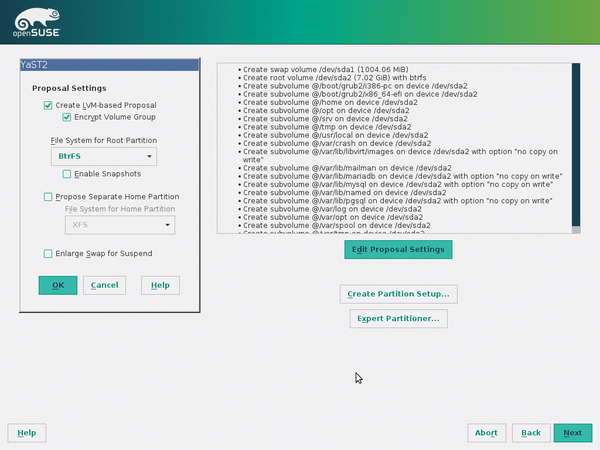 Figure 1: Btrfs as the default subvolume when installing openSUSE.
[...]
Buy this article as PDF
(incl. VAT)
Buy Linux Magazine
Subscribe to our Linux Newsletters
Find Linux and Open Source Jobs
Subscribe to our ADMIN Newsletters
Digital Autonomy
• How the Fediverse Found Parts for Its Platforms
• The Answer Was Already on the Shelf
• Changing the Chip Industry: How Public Investment Has Grown Open Silicon
• United Nations Open Source Portal Goes Live
• EU Open Source Strategy Plays Key Role in Tech Sovereignty Package
• France Says “Au Revoir” to Microsoft
Support Our Work
Linux Magazine content is made possible with support from readers like you. Please consider contributing when you’ve found an article to be beneficial.

News
-
Bottlenecks Discovered by Meta Engineers Lead to Scalability Improvements
Thanks to a small group of engineers at Meta, the Linux kernel module kernfs has been improved, which has led to some serious gains.
-
PwnEscape Poses VM Vulnerability
A guest-to-host escape flaw in Linux KVM, named PwnEscape, might be yet another means of attacking Linux.
-
Linux Mint 27 Set for a Christmas Release
The developers behind Linux Mint have announced a Christmas release, and it looks like Santa's sack will be brimming with features.
-
Is Linus Torvalds Vibe Coding?
The creator of Linux has added AI into his process for Linux kernel development, and it's more than just for debugging.
-
openKylin 3.0 Released with Expanded AI Integration
The latest release features a pre-installed AI agent to help perform tasks.
-
DigitalOcean Ends Open Source Credits Program
In a change that has surprised many open source developers, DigitalOcean has decided to sunset its Open Source Credits Program.
-
Office 365 Available for Testing on Linux via Bottles
Linux users can now test the official Office 365, thanks to Mirko Brombin's work on Bottles.
-
Dutch Government Turns to Open Source for Digital Sovereignty
Following in the footsteps of other European countries, the Netherlands is looking to increase its sovereign digital infrastructure with open source software.
-
Linux May Soon Work on Snapdragon X2-Based PCs
If you're thinking about buying a Snapdragon X2-based desktop or laptop, Linux may soon be an option.
-
KDE for People Initiative Calls for AI Ban in Plasma
A new community of KDE wants the project to adopt a strict no-AI policy for KDE Plasma.