


Host Your Own Secure Pastebin with ZeroBin

Productivity Sauce
A webapp for storing text fragments and code snippets can come in handy in many situations, and there are several third-party pastebins at your disposal. But if you prefer to host a pastebin on your own server, ZeroBin is right up your alley. For starters, ZeroBin is rather easy to install. Grab the latest version of the application, extract the download archive, move the resulting directory to the document root of your server, and ZeroBin is ready to go.
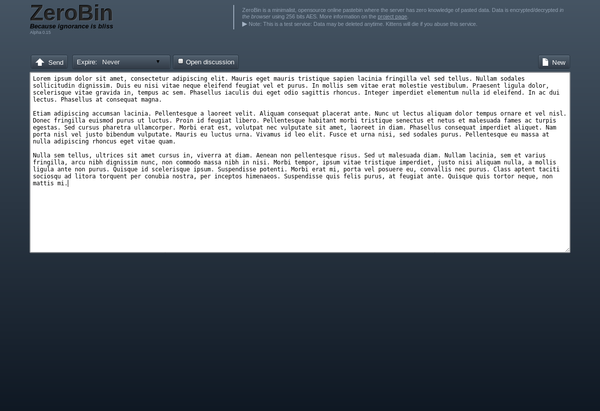
Using the application is not particularly difficult either. Paste a text or code fragment, press the Send button, and use the generated URL to share the specific page. For each pasted snippet, you can specify an expiration period and enable comments. The latter feature can be useful when you want not only to share a text fragment or code, but also receive feedback from other users. All the data you send through ZeroBin is compressed and encrypted in the browser before they are pushed to the server using the 256-bit AES encryption. So even if the server is breached or seized, the ZeroBin data will remain safe from prying eyes. Because the URL generated for each pasted snippet contains both a unique identifier and a decryption key, the link is usually very long and practically impossible to remember. Fortunately, ZeroBin features the Shorten URL button which lets you shorten the URL using the SnipURL service.
Despite being at the alpha stage of development, ZeroBin is surprisingly stable and usable, but you should use it with caution anyway.
comments powered by DisqusSubscribe to our Linux Newsletters
Find Linux and Open Source Jobs
Subscribe to our ADMIN Newsletters
Digital Autonomy
• How the Fediverse Found Parts for Its Platforms
• The Answer Was Already on the Shelf
• Changing the Chip Industry: How Public Investment Has Grown Open Silicon
• United Nations Open Source Portal Goes Live
• EU Open Source Strategy Plays Key Role in Tech Sovereignty Package
• France Says “Au Revoir” to Microsoft
Support Our Work
Linux Magazine content is made possible with support from readers like you. Please consider contributing when you’ve found an article to be beneficial.

News
-
openKylin 3.0 Released with Expanded AI Integration
The latest release features a pre-installed AI agent to help perform tasks.
-
DigitalOcean Ends Open Source Credits Program
In a change that has surprised many open source developers, DigitalOcean has decided to sunset its Open Source Credits Program.
-
Office 365 Available for Testing on Linux via Bottles
Linux users can now test the official Office 365, thanks to Mirko Brombin's work on Bottles.
-
Dutch Government Turns to Open Source for Digital Sovereignty
Following in the footsteps of other European countries, the Netherlands is looking to increase its sovereign digital infrastructure with open source software.
-
Linux May Soon Work on Snapdragon X2-Based PCs
If you're thinking about buying a Snapdragon X2-based desktop or laptop, Linux may soon be an option.
-
KDE for People Initiative Calls for AI Ban in Plasma
A new community of KDE wants the project to adopt a strict no-AI policy for KDE Plasma.
-
KDE Sets Ambitious Goals for 2026 and Beyond
KDE Connect reveals the goals for the Linux desktop darling, with one of those goals long overdue.
-
It’s Time to Test Fedora 45 Beta
Fedora 45 beta has been released with updated Gnome, KDE Plasma, and kernel.
-
Ubuntu Stonking Stingray Gets Even Rustier
Ubuntu 26.10 has completed its migration to the Rust-based coreutils.
-
AI Fixes Linux Bottlenecks Using “Hideous” Code
A Linux developer used AI to fix bottlenecks that caused problems when building the kernel. The resulting AI-generated code needed a lot of work.