


Quickly Publish Photos on the Web with Photocrumbs

Productivity Sauce
Usually, I use my Pygmyfoto application to publish photos on the web. But there are situations when I need to quickly share a bunch of photos with a minimum of fuss. Inspired by the Loading images from a directory with PHP article, I whipped up a slightly more advanced version of the original script. For lack of a better name I dubbed it Photocrumbs. The app consists of a PHP script which does most of the work and a handful of helper files. Besides scaling photos and displaying them as a continuous stream, the script also extracts basic EXIF info, such as aperture, shutter speed, ISO, and date. Installing Photocrumbs is a rather straightforward affair, and you'll find installation instructions in the supplied README.md file. Publishing photos with Photocrumbs is not particularly complicated either: simply drop them into the Photocrumbs/photos directory (or the directory you specified in the config.php file), and you are done.
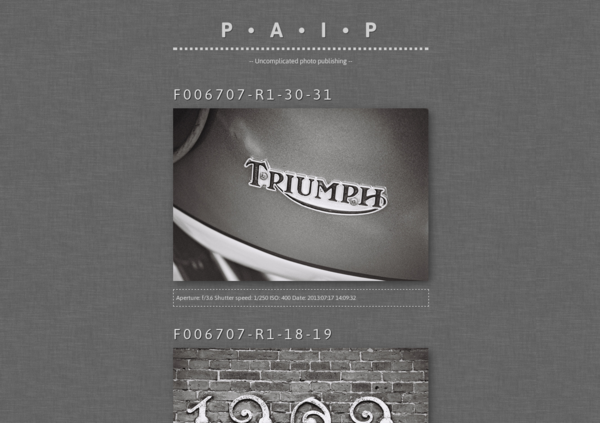
Of course, as a no-frills app, Photocrumbs does have some shortcomings. The most important one is the fact that the script displays scaled versions of full-sized photos. A better approach would have been to generate and display thumbnails, and I might implement this feature at some point (no promises, though).
I released Photocrumbs on GitHub under the GPLv3 license.
comments powered by DisqusSubscribe to our Linux Newsletters
Find Linux and Open Source Jobs
Subscribe to our ADMIN Newsletters
Digital Autonomy
• How the Fediverse Found Parts for Its Platforms
• The Answer Was Already on the Shelf
• Changing the Chip Industry: How Public Investment Has Grown Open Silicon
• United Nations Open Source Portal Goes Live
• EU Open Source Strategy Plays Key Role in Tech Sovereignty Package
• France Says “Au Revoir” to Microsoft
Support Our Work
Linux Magazine content is made possible with support from readers like you. Please consider contributing when you’ve found an article to be beneficial.

News
-
openKylin 3.0 Released with Expanded AI Integration
The latest release features a pre-installed AI agent to help perform tasks.
-
DigitalOcean Ends Open Source Credits Program
In a change that has surprised many open source developers, DigitalOcean has decided to sunset its Open Source Credits Program.
-
Office 365 Available for Testing on Linux via Bottles
Linux users can now test the official Office 365, thanks to Mirko Brombin's work on Bottles.
-
Dutch Government Turns to Open Source for Digital Sovereignty
Following in the footsteps of other European countries, the Netherlands is looking to increase its sovereign digital infrastructure with open source software.
-
Linux May Soon Work on Snapdragon X2-Based PCs
If you're thinking about buying a Snapdragon X2-based desktop or laptop, Linux may soon be an option.
-
KDE for People Initiative Calls for AI Ban in Plasma
A new community of KDE wants the project to adopt a strict no-AI policy for KDE Plasma.
-
KDE Sets Ambitious Goals for 2026 and Beyond
KDE Connect reveals the goals for the Linux desktop darling, with one of those goals long overdue.
-
It’s Time to Test Fedora 45 Beta
Fedora 45 beta has been released with updated Gnome, KDE Plasma, and kernel.
-
Ubuntu Stonking Stingray Gets Even Rustier
Ubuntu 26.10 has completed its migration to the Rust-based coreutils.
-
AI Fixes Linux Bottlenecks Using “Hideous” Code
A Linux developer used AI to fix bottlenecks that caused problems when building the kernel. The resulting AI-generated code needed a lot of work.