


Request Spotify dossiers and evaluate them with Go and R

Programming Snapshot – Go and R

© Lead Image © bowie15, 123RF.com
Spotify, the Internet music service, collects data about its users and their taste in music. Mike Schilli requested a copy of his files to investigate them with Go.
Streaming services such as Spotify or Apple Music dominate the music industry. Their extensive catalogs now cover the entire spectrum of consumable music. Relying on artificial intelligence, these services introduce users to new songs they'll probably like, as predicted by the services' algorithms. Traditional physical music media no longer stand a chance against this and gather dust on the shelves. Of course, this development also means that anonymous music consumption is a thing of the past, because streaming services keep precise records of who played what track, when, and for how long.
On request, Spotify will even hand over the acquired data (Figure 1). If you poke around a bit on their website, you'll find the buttons you need to press to request a copy of these files in Account | Privacy Settings, but Spotify takes their sweet time to respond. From the time of the request, it takes about a week for their archivist to retrieve the data from the files in the Spotify basement, compress them, and post them as a ZIP archive on the website for you to pick up. After receiving Spotify's email notification, you can then download the data for two weeks and poke around in it locally to your heart's content.
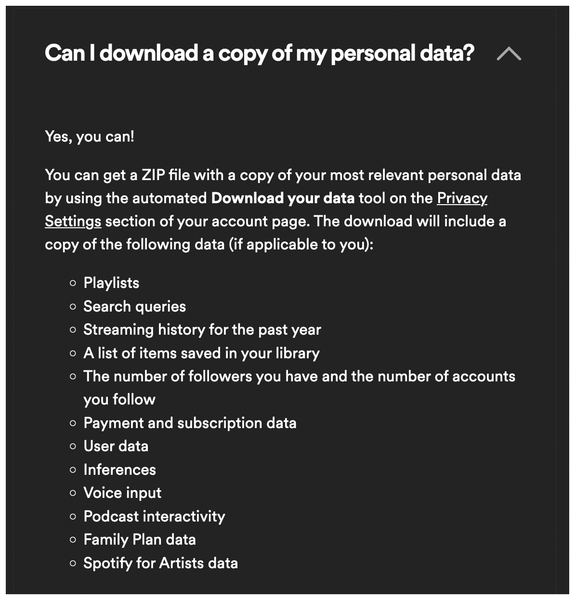 Figure 1: Spotify lets its users view the data it collected about them.
[...]
Buy this article as PDF
(incl. VAT)
Buy Linux Magazine
Subscribe to our Linux Newsletters
Find Linux and Open Source Jobs
Subscribe to our ADMIN Newsletters
Digital Autonomy
• The Answer Was Already on the Shelf
• Changing the Chip Industry: How Public Investment Has Grown Open Silicon
• United Nations Open Source Portal Goes Live
• EU Open Source Strategy Plays Key Role in Tech Sovereignty Package
• France Says “Au Revoir” to Microsoft
Support Our Work
Linux Magazine content is made possible with support from readers like you. Please consider contributing when you’ve found an article to be beneficial.

News
-
KDE for People Initiative Calls for AI Ban in Plasma
A new community of KDE wants the project to adopt a strict no-AI policy for KDE Plasma.
-
KDE Sets Ambitious Goals for 2026 and Beyond
KDE Connect reveals the goals for the Linux desktop darling, with one of those goals long overdue.
-
It’s Time to Test Fedora 45 Beta
Fedora 45 beta has been released with updated Gnome, KDE Plasma, and kernel.
-
Ubuntu Stonking Stingray Gets Even Rustier
Ubuntu 26.10 has completed its migration to the Rust-based coreutils.
-
AI Fixes Linux Bottlenecks Using “Hideous” Code
A Linux developer used AI to fix bottlenecks that caused problems when building the kernel. The resulting AI-generated code needed a lot of work.
-
Advanced Video Coding Still Under Patent
Brazilian patent BRPI0109962B1 has expired, which means that DivX and Xvid are no longer problematic for Linux, but it doesn’t mean that video is all of a sudden fully unleashed.
-
2,000 Vulnerabilities per Linux Release
Thanks to AI bug hunters, the Linux kernel is seeing record numbers of vulnerabilities, and it's overwhelming developers.
-
Linux Exempt from California’s Age Verification Law
So long as Linux is distributed under the GPL, MIT, BSD, and Apache licenses, the OS is exempt from being required to verify the age of its users in California.
-
Roll Out the Cake: Linux Turns 35
35 years ago, a Finnish student began a humble project that would forever change the course of technology.
-
China Switching from Windows to Linux
China has ordered several government agencies to drop a Chinese-developed version of Windows 10 in favor of either KylinOS or UOS.