


Android 1.6 with More Bells and Whistles

The new Android version code-named Donut comes with Kernel 2.6.29, more applications and usability improvements. Developers now have more possibilities with the new hardware capabilities of the software development kit (SDK).
Among the new Donut user features is a battery usage indicator per application to identify and adjust or drop resource-hungry apps. Another feature is a configuration control panel for various VPN types (L2TP, IPSEC, and PPTP). Add to that a quick search framework across multiple sources directly from the home screen. Searches increase in relevance by time, so that the more recently accessed contacts or apps are listed first. The quick search feature should also help developers in making their Android applications "searchable" in response to user queries.
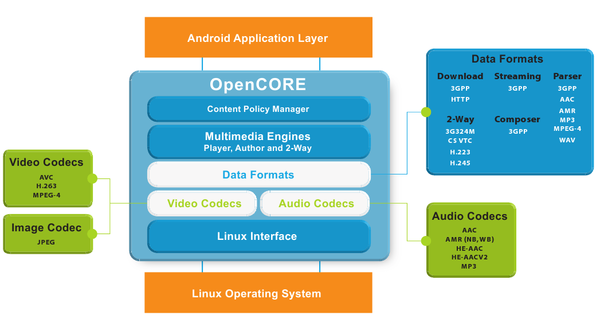 OpenCore from the San Diego CA company PacketVideo provides multimedia support in Android.
The Android 1.6 SDK, updated for the operating system, also provides a series of new enhancements. The SDK provides its users immediate access to updates and extensions. The development environment itself, for example, has a larger selection of screen sizes and resolutions. Developers can now use the
<supports-screens>
element to set small, normal, large, any density and resizable screen values. In a similar vein, the
android.graphics
classes now support scaling for different screen densities.
The new
android.speech.tts
classes provide text-to-speech synthesis, in English, Italian, Spanish, French and German. A GestureBuilder tool allows recognizing and capturing users' on-screen gestures (strokes) and integrating them into Android apps. Android 1.6 also supports code division multiple access (CDMA) for broadband transfer in the telephony stack. Not least of all is inclusion of the Opencore 2 media engine, a product of the PacketVideo firm that integrated a multimedia subsystem into Android and is a founding member of the Open Handset Alliance.
The Android 1.6 SDK is available for Linux, Mac OS X and Windows at the developers download site.
Subscribe to our Linux Newsletters
Find Linux and Open Source Jobs
Subscribe to our ADMIN Newsletters
Digital Autonomy
• How the Fediverse Found Parts for Its Platforms
• The Answer Was Already on the Shelf
• Changing the Chip Industry: How Public Investment Has Grown Open Silicon
• United Nations Open Source Portal Goes Live
• EU Open Source Strategy Plays Key Role in Tech Sovereignty Package
• France Says “Au Revoir” to Microsoft
Support Our Work
Linux Magazine content is made possible with support from readers like you. Please consider contributing when you’ve found an article to be beneficial.

News
-
Is Linus Torvalds Vibe Coding?
The creator of Linux has added AI into his process for Linux kernel development, and it's more than just for debugging.
-
openKylin 3.0 Released with Expanded AI Integration
The latest release features a pre-installed AI agent to help perform tasks.
-
DigitalOcean Ends Open Source Credits Program
In a change that has surprised many open source developers, DigitalOcean has decided to sunset its Open Source Credits Program.
-
Office 365 Available for Testing on Linux via Bottles
Linux users can now test the official Office 365, thanks to Mirko Brombin's work on Bottles.
-
Dutch Government Turns to Open Source for Digital Sovereignty
Following in the footsteps of other European countries, the Netherlands is looking to increase its sovereign digital infrastructure with open source software.
-
Linux May Soon Work on Snapdragon X2-Based PCs
If you're thinking about buying a Snapdragon X2-based desktop or laptop, Linux may soon be an option.
-
KDE for People Initiative Calls for AI Ban in Plasma
A new community of KDE wants the project to adopt a strict no-AI policy for KDE Plasma.
-
KDE Sets Ambitious Goals for 2026 and Beyond
KDE Connect reveals the goals for the Linux desktop darling, with one of those goals long overdue.
-
It’s Time to Test Fedora 45 Beta
Fedora 45 beta has been released with updated Gnome, KDE Plasma, and kernel.
-
Ubuntu Stonking Stingray Gets Even Rustier
Ubuntu 26.10 has completed its migration to the Rust-based coreutils.