


Use LEGO Sensors and Actuators with the Build HAT

Frankenstein Pi

© Lead Image © lineartestpilot, 123RF.com
The Build HAT combines the latest generation of LEGO electronics with the Raspberry Pi. This enables significantly more complex projects and breathes new life into LEGO bricks that might otherwise have reached the end of their usefulness.
For just EUR27 (~$31), the Raspberry Pi Build HAT lets you connect the world of LEGO to the Raspberry Pi. LEGO sensors, motors, and lights attach to the Build HAT's four gray connectors at the top (Figure 1). You can then activate and control all of the connected components using Python on the Raspberry Pi. Python, in particular, enables significantly more complex applications than what LEGO sets were actually designed for, while at the same time making LEGO building blocks more interesting for adults. Having said this, the Build HAT developers have placed several hurdles in the way of exciting DIY projects.
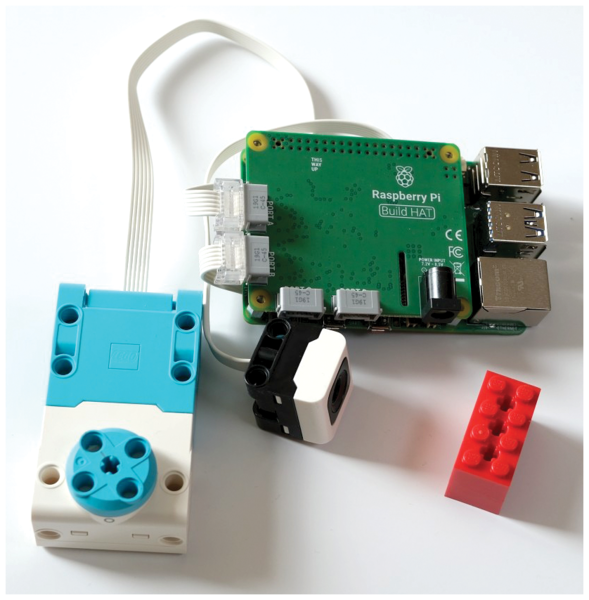 Figure 1: The Build HAT connects a motor and a color sensor from the Spike set to the Raspberry Pi.
In addition to its classic legacy blocks – which have caused many a painful moment for parents walking barefoot through the living room – LEGO offers several robot construction kits. These kits are primarily designed to introduce younger students to science and programming in a playful way. Besides numerous LEGO Technic parts, the kits also contain a handful of sensors and motors, which are typically controlled by a central brick that children can program with a colorful app that's modeled on the Scratch visual programming language [1].
[...]
Buy this article as PDF
(incl. VAT)
Buy Linux Magazine
Subscribe to our Linux Newsletters
Find Linux and Open Source Jobs
Subscribe to our ADMIN Newsletters
Digital Autonomy
• How the Fediverse Found Parts for Its Platforms
• The Answer Was Already on the Shelf
• Changing the Chip Industry: How Public Investment Has Grown Open Silicon
• United Nations Open Source Portal Goes Live
• EU Open Source Strategy Plays Key Role in Tech Sovereignty Package
• France Says “Au Revoir” to Microsoft
Support Our Work
Linux Magazine content is made possible with support from readers like you. Please consider contributing when you’ve found an article to be beneficial.

News
-
Working Exploit for a Linux Kernel Flaw Made Public
Even before a bug received its CVE identifier or an upstream fix, the local privilege escalation vulnerability exploit found its way into the wild.
-
r/opensource Bans AI-Assisted and AI-Related Projects
The de facto subreddit for all things open source has not only banned AI-related projects but also users who "don't speak English."
-
Bottlenecks Discovered by Meta Engineers Lead to Scalability Improvements
Thanks to a small group of engineers at Meta, the Linux kernel module kernfs has been improved, which has led to some serious gains.
-
PwnEscape Poses VM Vulnerability
A guest-to-host escape flaw in Linux KVM, named PwnEscape, might be yet another means of attacking Linux.
-
Linux Mint 27 Set for a Christmas Release
The developers behind Linux Mint have announced a Christmas release, and it looks like Santa's sack will be brimming with features.
-
Is Linus Torvalds Vibe Coding?
The creator of Linux has added AI into his process for Linux kernel development, and it's more than just for debugging.
-
openKylin 3.0 Released with Expanded AI Integration
The latest release features a pre-installed AI agent to help perform tasks.
-
DigitalOcean Ends Open Source Credits Program
In a change that has surprised many open source developers, DigitalOcean has decided to sunset its Open Source Credits Program.
-
Office 365 Available for Testing on Linux via Bottles
Linux users can now test the official Office 365, thanks to Mirko Brombin's work on Bottles.
-
Dutch Government Turns to Open Source for Digital Sovereignty
Following in the footsteps of other European countries, the Netherlands is looking to increase its sovereign digital infrastructure with open source software.