


Leave Geographical Breadcrumbs with Geofix

Productivity Sauce
When I'm out and about, I often need to quickly record my current position. As an amateur photographer, I appreciate the ability to record the geographical coordinates of locations I plan to photograph later and spots I've already taken pictures of. The latter helps me to geotag my photos in digiKam. When I travel, I prefer to record the locations of good eateries, coffee shops, interesting places, etc. An Android device is perfect for this task, but none of the apps I tried fit my needs. So I cobbled together my own tool called Geofix. This relatively simple Python-based script can be used to obtain and store the geographical coordinates of the current location. The script uses both the network and GPS to obtain coordinates, and it stores the data in a text file and an SQLite database. This redundancy provides a fallback in case one of the sources is unavailable. The script also records the date and time for each entry and generates an OpenStreetMap link which can be used to preview the recorded location. There is also an option to take an accompanying snapshot.
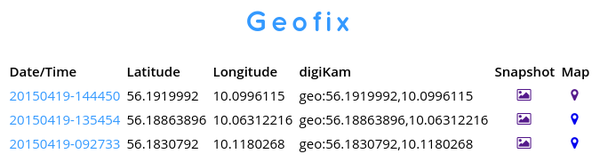
Geofix comes with a simple web app based on the Python bottle framework. You can use the web app to view records in the SQLite database using a regular browser.
To deploy Geofix on your Android device, install the SL4A and PythonForAndroid APK packages from Android Scripting first. Copy then the geofix.py script to the sl4a/scripts directory on the internal storage of your Android device, and you are good to go. Open the SL4A app, and launch the script. For faster access, you can add to the homescreen an SL4A widget that links to the script.
Instead of using SL4A and Python for Android, which are all but abandoned by Google, you can opt for QPython. In this case, you need to use the geofix-qpython.py script. Copy it to the com.hipipal.qpyplus/scripts directory, and use the QPython app to launch the script.
comments powered by DisqusSubscribe to our Linux Newsletters
Find Linux and Open Source Jobs
Subscribe to our ADMIN Newsletters
Digital Autonomy
• The Answer Was Already on the Shelf
• Changing the Chip Industry: How Public Investment Has Grown Open Silicon
• United Nations Open Source Portal Goes Live
• EU Open Source Strategy Plays Key Role in Tech Sovereignty Package
• France Says “Au Revoir” to Microsoft
Support Our Work
Linux Magazine content is made possible with support from readers like you. Please consider contributing when you’ve found an article to be beneficial.

News
-
Advanced Video Coding Still Under Patent
Brazilian patent BRPI0109962B1 has expired, which means that DivX and Xvid are no longer problematic for Linux, but it doesn’t mean that video is all of a sudden fully unleashed.
-
2,000 Vulnerabilities per Linux Release
Thanks to AI bug hunters, the Linux kernel is seeing record numbers of vulnerabilities, and it's overwhelming developers.
-
Linux Exempt from California’s Age Verification Law
So long as Linux is distributed under the GPL, MIT, BSD, and Apache licenses, the OS is exempt from being required to verify the age of its users in California.
-
Roll Out the Cake: Linux Turns 35
35 years ago, a Finnish student began a humble project that would forever change the course of technology.
-
China Switching from Windows to Linux
China has ordered several government agencies to drop a Chinese-developed version of Windows 10 in favor of either KylinOS or UOS.
-
Pine64 Halts Production of Linux Devices
With continued DRAM and eMMC shortages, Pine64 has decided to discontinue production of Linux devices.
-
The Bullet-Proof KDE Software Initiative Is Coming
KDE, Techpaladin, and Kubuntu Focus have announced a new initiative that will provide at least three years of support for KDE Plasma 6.6 LTS and related software.
-
Linux Mint Shares a Possible Kernel Cleanup Solution
For those on Linux Mint who like to keep multiple kernels around but don't want them to take up too much space, you might be getting a new automated tool.
-
CachyOS Gets an Update
CachyOS August 2026 release is now available with the latest version of KDE, some new features, and plenty of improvements.
-
The Linux Kernel Dev Staging Area Now Rejects AI-Generated Patches
Unless a kernel patch is a valid security fix, it will be rejected if it was created using AI.