


The ext filesystem – a four-generation retrospective

Family
© Lead Image © Bea Kraus, medchip, tempusfugit, Robert Mizerek 123RF.com
The extended filesystem has been part of the Linux kernel since 0.96c – a faithful companion of the free operating system. With its developments – or, rather, rebirths – through ext2, ext3, and ext4, it is one of the oldest Linux-specific software projects.
The Linux kernel [1] is now almost 22 years old. Its faithful companion since 1992 has been the family of extended filesystems, ext [2]-[4]. For many reasons, Linux took its first steps with a filesystem derived from Minix [3]-[5]). Originally, Linus Torvalds only wanted to develop a better terminal emulator for Minix. Therefore, he had no need for a separate filesystem. Even as the Torvalds project turned into an operating system kernel, the development still continued under Minix. The shared filesystem made it easier to exchange data.
A Star Is Born
The filesystem used in Minix, which was originally developed for educational purposes, had some significant limitations. The maximum file size was 64MB and the maximum filename length was 14 characters [4]. For some Linux pioneers, these limits were eventually unsustainable, and they started to think about a new, native Linux filesystem. Linus integrated the VFS (virtual filesystem) layer into kernel version 0.96a, which facilitated adding additional filesystems (Figure 1) [4] [6].
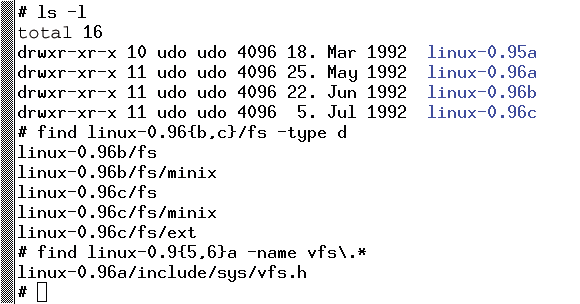 Figure 1: The Linux kernel 0.96a introduced VFS as a kind of jump-off point for the ext filesystem in 0.96c.
[...]
Buy this article as PDF
(incl. VAT)
Buy Linux Magazine
Subscribe to our Linux Newsletters
Find Linux and Open Source Jobs
Subscribe to our ADMIN Newsletters
Digital Autonomy
• How the Fediverse Found Parts for Its Platforms
• The Answer Was Already on the Shelf
• Changing the Chip Industry: How Public Investment Has Grown Open Silicon
• United Nations Open Source Portal Goes Live
• EU Open Source Strategy Plays Key Role in Tech Sovereignty Package
• France Says “Au Revoir” to Microsoft
Support Our Work
Linux Magazine content is made possible with support from readers like you. Please consider contributing when you’ve found an article to be beneficial.

News
-
openKylin 3.0 Released with Expanded AI Integration
The latest release features a pre-installed AI agent to help perform tasks.
-
DigitalOcean Ends Open Source Credits Program
In a change that has surprised many open source developers, DigitalOcean has decided to sunset its Open Source Credits Program.
-
Office 365 Available for Testing on Linux via Bottles
Linux users can now test the official Office 365, thanks to Mirko Brombin's work on Bottles.
-
Dutch Government Turns to Open Source for Digital Sovereignty
Following in the footsteps of other European countries, the Netherlands is looking to increase its sovereign digital infrastructure with open source software.
-
Linux May Soon Work on Snapdragon X2-Based PCs
If you're thinking about buying a Snapdragon X2-based desktop or laptop, Linux may soon be an option.
-
KDE for People Initiative Calls for AI Ban in Plasma
A new community of KDE wants the project to adopt a strict no-AI policy for KDE Plasma.
-
KDE Sets Ambitious Goals for 2026 and Beyond
KDE Connect reveals the goals for the Linux desktop darling, with one of those goals long overdue.
-
It’s Time to Test Fedora 45 Beta
Fedora 45 beta has been released with updated Gnome, KDE Plasma, and kernel.
-
Ubuntu Stonking Stingray Gets Even Rustier
Ubuntu 26.10 has completed its migration to the Rust-based coreutils.
-
AI Fixes Linux Bottlenecks Using “Hideous” Code
A Linux developer used AI to fix bottlenecks that caused problems when building the kernel. The resulting AI-generated code needed a lot of work.