


Making the Most of Cloud-Init on the Raspberry Pi

Automate Your Pi Setup

© Lead Image © Andrey Burmakin, 123RF.com
When booting a newer Raspberry Pi OS version, you might notice some cryptic cloud-init messages flash across the screen. We explain what they mean and how you can put them to good use.
Your Raspberry Pi may use cloud-init, but this does not mean that it joins some cloud during the installation. Instead it's using a bunch of scripts designed to keep your Rasp Pi properly configured and ready to use. All of this happens automatically in the background, but where does the necessary information come from?
This is where the Raspberry Pi Imager (version 2.0 and later) enters the scene. If you download an official Raspberry Pi OS image off the web, the program guides you through a series of dialogs and prompts you for information such as user account and network details (Figure 1). If, however, you use traditional Linux onboard tools such as unxz or dd for writing the image, you miss out on that setup service, and the same happens if you use an official Raspberry Pi OS but do not re-download it.
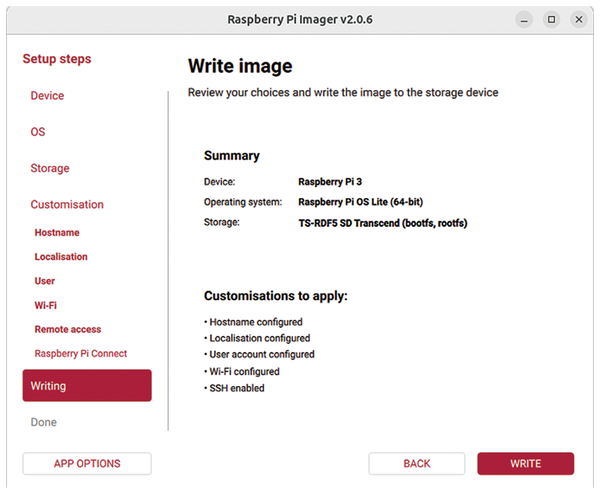 Figure 1: In the Raspberry Pi Imager, users enter various pieces of information step by step.
[...]
Buy this article as PDF
(incl. VAT)
Buy Linux Magazine
Subscribe to our Linux Newsletters
Find Linux and Open Source Jobs
Subscribe to our ADMIN Newsletters
Digital Autonomy
• How the Fediverse Found Parts for Its Platforms
• The Answer Was Already on the Shelf
• Changing the Chip Industry: How Public Investment Has Grown Open Silicon
• United Nations Open Source Portal Goes Live
• EU Open Source Strategy Plays Key Role in Tech Sovereignty Package
• France Says “Au Revoir” to Microsoft
Support Our Work
Linux Magazine content is made possible with support from readers like you. Please consider contributing when you’ve found an article to be beneficial.

News
-
Bottlenecks Discovered by Meta Engineers Lead to Scalability Improvements
Thanks to a small group of engineers at Meta, the Linux kernel module kernfs has been improved, which has led to some serious gains.
-
PwnEscape Poses VM Vulnerability
A guest-to-host escape flaw in Linux KVM, named PwnEscape, might be yet another means of attacking Linux.
-
Linux Mint 27 Set for a Christmas Release
The developers behind Linux Mint have announced a Christmas release, and it looks like Santa's sack will be brimming with features.
-
Is Linus Torvalds Vibe Coding?
The creator of Linux has added AI into his process for Linux kernel development, and it's more than just for debugging.
-
openKylin 3.0 Released with Expanded AI Integration
The latest release features a pre-installed AI agent to help perform tasks.
-
DigitalOcean Ends Open Source Credits Program
In a change that has surprised many open source developers, DigitalOcean has decided to sunset its Open Source Credits Program.
-
Office 365 Available for Testing on Linux via Bottles
Linux users can now test the official Office 365, thanks to Mirko Brombin's work on Bottles.
-
Dutch Government Turns to Open Source for Digital Sovereignty
Following in the footsteps of other European countries, the Netherlands is looking to increase its sovereign digital infrastructure with open source software.
-
Linux May Soon Work on Snapdragon X2-Based PCs
If you're thinking about buying a Snapdragon X2-based desktop or laptop, Linux may soon be an option.
-
KDE for People Initiative Calls for AI Ban in Plasma
A new community of KDE wants the project to adopt a strict no-AI policy for KDE Plasma.