


Wind River Brings Own Android to Market

Embedded specialist Wind River strives to win mobile network users with hardware compliance and its own Android branding.
Wind River is wooing mobile phone manufacturers with test runs and optimization that should make Wind River Android particularly reliable. The Android platform should run especially well on on the OMAP3 platform, but other boards should not present a problem for the mobile and embedded development vendor. Some of their collaborators already include Adobe (Flash), PacketVideo (multimedia player) and Red Bend (firmware over-the-air). New versions of Wind River Android should appear quarterly and concurrent with Android updates. The Intel undertaking will also naturally sell worldwide support for its mobile operating system. Prices have not been announced.
Wind River has already been busy with Android in the past. With the components of its newest Android offering, Wind River plans to optimize the Advanced Linux Sound Architecture (ALSA) for its hardware for Android and provide other hardware compatibilities as to multimedia and boot-time acceleration. OEMs and other providers can build in Wind River bootup and termination screens along with extended functions such as gesture options for calls and sending SMS messages. Another example is modified phone functions such as the short/long press behavior of hard and soft keys.
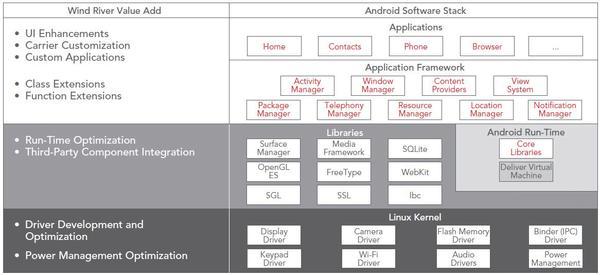 Above and beyond the standard Android functions, Wind River provides its own Android Platform third-party components and hardware compatibilities along with custom extensions and support.
With Texas Instruments, that is also a member of the Open Handset Alliance and the Limo Foundation, Wind River, which was recently acquired by Intel, entered a stragegic partnership in, among other things, Android and OMAP (Open Multimedia Application Platform). In November chip designer ARM instituted its own Android project. Meanwhile Qualcomm set up a new Innovation Center "focused on mobile open source platforms," with Android just among a few others.
The Linux-based mobile network system enhanced its multimedia capabilities in September with its new Android 1.6. It also provided multiple account and sychronization functions in its latest major update to 2.0 in October. Its newest release is Android 2.0.1.
Subscribe to our Linux Newsletters
Find Linux and Open Source Jobs
Subscribe to our ADMIN Newsletters
Digital Autonomy
• How the Fediverse Found Parts for Its Platforms
• The Answer Was Already on the Shelf
• Changing the Chip Industry: How Public Investment Has Grown Open Silicon
• United Nations Open Source Portal Goes Live
• EU Open Source Strategy Plays Key Role in Tech Sovereignty Package
• France Says “Au Revoir” to Microsoft
Support Our Work
Linux Magazine content is made possible with support from readers like you. Please consider contributing when you’ve found an article to be beneficial.

News
-
openKylin 3.0 Released with Expanded AI Integration
The latest release features a pre-installed AI agent to help perform tasks.
-
DigitalOcean Ends Open Source Credits Program
In a change that has surprised many open source developers, DigitalOcean has decided to sunset its Open Source Credits Program.
-
Office 365 Available for Testing on Linux via Bottles
Linux users can now test the official Office 365, thanks to Mirko Brombin's work on Bottles.
-
Dutch Government Turns to Open Source for Digital Sovereignty
Following in the footsteps of other European countries, the Netherlands is looking to increase its sovereign digital infrastructure with open source software.
-
Linux May Soon Work on Snapdragon X2-Based PCs
If you're thinking about buying a Snapdragon X2-based desktop or laptop, Linux may soon be an option.
-
KDE for People Initiative Calls for AI Ban in Plasma
A new community of KDE wants the project to adopt a strict no-AI policy for KDE Plasma.
-
KDE Sets Ambitious Goals for 2026 and Beyond
KDE Connect reveals the goals for the Linux desktop darling, with one of those goals long overdue.
-
It’s Time to Test Fedora 45 Beta
Fedora 45 beta has been released with updated Gnome, KDE Plasma, and kernel.
-
Ubuntu Stonking Stingray Gets Even Rustier
Ubuntu 26.10 has completed its migration to the Rust-based coreutils.
-
AI Fixes Linux Bottlenecks Using “Hideous” Code
A Linux developer used AI to fix bottlenecks that caused problems when building the kernel. The resulting AI-generated code needed a lot of work.