


Exploring the Matrix Communication Protocol

Chat Freedom

Lead Image © Joannis Kounadeas, Fotolia.com
Corporate communication platforms might be convenient, but they put your privacy at risk. The Matrix open communication standard offers a different approach.
Imagine your entire digital social life (all your private conversations, critical work discussions, and sensitive family photos) living on a handful of servers controlled by a few massive corporations. This isn't a dystopian concept; it's the reality of modern online communication, and this centralization comes with a heavy price: a critical lack of control, privacy, and interoperability.
The sheer convenience of services like WhatsApp, Slack, and Discord has successfully aggregated billions of users, but this dominance has created a landscape riddled with digital silos. This model presents fundamental flaws that undermine user freedom. First, privacy and security are constantly under threat. All your messages and your valuable metadata (who you talk to, when, and for how long) are aggregated in one place, creating an irresistible target for hackers and a single, rich source of data for corporate use. Furthermore, when the centralized server of a major platform collapses, your communication instantly ceases entirely, crippling everything from business operations to personal connections.
Second, users face the infuriating dilemma of vendor lock-in, often called the interoperability trap. If your family insists on WhatsApp and your professional team lives on Slack, there is no simple way to communicate between them. You are constantly locked into a specific platform, forced to download multiple apps and habitually switch contexts. These communication giants simply refuse to talk to each other, leading to a deeply frustrating and fragmented digital life.
Finally, the most insidious issue is the lack of data sovereignty. You don't truly own your space; you are merely renting it. The third-party provider dictates the rules of engagement. They maintain the power to censor content, ban accounts, or arbitrarily change how long your history is stored, all with little meaningful recourse for you. Your most sensitive conversations are ultimately subject to the business models and unpredictable whims of someone else's company.
The necessity of avoiding these central points of control has become a matter of public urgency, particularly in Europe. Across the continent, lawmakers are actively debating the Regulation to Prevent and Combat Child Sexual Abuse, commonly dubbed "Chat Control." This controversial proposal, in its various forms, aims to impose mandatory, systematic scanning of private messages, including those on end-to-end encrypted services, either on the device itself or via a backdoor. Though the concept is driven by a noble cause, critics warn that, if adopted, this legislation would effectively mandate a mechanism for mass surveillance without probable cause for hundreds of millions of citizens, fundamentally breaking the integrity of private digital spaces. Such a system would not only compromise encryption for every user but would also set a global precedent for governments to monitor conversations at will.
The digital world desperately needs an open, resilient, and user-centric foundation for real-time communication. This is precisely where the Matrix protocol steps in. Matrix [1] is an open standard designed not as another proprietary app but as a unified, decentralized network that aims to do for instant messaging what email did for asynchronous communication: Empower the user, guarantee security, and connect everything.
What Is Matrix?
Matrix is often mistakenly identified with a single application, but it is actually an open standard, a definitive blueprint for a decentralized, real-time communication protocol. It is designed to be the foundational "glue" of the Internet's chat layer, much like the Simple Mail Transfer Protocol (SMTP) defines how email works. The entire power of Matrix rests on its radical departure from the centralized model, opting instead for federation.
In the Matrix network, no single, massive corporate server holds everyone's data. Instead, the network is composed of thousands of individual Home Servers (HSs). A home server is simply the software that hosts your user account and stores your data. When you create a Matrix account, your identity is formatted like an email address: @user:server.com. The part after the colon is the domain of your specific home server. Crucially, you are free to choose a public server, or you can elect to host your own server on your own hardware, granting you complete, verifiable control over your communications. The two primary reference implementations for these home servers are Synapse, the original, feature-complete server, and Dendrite, a newer, more efficient, and scalable second-generation alternative.
The true operational magic of Matrix lies in federation, the process by which separate home servers communicate and share data to form a cohesive, global network. When a user in a Matrix room sends a message, that message (termed an event) is cryptographically signed and replicated across all participating home servers in that room. Consequently, the chat history is not stored centrally; it is a shared, synchronized, and cryptographically verified log, functioning much like a distributed ledger across the entire network of servers. This architecture yields immense benefits: It guarantees no single point of failure, since the conversation persists on other servers, even if one goes offline; it ensures data sovereignty, allowing users a level of ownership and control over their communication history; and it builds in censorship resistance, as shutting down a conversation would require dismantling every independent, participating server globally. In essence, Matrix treats communication as a robust, distributed conversation history that is synchronized between all relevant parties, turning the fragmented Internet into a single, seamless communication space.
Pillars of the Matrix Ecosystem
Matrix's architectural shift from centralization to federation is merely the foundation; the true value for the user is built upon three core pillars: uncompromising security, seamless interoperability, and a diverse range of clients. These features together form a truly user-centric communication network that challenges the status quo.
The Matrix protocol makes End-to-End Encryption (E2EE) the default standard for private and group conversations. Messages are encrypted on the sender's device and can only be decrypted on the recipient's device. Crucially, even the home servers that transmit the data only store the encrypted ciphertext and have no capacity to read the content. Matrix achieves this robust security using a pair of advanced cryptographic ratchets. Olm is an implementation of the secure Double Ratchet algorithm [2], optimized for deniable, one-to-one chats. Built upon Olm, Megolm is a mechanism designed to efficiently scale those same E2EE guarantees to large, asynchronous group chats with dozens or even thousands of participants. This highly audited and constantly evolving encryption ensures that the data being transmitted remains safe from governments, hackers, and even the server administrators, directly addressing the privacy threats highlighted by initiatives like Chat Control.
Perhaps the most revolutionary feature of the Matrix ecosystem is its commitment to solving the problem of fragmentation through bridges. A Matrix bridge is essentially an application service, a piece of software that runs alongside a home server and acts as a sophisticated two-way translator between the Matrix network and an external communication platform. Bridges allow a Matrix user to communicate directly with users on entirely separate services, all from their single chosen Matrix client. For instance, a user in a Matrix room can send a message that appears instantly in a Telegram group, a Slack channel, or a Discord server, and receive replies back in real-time. More advanced bridges even allow for "puppeting," where a Matrix user controls their identity on the remote network, such as their WhatsApp or Signal account, making the communication completely transparent to the user on the other side. This bridging capability transforms Matrix into the ultimate communication glue. It allows users to consolidate their fragmented digital lives into one secure, decentralized interface without requiring them to compromise their privacy.
The Matrix standard fosters innovation by intentionally separating the protocol from the user interface. This separation has led to a rich and competitive ecosystem of client applications. Element, the most prominent client developed by the core Matrix team, is available across web, desktop (Figure 1), and mobile platforms (Figure 2), serving as the flagship, feature-rich example of what the protocol can do. However, because the specification is open, the community offers a variety of alternative clients tailored to different needs, such as Nheko (a native desktop client focused on performance) or FluffyChat (a mobile client prioritizing a simple, colorful user experience). This inherent freedom to choose and switch clients while remaining connected to the same underlying federated network ensures that no single company can dictate the user experience, maintaining the user-centric ethos of the entire Matrix project.
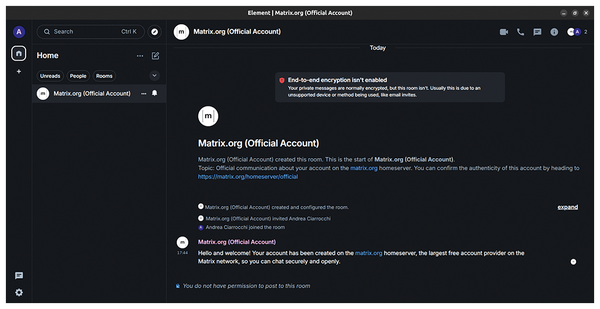 Figure 1: The Element X client for Linux.
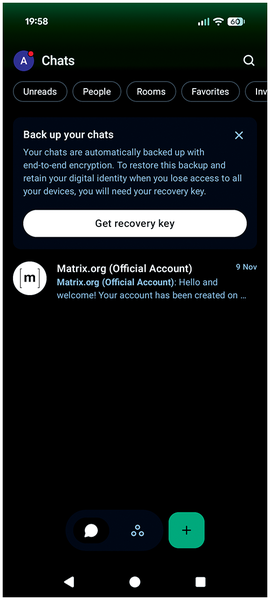 Figure 2: The Element X client for Android.
Impact and Use Cases
The Matrix protocol is a mature, production-ready system that has achieved widespread adoption among institutions prioritizing digital sovereignty, security, and interoperability. The most notable deployments have occurred within the public sector, where the need to reduce reliance on external, centralized, proprietary platforms is a strategic imperative.
Several European governments and institutions have chosen Matrix as the foundation for secure, cross-organizational communications. For example, the French government's internal secure messaging system, Tchap, is a private Matrix federation used by hundreds of thousands of public servants [3]. Its deployment was explicitly motivated by the need for openness, transparency, and a high degree of digital control to avoid dependence on large foreign technology firms. Similarly, Germany is undergoing a multi-sector rollout [4]. These large-scale deployments showcase Matrix's resilience, interoperability, and capability to handle massive federated networks while adhering to strict security and regulatory requirements.
Beyond national governments, Matrix's decentralized nature makes it ideal for several other critical use cases. Within open source communities, major projects such as the KDE community and large events like FOSDEM have migrated their communications to Matrix to align their messaging platform with their values of open standards and decentralized governance [5]. A key practical use is bridging legacy networks; Matrix's bridging capability provides immediate value for communities struggling with fragmentation, as it is commonly used to bring disparate users from platforms like IRC, Telegram, and Discord into a single, unified, and encrypted interface, thus unifying scattered communication channels. Finally, the protocol's architecture, which handles real-time data synchronization across many servers, is well-suited for non-human interactions, particularly in the Internet of Things (IoT), where Matrix serves as a standardized, low-latency publish/subscribe bus for IoT devices, effectively turning it into a signaling layer for the entire network of connected devices.
In sum, Matrix is positioning itself not just as a replacement for proprietary chat apps, but as the underlying, open source communication layer necessary for the modern Internet, offering a model for connectivity where the user, rather than the corporation, is in control.
Buy this article as PDF
(incl. VAT)
Buy Linux Magazine
Subscribe to our Linux Newsletters
Find Linux and Open Source Jobs
Subscribe to our ADMIN Newsletters
Digital Autonomy
• How the Fediverse Found Parts for Its Platforms
• The Answer Was Already on the Shelf
• Changing the Chip Industry: How Public Investment Has Grown Open Silicon
• United Nations Open Source Portal Goes Live
• EU Open Source Strategy Plays Key Role in Tech Sovereignty Package
• France Says “Au Revoir” to Microsoft
Support Our Work
Linux Magazine content is made possible with support from readers like you. Please consider contributing when you’ve found an article to be beneficial.

News
-
openKylin 3.0 Released with Expanded AI Integration
The latest release features a pre-installed AI agent to help perform tasks.
-
DigitalOcean Ends Open Source Credits Program
In a change that has surprised many open source developers, DigitalOcean has decided to sunset its Open Source Credits Program.
-
Office 365 Available for Testing on Linux via Bottles
Linux users can now test the official Office 365, thanks to Mirko Brombin's work on Bottles.
-
Dutch Government Turns to Open Source for Digital Sovereignty
Following in the footsteps of other European countries, the Netherlands is looking to increase its sovereign digital infrastructure with open source software.
-
Linux May Soon Work on Snapdragon X2-Based PCs
If you're thinking about buying a Snapdragon X2-based desktop or laptop, Linux may soon be an option.
-
KDE for People Initiative Calls for AI Ban in Plasma
A new community of KDE wants the project to adopt a strict no-AI policy for KDE Plasma.
-
KDE Sets Ambitious Goals for 2026 and Beyond
KDE Connect reveals the goals for the Linux desktop darling, with one of those goals long overdue.
-
It’s Time to Test Fedora 45 Beta
Fedora 45 beta has been released with updated Gnome, KDE Plasma, and kernel.
-
Ubuntu Stonking Stingray Gets Even Rustier
Ubuntu 26.10 has completed its migration to the Rust-based coreutils.
-
AI Fixes Linux Bottlenecks Using “Hideous” Code
A Linux developer used AI to fix bottlenecks that caused problems when building the kernel. The resulting AI-generated code needed a lot of work.