


Javascript: Pre-version of Mozilla Firefox holds up against Google Chrome

Google touts its Javascript engine version 8, among other things, as setting new speed records for its Chrome browser. Linux Magazine found during a benchmark test that the next Firefox generation can keep up with it.
As Javascript expert John Resig of the Mozilla Corporation informs us in his blog, Mozilla developers can currently benefit from its new homegrown script engine. Known by its codename TraceMonkey, it supposedly leaves the previous SpiderMonkey engine in the dust through its Just In Time (JIT) compiling to native code in terms of processing JavaScript code.
We used a small JavaScript benchmark, SunSpider 0.9 from the WebKit team, to test Google’s Chrome beta against the newest nightly build of the Firefox 3.1 in development, code name Minefield. The JIT compilation was activated with JavaScript variable javascript.options.jit.content. For lack of a workable Linux version of the Chrome browser (installation attempts under Wine ended within a second), Windows Vista was used instead, with an Intel Core2 dual processor of 2.20 GHz and 4 GB RAM.
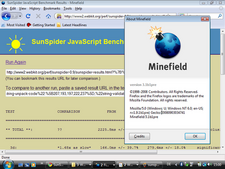 The editorial staff ran a benchmark of a nightly Firefox 3.l “Minefield” build against Google Chrome.
The result: Both JavaScript engines ran in a virtual tie, with the Google product slightly ahead, perhaps faster by 15 percent, not a substantial Chrome lead, considering the margin of error inherent in the SunSpider test. Significant differences emerged, however, in performing certain tasks: Chrome did better with 3D and crypto tasks; Firefox with strings, regex, and math. The German sister publication Linux Magazin Online provides the test results as a download.
Comments
comments powered by DisqusSubscribe to our Linux Newsletters
Find Linux and Open Source Jobs
Subscribe to our ADMIN Newsletters
Digital Autonomy
• How the Fediverse Found Parts for Its Platforms
• The Answer Was Already on the Shelf
• Changing the Chip Industry: How Public Investment Has Grown Open Silicon
• United Nations Open Source Portal Goes Live
• EU Open Source Strategy Plays Key Role in Tech Sovereignty Package
• France Says “Au Revoir” to Microsoft
Support Our Work
Linux Magazine content is made possible with support from readers like you. Please consider contributing when you’ve found an article to be beneficial.

News
-
openKylin 3.0 Released with Expanded AI Integration
The latest release features a pre-installed AI agent to help perform tasks.
-
DigitalOcean Ends Open Source Credits Program
In a change that has surprised many open source developers, DigitalOcean has decided to sunset its Open Source Credits Program.
-
Office 365 Available for Testing on Linux via Bottles
Linux users can now test the official Office 365, thanks to Mirko Brombin's work on Bottles.
-
Dutch Government Turns to Open Source for Digital Sovereignty
Following in the footsteps of other European countries, the Netherlands is looking to increase its sovereign digital infrastructure with open source software.
-
Linux May Soon Work on Snapdragon X2-Based PCs
If you're thinking about buying a Snapdragon X2-based desktop or laptop, Linux may soon be an option.
-
KDE for People Initiative Calls for AI Ban in Plasma
A new community of KDE wants the project to adopt a strict no-AI policy for KDE Plasma.
-
KDE Sets Ambitious Goals for 2026 and Beyond
KDE Connect reveals the goals for the Linux desktop darling, with one of those goals long overdue.
-
It’s Time to Test Fedora 45 Beta
Fedora 45 beta has been released with updated Gnome, KDE Plasma, and kernel.
-
Ubuntu Stonking Stingray Gets Even Rustier
Ubuntu 26.10 has completed its migration to the Rust-based coreutils.
-
AI Fixes Linux Bottlenecks Using “Hideous” Code
A Linux developer used AI to fix bottlenecks that caused problems when building the kernel. The resulting AI-generated code needed a lot of work.
Google
Anyway, it is good news that Firefox will have parity in Javascript engine speed.
Good stuff